



 The creation of man. The Garden of Earthly Delights, by Bosch.
ARTISTIC COMMENTARY
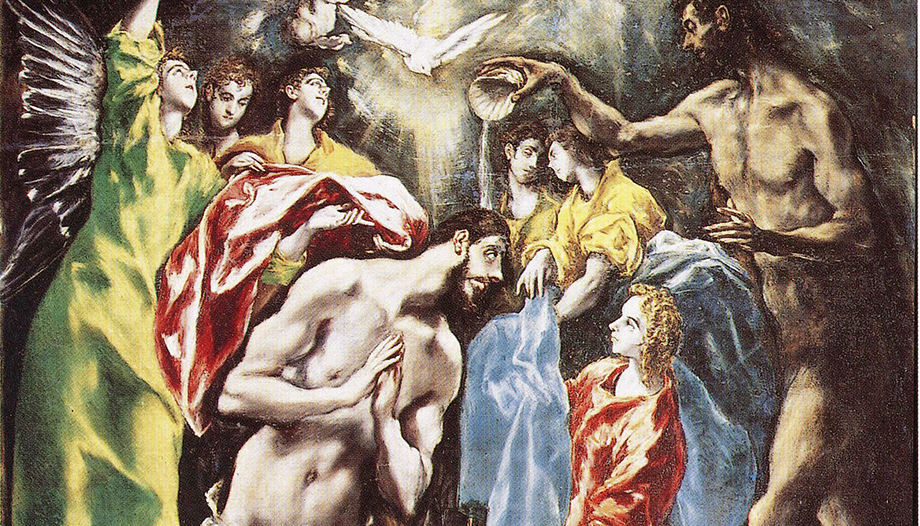
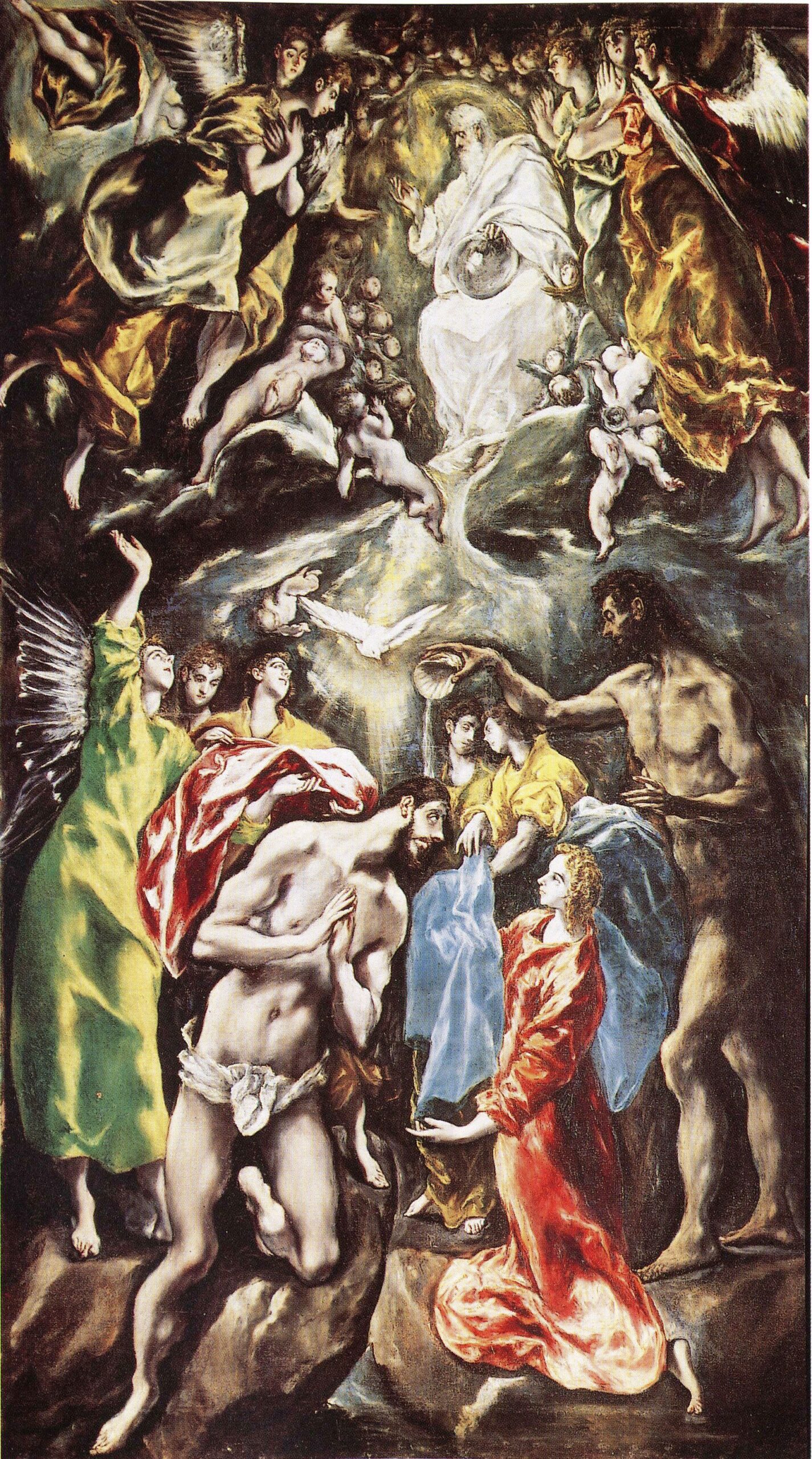
The work on Baptism of Christ was commissioned for the church of the Colegio de la Encarnación in Madrid. The painting represents the Baptism of Christ by St. John the Baptist. The composition is divided into two distinct areas, separated by the Holy Spirit, who appears in the center in the form of a dove.
The celestial order and the earthly world
The heavenly realm occupies the upper part of the canvas. There, El Greco places God the Father, dressed in pure white, blessing with his right hand, while directing a tender gaze towards his Son, Jesus Christ. God is surrounded by the angelic hierarchy, with cherubs arranged in various dynamic postures at his feet. Below them, a radiant white dove with outstretched wings acts as a visual and symbolic divider between the heavenly and earthly spheres.
The lower half of the canvas represents the earthly realm. Standing on rocky ground, Christ receives the waters of Baptism. His hands are joined in prayer, his head slightly bowed and his gaze elevated. This posture was common in the representation of saints in an attitude of prayer and adoration. The face of Christ is treated with special care and refinement compared to the rest of the figures in the composition. On the right, St. John the Baptist, tanned and thin as a result of his ascetic lifestyle, dressed in his traditional camel skin, pours water with a shell over Christ's head. A group of angels accompanies Jesus and frames the scene with a red cloth, symbol of martyrdom. An axe embedded in the trunk of a tree alludes to the Gospel passage: “Already the axe toucheth the root of the trees, and every tree that bringeth not forth good fruit shall be hewn down and cast into the fire.” (Mt 3:10). Under the knees of Christ, a small cartellino bears the signature of the artist and the date.
El Greco's stylistic maturity
The painting is 350 cm high and the figures in the foreground are life-size. Seen from below, the figures appear surprisingly tall, a result of El Greco's characteristic elongation of forms and his emphasis on verticality, a trait especially accentuated in the final stages of his career. The brushwork is loose and the contours are dissolved in light and color. Although the modeling remains firm and the anatomical representation powerful, it is softened by the predominance of cold tones. The foreshortened cherubs recall models used by artists such as Rubens, although El Greco reinterprets them in a personal and distinctive way.
The palette is dominated by cool, contrasting tones, especially blues and yellows. The red cloth is the only element that introduces warmth, thus drawing attention to the central action. The prominent use of yellows refers to the artist's Venetian background. Born on the island of Crete when it belonged to the Republic of Venice, El Greco was trained in the Renaissance tradition and worked in Venice for three years. There he assimilated the Venetian approach to color, perspective, anatomy and oil painting, gradually developing his own highly personal style.
After working in several Italian cities, El Greco moved to Spain, where he settled in Toledo and devoted himself mainly to religious themes. In 1596 he was commissioned to paint the main altarpiece of the Colegio de la Encarnación in Madrid, an Augustinian seminary better known by the name of its founder, Doña María de Córdoba y Aragón (1539-1593). The work entered the collection of the Prado Museum in 1872.
CATECHETICAL COMMENTARY
After approximately 30 years of hidden life in Nazareth, Jesus comes to the banks of the Jordan, where his cousin John was baptizing, to be presented to all the people of Israel. Precisely the powerful figure of the Baptist in the painting, to the right of Jesus, painted with the austere features of an ascetic, reminds us that the Lord assumes the Baptism of the Forerunner both to receive it and to overcome it.
John's Baptism was a provisional but profound sign, in which the believer who wanted to return to God in order to be well prepared for the end times, for the nearness of the Kingdom of God, received an impulse for his conversion and a way to obtain the forgiveness of his sins. Before John's vibrant preaching, he is approached by a crowd that almost universally represents the people of Israel. They come from all regions of Palestine, from the north to the south. They come from all social classes, from rich publicans to poor prostitutes. They come from all the factions into which Jewish society was broken at that time, from the worldly and conservative Sadducees to the progressive and devout Pharisees.
John's Baptism, therefore, is already announcing the gifts that the sacramental Baptism established by Christ would bring. These would be, among others, conversion, forgiveness of sins and the gathering of a universal multitude of believers into a single entity: the Body of Christ, the Church. As if it were a transfer of power, John and Jesus dialogue at the moment prior to the Baptism. Then Jesus is immersed in the water, joining the multitude of sinners seeking conversion to God, after which the heavens are opened, the Spirit descends and the voice of the Father is heard over the Son.
The revelation of the Son
In approaching the Baptism of John, Jesus accepts his mission and at the same time publicly inaugurates it. This mission is none other than that of the suffering Servant of God, already foreshadowed in the prophecy of Isaiah (cf. Isaiah 53:12). Isaiah's texts on the Servant of God underlie many details of the account of the Baptism of Jesus. In particular, it is announced here that Jesus will present himself as the innocent Lamb, who in Baptism wished to be numbered among sinners. Also that this Baptism of water will culminate in the Baptism of blood announced by Jesus in his ministry (Lk 12:50) and fulfilled in the sacrifice of the Cross.
At the beginning of this public mission, the accounts of the Baptism of Jesus implicitly present a dialogue between the Father and the Son, well represented by El Greco in the tender gaze that the Father directs towards his Son from the top of the canvas. In this dialogue, Jesus says that he has come to fulfill all righteousness, thus expressing his determination to obey the Father by identifying himself with his Will, which is none other than to accept out of love his offering as a victim for the sins of humanity, of whose purification John's Baptism was a clear announcement.
Before the perfect and loving obedience of the Son, the Father responds in the heavenly voice that expresses divine complacency. Once again we find a text from Isaiah about the Servant of God, which the Gospels put in the mouth of the Father at the Baptism and the transfiguration of Jesus: “behold my Servant, whom I uphold; my chosen one, in whom I am well pleased; I have put my spirit upon him, he will manifest righteousness to the nations.” (Is 42:1).
The dialogue closes with the gift of the Holy Spirit, which is the bond that eternally closes the current of love between the Father and the Son in the bosom of the Most Holy Trinity. Jesus is thus revealed before all Israel as the Son by the voice of the Father (changing the “servant” of the prophet for the “Son” of the Gospel text, taking advantage of the equivalence that exists in Greek between the two terms), and, at the same time, it is intuited how Jesus, conceived by the work of the Holy Spirit in the womb of Mary, is also eternally begotten in his procession from the Father.
As a proof of this clear revelation of the divine filiation of Jesus and, at the same time, a veiled but suggestive revelation of the Trinity, the Heavens are opened, the same Heavens that were closed after Adam's sin. This opens the way to understand Christian Baptism, inaugurated by Christ, as the creative act of a new humanity, which has opened the way to return to the paradise from which the first Adam was expelled. The Creator God, whose spirit hovered over the waters at the dawn of Creation, now sends the Holy Spirit once again over the waters in which the Son is immersed to point the way to this new Creation, which converts sinful humanity into the family of the children of God.
Sons in the Son
Therefore, the sacrament of Baptism opens the way for the new creation of the human being through sacramental assimilation to Jesus, repeating the same gesture with which the Lord begins his mission. This sacrament assimilates us to the Baptism of Jesus, and therefore unites us to the mystery of death (immersion in water) and resurrection (emergence from the water) signified in the gesture that Jesus performs on the banks of the Jordan. Precisely because of this mystery of death and resurrection, through sacramental Baptism, man is renewed and recreated in the image of the New Adam, the risen Christ, and participates in his filiation.
The gesture of Christ's abasement in El Greco's painting, kneeling on a rock and in a position inferior to that of the Baptist, also indicates that this recreation is reached through a sequence of abasement, humility, repentance, descent into the water with Jesus and finally exaltation with Him. This is the way to be reborn of water and the Spirit and, thus reborn, to live as a son of God assimilated to the Son eternally begotten by the Father. And, being a son, to live also experiencing the love and pleasure of the Father, expressed in the heavenly voice.
The Baptism of Jesus inaugurates on Earth the life of Heaven, just as El Greco represents the earthly and heavenly realms. It is the gift of a new life, the life that Jesus inaugurates in his Passover (announced and contained in his Baptism before John) and that moves the human being towards the blessing and benevolence of the Father in Heaven. Hence the open Heavens, shining in the splendid blues and yellows of the painting, express that Baptism is the Door to eternal life and the door to all the other sacraments, which bring us to Earth to the God of Heaven.
Work
Art historian and Doctor of Theology




 Español
  English
  Italiano