



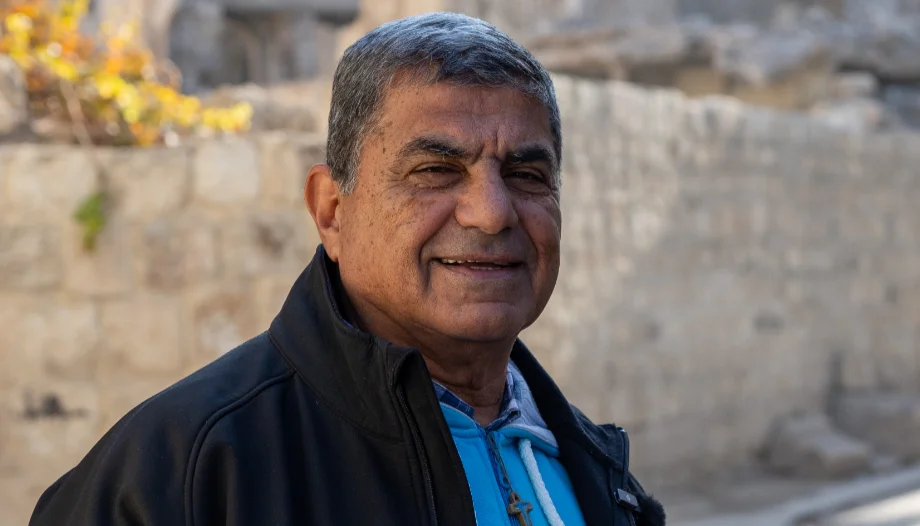
Brother George Sabe is today the only Marist Brother stationed in Syria. From Aleppo, he coordinates a wide network of aid to Christians and Muslims through the Blue Marists.
George Tabeé was born in Aleppo, Syria, and discovered his Marist vocation as a student at a Marist school in his hometown. Today he belongs to the Mediterranean Province of the Marist Brothers and his career has taken him to various countries of the Middle East and Africa, including a period in the Ivory Coast. He is currently visiting Spain to present the Manos Unidas campaign, which supports educational, development and social reconstruction projects in the country.
He speaks Arabic and French as his mother tongues and retains a fluent Spanish learned more than fifty years ago, when he made his novitiate in Spain. “I learned Spanish there and continue to practice it,” he explains with simplicity at 74 years of age.
In 2012, at the beginning of the war in Aleppo, he returned permanently to Syria. Since then he has been living and working in a city devastated by more than a decade of conflict.
The hand of God
Among the harshest memories of his mission, Brother George recounts the kidnapping of a father of a family in 2013. He himself negotiated with the armed group and brought the money for his release, directly confronting armed men.
At that moment, he recalls that “the words of Jesus came to him: ‘Do not be afraid. Days later, the kidnapped man was released. ’There we discovered that the Lord was present, accompanying and illuminating our decisions.”.
An experience that, like so many others, sustains his conviction that even in war it is possible to educate, accompany and sow hope.
Blue Marists: a Church at the service of everyone
Currently, Brother George is part of the Blue Marists association, born in 2012 as a direct response to the war and the massive displacement of the population. The project has its roots in an earlier initiative, “Ear of God”, created in 1986 to support the poorest Christians in Aleppo.
With the outbreak of the conflict, the action was expanded and transformed. Today, the Blue Marists develop 14 active projects, centered on three fundamental axes: education, human development -especially for women- and emergency assistance.
“We are 160 volunteers,” he explains, “and we believe in a local Church at the service of the local population, Christian and Muslim.”.
The only Marist in Syria
George is currently the only Marist Brother present in Syria. “It takes speaking Arabic and accepting the reality of war,” he says. However, he stresses that he is not alone: a wide network of lay people trained in Marist spirituality supports the daily work.
Most of the projects serve both Christians and Muslims. Some educational programs even target 100% Muslim children, as an expression of a mission based on service rather than religious affiliation.
The support of Manos Unidas has been key to sustaining and expanding these projects. The NGO decided to enter Syria hand in hand with the Marists, financing educational initiatives, development programs for women and economic micro-projects.
“Education is essential to educate in peace, non-violence and respect for those who are different,” Brother George stresses. As for women's development, he stresses its transformative impact in a society where female identity is often defined in relation to others. “We believe that women have their own identity and capabilities.”.
The microprojects, promoted since 2014, seek to prepare the population for a peaceful future, allowing families to make a decent living from their own work.
Christians in Syria: respect, but open wounds
According to George, Christians are not a community persecuted by the current regime, which, despite its Islamist character, has shown respect for Christian life. “We celebrate the Eucharist, we live our faith normally,” he says.
The attacks that occasionally occur, he explains, come from groups linked to the Islamic State, not from the authorities. “What Christians are suffering is the same as what the entire Syrian population is suffering,” he sums up.




 Español
  English
  Italiano