



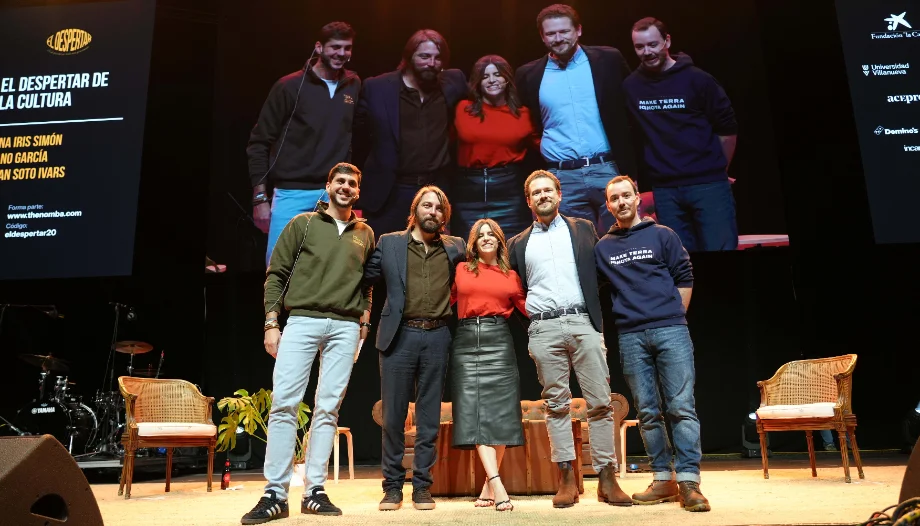
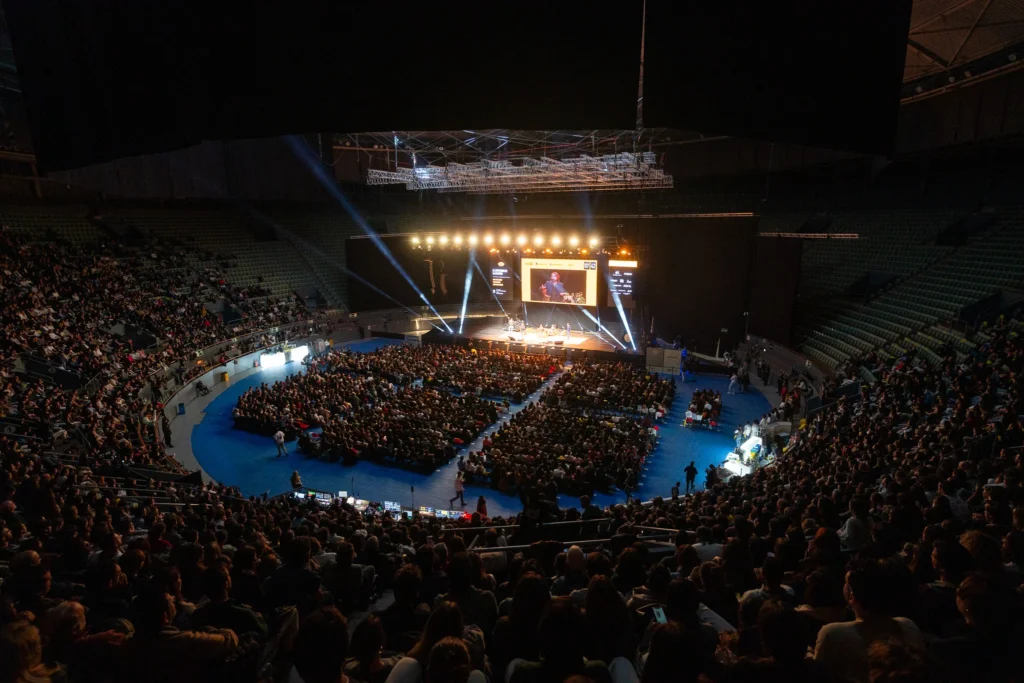
The impact of the El Despertar convocation last January 17 in Vistalegre has only grown. An original event, in which thousands of young people paid their ticket to hear a priest and a handful of intellectuals to tell them truths that go against the current. And to end with music and beers, too. El Despertar sounded a bit like a cult, but the six thousand attendees -most of them around 30 years old- at the old Vistalegre bullring were summoned to an event that was meant to be a call to understand society in a different way. The key: to create links. Along with this, two other legs for the stool that supports the person: the value of a job well done and attending to transcendence.
“The Awakening” was the mass event, the launching of “It's Time to Think”, an initiative created during the pandemic by a couple of young people, with no one behind them, no political parties, no associations, no religious confessions. They organized, by calling friends, meetings online of dozens of people asking questions of people who had something to say. The initiative became a face-to-face initiative on January 5, 2022. More than two hundred intellectuals have attended its meetings, the thinkglaos (more than four hundred over the years) in more than thirty cities in Spain, Germany and other countries. “We want to create spaces where people stop, think and look for the truth,” explained Javier Fernández, one of the visible heads of this initiative.
Attendee profile
“There is a rumor that is spreading,” warned the presenter in Vistalegre. “People want to build again, to unite, to transcend, to look at a history that belongs to no one because it is everyone's”. Those who read the call in a political or religious key are mistaken. Were there participants from the right? And Catholics? Yes, of course, and people of other ways of thinking. Left and right, religious and atheists, from north and south. Many came - paying - without knowing very well what they were coming for. They had been invited by a friend. That is the key to the origin and unstoppable growth of “It's Time to Think”. “It's not a cultural event, it's not a party, it's the beginning of something that has no name,” they explained at the beginning of the event, shortly before releasing giant balloons and waving thousands of yellow scarves.
The idea was: we already know what we disagree on, so let's talk about what we can improve and what we can help. They pointed out three problems that made up the outline of the meeting: the precariousness of life, the division caused by ideologies and the fact that the real problems are not solved.
The speakers
Eleven “matadors” performed in the Vistalegre arena for nearly five hours. Top swordsmen of thought, and of the social networks.
To be able to speak, first silence. And who better than Jacques Philippe to introduce the topic. The French priest, of the Community of the Beatitudes, one of the most widely read authors of spirituality in the world, spoke of the “importance of rediscovering the value of silence and applying recollection in our lives.” “Silence puts us in an attitude of receptivity, of listening. It leads us to our supernatural dimension.” “Today we tend to plan everything, but life is not something that can be planned.” “There is a tendency to react immediately, emotionally. So it is difficult to mature a reflection. It requires time, and silence allows for that reflection.” “Without silence we stay on the surface of things and will not go deep.” The thousands in attendance listened avidly. It was exactly seventeen minutes. Just the stipulated time.
The second block consisted of dialogue, with three round tables: culture, work, transcendence. The first, the Awakening of Culture, with Juan Soto Ivars -who has just become a columnist at ABC-, Ana Iris Simón - the author of Fair is a columnist for The country- and Jano García. The journalist highlighted the idea of community, which is being lost, outside the state and the market, and warned: “we do not value what has been given to us (family, homeland, biological sex) and it seems as if only what we choose is important”.
Jano García, economist and network disseminator, pointed out the crisis in society by referring to Ratzinger: “the problem is nihilism: good and evil are the same, everything is the same, they argue”. “Differences can exist as long as you have a society based on values. Everyone in their own sphere can fight to vindicate those values. This does not destroy coexistence”.
Juan Soto Ivars, combative and provocative, made reference to one of the cross-cutting issues of the whole event: “The key is that links can emerge”. “In my house there was a grandfather on the extreme right, another on the extreme left... They argued... But underneath it all was my grandmother's phrase, which we captured in her epitaph: ‘Quereos mucho’”. Ana Iris added: “The solution is that charity and love must rule. It sounds corny but, for example, Podemos refers to that when it talks about the importance of care.”.
The world of work
Juan Manuel de Prada, the French philosopher Fabrice Hadjadj, and the French philosopher Fabrice Hadjadj were invited to speak about the Awakening of Work. youtuber Antonini de Jiménez. The Planeta Prize winner spoke against the precariousness of existing employment and individualism: “Milton Friedman spoke of a society of robinsons and in the face of this we must put up an anthropological resistance”. In this sense, he reacted against the idea of dispensing with others in the struggle for social improvement: “We need other people, and we must work with them. And if necessary, because the current ones do not serve us, create new associations, unions, political parties”.
The French philosopher - who has moved to Spain and spoke in Spanish - focused on the need for work to have meaning. “The inhumanity of a job is not measured by the effort it requires. A soccer game requires great effort, but that does not make it inhuman. What gives meaning is the purpose of the work that is produced. Today that visible meaning is missing”. In this regard he spoke of what he described as “bullshit works” (something like cow shit jobs, or bull shit), in large companies, with mechanized production or where financial products are trafficked, without the worker knowing very well what he is doing that for. “They don't do a work, they just work.” He added that some companies talk about “a culture of work” and similar terms: “what they do is to perfume that ‘shit’ of the bull, instead of tore it. Whoever does not want to take the bull by the horns can only limit himself to picking up the bull's shit.” “In medieval knights, their effort made sense because there was a maiden to defend or save. Today at work, without that meaning the effort is not worthwhile.”.
In a bullring like the one in Vistalegre, Hadjadj liked the bullfighting simile and spoke of his companions -and in general, of any opinion- as exercising different types of bullfighting, but all equally valid: one, a bullfighting of endurance, another, tough... Thus, De Prada described Hadjadj as “our Morante: he fights with elegance and depth”.
Awakening of meaning
The last block was dedicated to the third leg of the stool that centered the core of the event. It was the Awakening of Sense. Sarab Rey (formerly called Izanami), evangelical, anthropologist, who enjoys undoubted success in the networks talking about human behavior, shared the stage with René ZZ, youtuber famous for his content on tattooing... until he converted and is known for his videos on the Catholic faith, and with Pedro Herrero, an expert in communication and defender of the family. It was another dialogue in which they exposed their personal convictions on religious issues without any qualms. This is very topical in the current context in which artists, thinkers and content creators “come out of the religious closet” to show their faith in public without ambiguity.
José Ballesteros, another figure of the social networks, brought the event to a close with his messages on leadership and motivation. In the midst of festive music and an apotheosis atmosphere, in the farewell, the jurist Ricardo Calleja and again Pedro Herrero intervened briefly. They were the first to take part in a “social networking event".“thinkglao”. And they summed up with two sentences all this awakening that wanted to start in Vistalegre. “What sustains this is the friendship of two friends,” Calleja pointed out. “Chavales, you have to transform reality,” exhorted Herrero.
The audience, enthusiastic, turned to applause. In other circumstances, they would have asked for two ears and a tail for an outstanding performance.





 Español
  English
  Italiano