



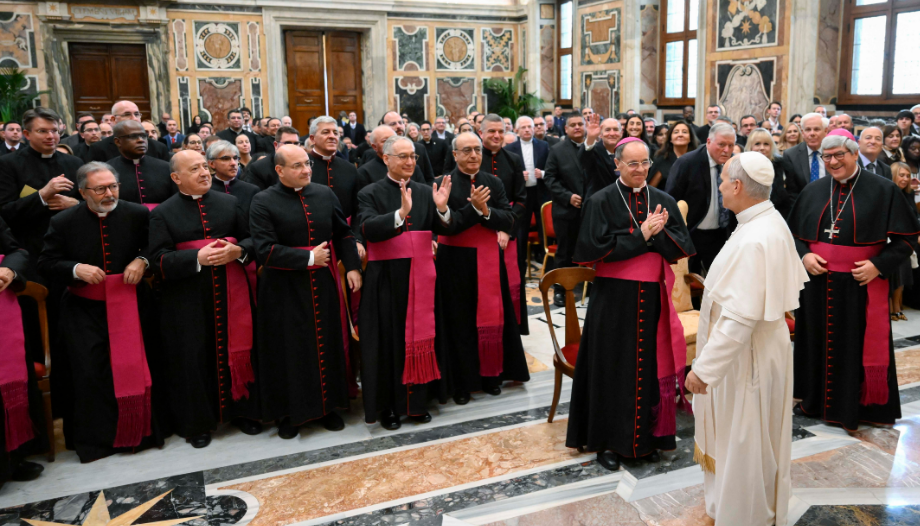
“The service of truth in charity must shine forth in all the work of the ecclesiastical tribunals,” Pope Leo XIV said in his Speech the prelates of the Apostolic Tribunal of the Roman Rota, whom he received in audience on the morning of January 26 at the Vatican, on the occasion of the opening of the Judicial Year.
It is a fundamental theme that has dominated the speeches addressed to this Tribunal from Pius XII to Pope Francis: the relationship of its activity with the truth inherent in justice, said the Pope, who offered “some reflections on the close connection between the truth of justice and the virtue of charity”.
Greetings to the Dean of the Tribunal, Msgr. Alejandro Arellano
First of all, the Pontiff thanked “His Excellency the Dean for his words, which express the union of all of you with the Successor of Peter. And my gratitude extends also to all the tribunals of the Church throughout the world. The ministry of judge that I have had the opportunity to exercise allows me to better understand your experience and to appreciate the ecclesial relevance of your task.”.
As is well known, the Dean of the Tribunal of the Roman Rota is Spanish Archbishop Alejandro Arellano Cedillo, who at the end of August 2025 was appointed by Pope Leo XIV as a member of the Dicastery for the Clergy. In addition, in January of the same year he had been appointed member of the Dicastery for the Causes of Saints by Pope Francis, and is pontifical commissary plenipotentiary for Torreciudad.
Truth and charity
In his address, referring to the close connection between truth and the virtue of charity, Pope Leo XIV pointed out that “these are not two opposing principles, nor values to be balanced according to purely pragmatic criteria. Rather, they are two dimensions intrinsically united, which find their deepest harmony in the very mystery of God, who is Love and Truth”.
“This correlation calls for constant and careful critical exegesis, since, in the exercise of jurisdictional activity, a dialectical tension often arises between the demands of objective truth and the concerns of charity,” the Pope continued.
Risks
At times, “there is a risk that excessive identification with the often problematic experiences of the faithful can lead to a dangerous relativization of the truth. In fact, misguided compassion, even if it seems motivated by pastoral zeal, risks obscuring the necessary dimension of the search for truth proper to the judicial office.”.
“This can occur not only in cases of marriage annulment -where it could lead to pastoral decisions lacking a solid objective foundation”, the Pontiff stressed, “but also in any type of procedure, undermining its rigor and fairness”.
“On the other hand, sometimes there can be a cold and distant affirmation of the truth that does not take into account all that love for people demands, omitting those concerns that respect and mercy dictate, which must be present in all phases of a process.”.
Benedict XVI on ‘Caritas in veritate’.’
Pope Benedict XIV emphasized in his encyclical ‘Caritas in veritate’.’ the “need to combine charity with truth not only in the direction, indicated by St. Paul, of ‘veritas in caritate‘ (Eph 4:15), but also in the opposite and complementary direction of ‘caritas in veritate’. Truth must be sought, found and expressed in the ‘economy’ of charity, but charity in its turn must be understood, validated and practiced in the light of truth” (n. 2), Leo XIV pointed out.
Therefore, “their actions must always be motivated by that true love of neighbor that seeks above all their eternal salvation in Christ and in the Church, which implies adherence to the truth of the Gospel”.
All aspects of the canonical processes could be framed in the truth in charity, the Successor of Peter summarized.
Canonical judgments: must inspire confidence
As noted above, the Pope has stressed that “the service of truth in charity must shine forth in all the work of ecclesiastical tribunals. This must be appreciated by the entire ecclesial community, especially by the faithful involved. Those who seek judgment on their marital union, those who are accused of committing a canonical crime, those who consider themselves victims of a grave injustice and those who claim a right.”.
The Pope went on to say that “canonical judgments must inspire the confidence born of professional seriousness, intense and dedicated work, and a convinced dedication to what can and must be perceived as a true professional vocation”.
Indeed, “the faithful and the entire ecclesial community have the right to the proper and timely exercise of procedural functions, for it is a process that affects consciences and lives.” “The trial is not in itself a tension between competing interests, as is sometimes misunderstood,” the Pope added, “but an indispensable tool for discerning truth and justice in a case.”.
“Continue to study and apply canon marriage law seriously.”
The Pontiff noted in his address that “in the brief procedure of matrimonial nullity before the diocesan bishop, the prima facie obvious nature of the cause of nullity that makes it possible must be carefully evaluated. Without forgetting that the process itself, duly processed, must confirm the existence of the nullity or determine the need to have recourse to the ordinary process”.
“Therefore,” Leo XIV has been concluding, “it is essential to continue to study and apply canon law of marriage with scientific seriousness and fidelity to the Magisterium. This knowledge is indispensable for resolving cases by following the criteria established by the law and the jurisprudence of the Roman Rota, which, in most cases, are limited to stating the requirements of natural law.”.
Noble and demanding“ mission of the prelates
Finally, the Pope described the mission of the prelates of the Tribunal of the Roman Rota as “noble and demanding. They are called to guard the truth with rigor, but without rigidity, and to exercise charity without omissions. In this balance, which in reality is a profound unity, true Christian juridical wisdom must be manifested”.
And he entrusted his task “to the intercession of Our Lady, Speculum Iustitiae, perfect model of truth in charity”.




 Español
  English
  Italiano