



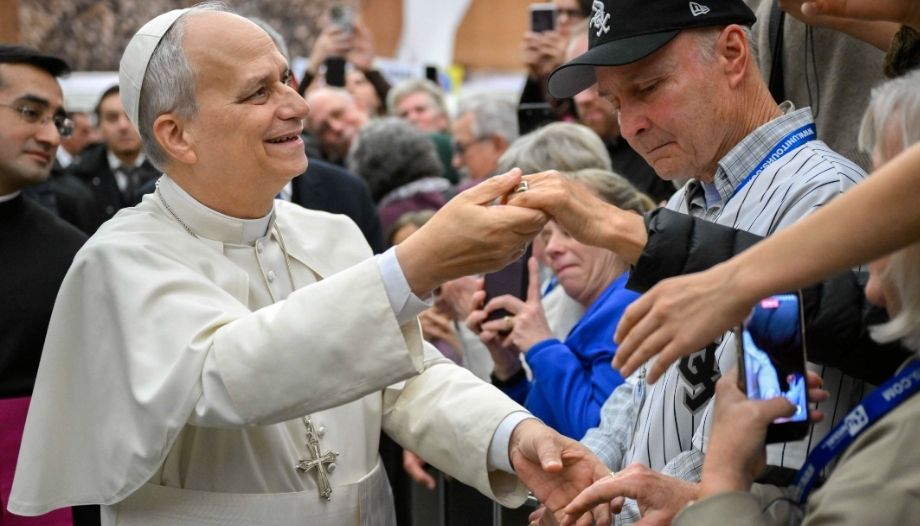
Leo XIV reflected this morning on Christian formation, following a theme dear to St. Paul, he recalled. At the plenary session of the Dicastery for the Laity, the Family and Life, likened the task of the formator more to that of “a father capable of engendering in the faith” than that of a “pedagogue”. And he conveyed with Benedict XVI that “without sacraments there is no Christian life”.
After quoting St. Paul, the Successor of Peter recalled that “after the Resurrection, Jesus entrusted the missionary mandate to the Apostles, telling them to ‘make disciples of all nations,’ to ‘baptize them’ and to ‘teach them to observe his commandments’ (cf. Mt 28:19-20).”.
“Baptism and Sacraments, or their rediscovery.”
“I remember these expressions,” he stressed, “because in them we find summarized other fundamental elements of the formator's mission, which I would also like to emphasize.”.
“First of all, the need to favor constant, involving and personal life itineraries that lead to Baptism and the Sacraments, or to their rediscovery, because without them there is no Christian life (cf. Benedict XVI, Apostolic Exhortation Sacramentum Caritatis, February 22, 2007, 6).”.
“Our mission is higher: as parents who sacrifice for the sake of their children.”
In the Church, at times, the figure of the formator as ‘pedagogue’, committed to the transmission of instructions and religious skills, has prevailed over that of the ‘father’ capable of engendering in the faith, the Pope recalled.
However, “our mission is much higher, so we cannot limit ourselves to transmitting a doctrine, an observance, an ethic, but we are called to share what we live, with generosity, sincere love for souls, willingness to suffer for others, unreserved dedication, like parents who sacrifice themselves for the good of their children”.
St. Paul: “it is I who have begotten you in Christ Jesus”.”
The Pontiff pointed out at the beginning some well-known words of St. Paul to the Corinthians that guided his brief address.
“This is a theme dear to the Apostle and present in several passages of his letters. For example, when he addresses the Corinthians and says: ‘You may have ten thousand pedagogues in Christ, but certainly not many fathers: it is I who have begotten you in Christ Jesus through the Gospel’ (1 Cor 4:15).”.
The Apostle addresses the Galatians and calls them ‘my children’, referring to the ‘childbirth’ with which, not without suffering, he led them to welcome Christ, the Pope meditated.
“Formation is thus placed under the sign of ‘generation,’ of ‘giving life,’ of ‘giving birth,’ in a dynamic that, although painful, leads the disciple to vital union with the very person of the Savior, living and acting in him or her, capable of transforming ‘life in the flesh’ (cf. Rom 7:5) into ‘Christ's life in us’ (cf. 2 Cor 13:5; Gal 2:20).”.
“Respect for human life in all its stages”, and prevention of “all forms of abuse”.”
The Pope went on to exhort, in an “indispensable” way, to “take care in our communities of the formative aspects oriented towards respect for human life in all its stages, in particular those that contribute to preventing all forms of abuse against minors and vulnerable persons, as well as to accompany and support the victims”.
He also referred to the community dimension. “Just as human life is transmitted thanks to the love of a man and a woman, so too Christian life is transmitted by the love of a community. It is not the priest alone, nor a catechist or a charismatic leader, who engenders in the faith, but the Church (cf. Francis, Apostolic Exhortation Evangelii Gaudium, 24 November 2013, 111).”.
It is about “the Church united, alive, made up of families, young people, singles, consecrated people, animated by charity and, therefore, eager to be fruitful, to transmit to all, and especially to the new generations, the joy and fullness of meaning that it lives and experiences”.
“The art of training is not easy and is not improvised.”
This is how Leo XIV expressed himself at the Assembly of the Dicastery for the Laity, the Family and Life, whose Prefect is the Cardinal Kevin Farrell.The art of formation requires patience, listening, accompaniment and verification, both on a personal and community level, and cannot do without the experience and company of those who have lived it, in order to learn and take an example”.
Thus, over the centuries, “giants of the spirit such as St. Ignatius of Loyola, St. Philip Neri, St. Joseph Calasanz, St. Gaspar del Bufalo and St. John Leonardi have emerged. And it is in this perspective that also St. Augustine, recently elected bishop, composed his treatise ‘De catechizandis rudibus’, whose indications continue to be useful and valuable to this day”.
World meetings
At the beginning of his speech, the Pope had mentioned the World Encounters, which “involve a large number of participants and require complex organizational work, in listening and collaboration with local communities and with people and organizations, many of whom have long and valuable experience in evangelization”.
“You must not be discouraged.”
In concluding, the Pope acknowledged that “the challenges you face at times may seem beyond your strength and resources. But you should not be discouraged.
Start small, following, in faith, the Gospel logic of the ‘mustard seed’ (cf. Mt 13:31-32), confident that the Lord will never let you lack, at the right time, the necessary energy, people and graces.
And “look to Mary: in giving us Christ, ‘she has cooperated through love to engender the Church of the faithful, who form the members of that head»” (St. Augustine, De sancta virginitate 6, 6). Imitate her faith and always trust in her intercession".




 Español
  English
  Italiano