



Dear artists, you are the guardians of beauty; thanks to your talent, you have the possibility of speaking to the heart of humanity, of touching individual and collective sensitivity, of awakening dreams and hopes, of widening the horizons of knowledge and human commitment. Therefore, be grateful for the gifts you have received and be fully aware of the great responsibility of communicating in beauty and through beauty. You too, through your art, be heralds and witnesses of hope for humanity".
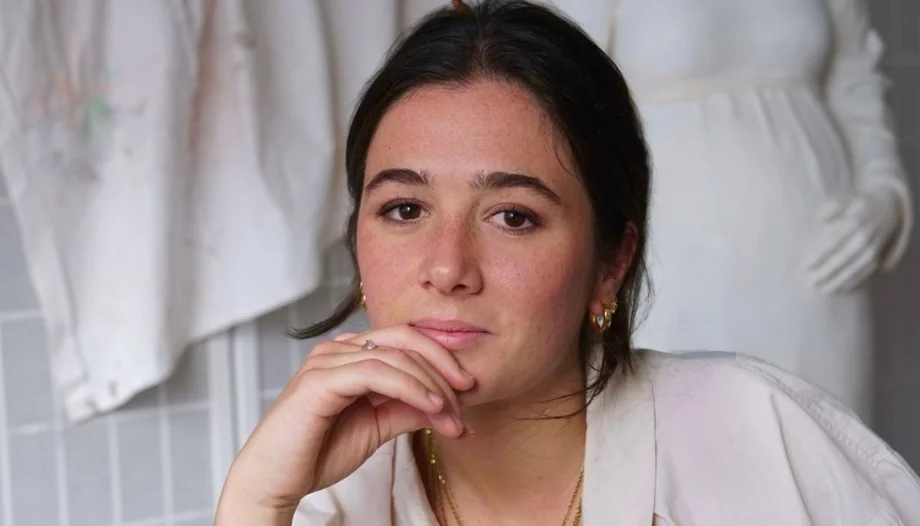
With this quote from Pope Benedict XVI began the Master's Thesis of the sculptor from Madrid. Elena Egea. His great obsession, he says, is that his works should be a testimony and a bridge to beauty: «the artist is called to create beauty».
In an artistic context of visual immediacy, AI and mass production, it might seem that sacred art is outdated or even belongs to another time. However, Elena proves the opposite: religious imagery is not only still alive, but it urgently needs new looks. Her work proposes to renew the sacred sculptural language from a contemporary sensibility, technical research and spiritual reflection.
Elena wonders why sacred art insists on representing the same biblical scenes when there are many other passages, equally relevant and full of meaning, that have barely been explored by sculpture. Far from reproducing traditional models or inherited formulas, Egea understands religious sculpture as an opportunity for experimentation, humanity and creative risk.
Creating without solemnity to reach the sacred
One of the most surprising aspects of his process is his approach to the devotional image. Unlike what might be expected, he does not work from the symbolic weight or the spiritual pressure of the commission.
During creation, avoid thinking that you are sculpting a Madonna or a Christ.
“If you treat the work as something sacred from the beginning, you block yourself from the responsibility that implies. It is important to let your way, your gesture and the conception you have of the image flow. For me, when I make a Virgin or a Christ, I am not aware that I have made a religious image until I finish it and see people praying to it.”.
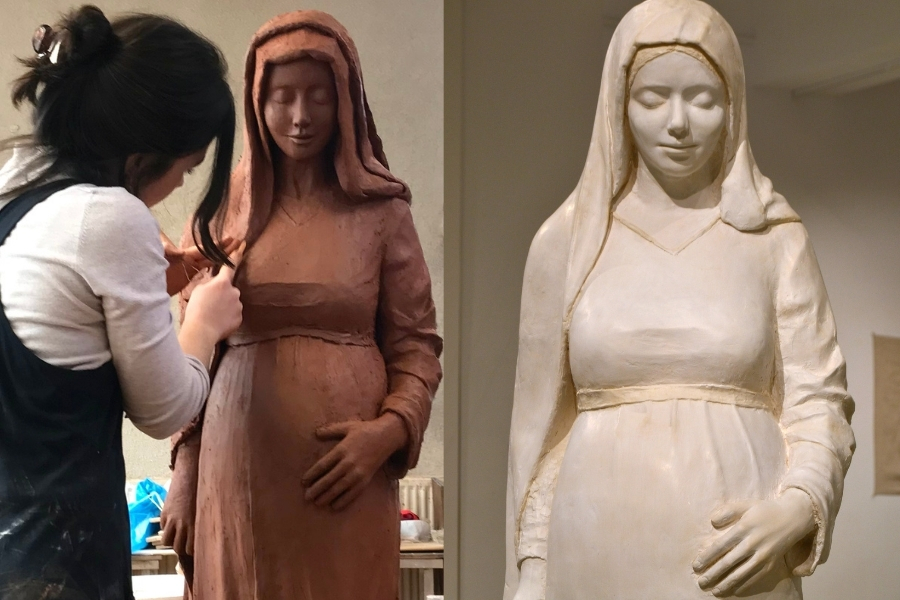
This distancing allows him to preserve his expressive honesty. Only later, when the work leaves the workshop and enters the liturgical space, does he become aware of its impact: the faithful kneel down, their gazes are moved, silences are generated in front of the piece. It is then that he understands the true dimension of his work: he has created an image capable of provoking devotion.
A Madonna in today's world
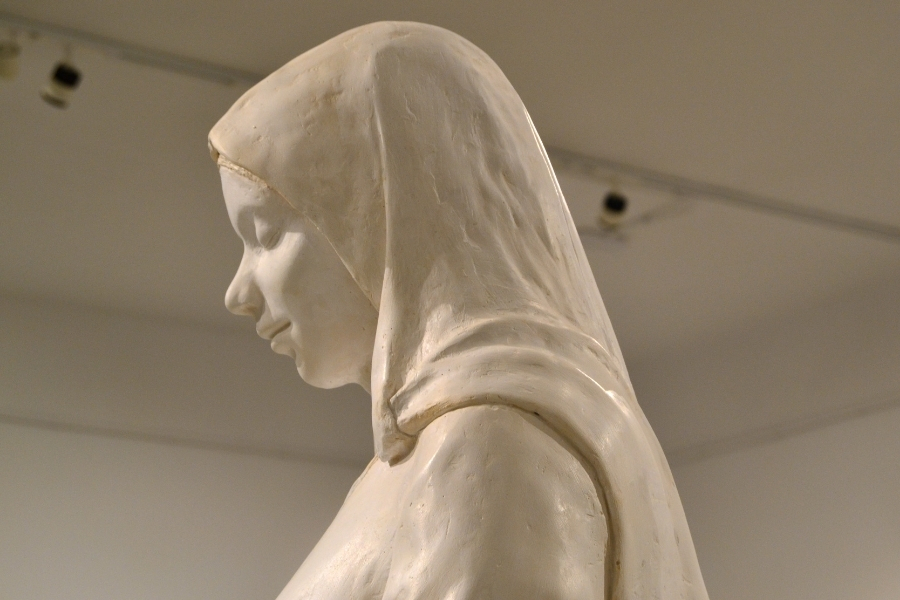
Elena's pregnant Virgin hides a peculiar story. To represent a Virgin in today's world is to go completely against the current. And even more so in a university like the Complutense. Elena sculpted it as part of her Final Degree Project and says that opting for sacred art in that context was, in a way, «a way of evangelizing in silence».
So much so that one of her closest companions confessed to her: «Elena, I can no longer mess with the Virgin because now I put a face to her». She was impressed to see that sometimes there is no need for words, but the images themselves speak for themselves.
The artist's challenge: to update without losing essence
For Elena, the challenge for artists is to renew sacred art without losing its essence: “Today's society does not need the same as it did a hundred years ago. We live in a very visual world in which everything is represented with images. If sacred art wants to continue to connect, it has to be updated”.
While religious architecture has evolved towards modern and luminous spaces, sculpture has remained anchored to serial and repetitive models, heirs of industrialization and mass reproduction workshops.
New iconographies
Returning to Elena's pregnant Virgin, it can be said that she tackled a representation almost nonexistent in the history of art. An intimate, human, vulnerable image.
Elena wanted to sculpt the period of recollection and waiting of the Virgin for the arrival of Jesus: “For me it is when she had to think the most. She was pregnant with the Holy Spirit and would have some uncertainty. That emotional tension is almost not represented”.
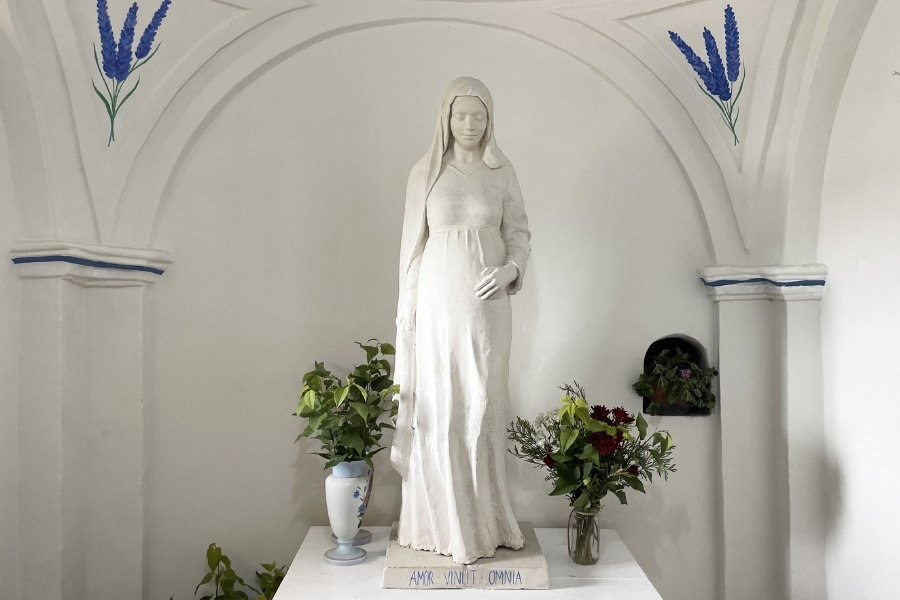
The work was exhibited in a parish in Madrid and received an unexpectedly warm welcome. It confirmed that there was a real need for new images.
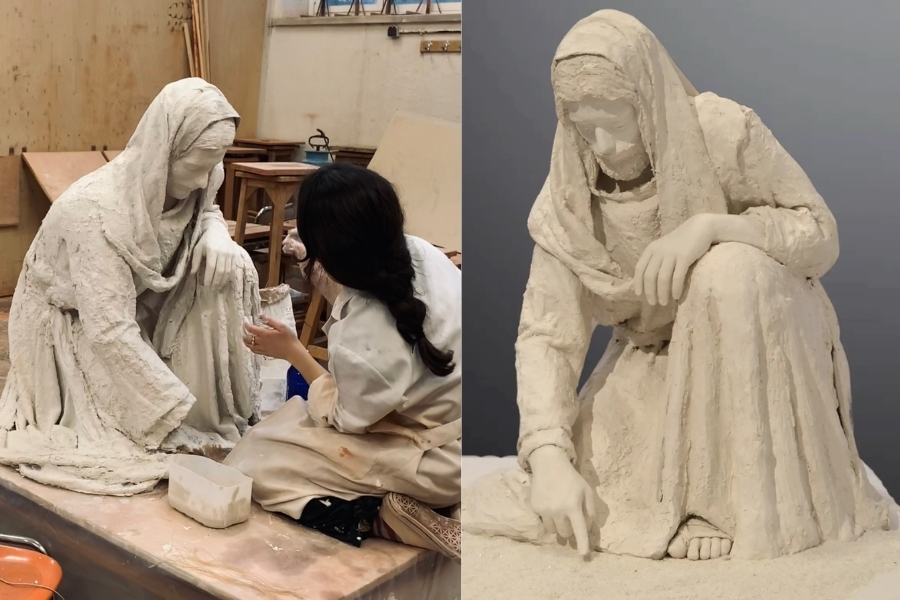
Later, in his Master's thesis, he created a sculpture that represents the moment in which Jesus kneels before the stoning of Mary Magdalene. Again, a passage barely treated, focused on compassion.
Contemporary technology, ancestral spirituality
Formally, his work also breaks with tradition in terms of the materials he uses.
Egea uses casts from life, plaster-impregnated canvases, metallic structures and semiotic concepts linked to «indexical» art. The canvases preserve the trace of the absent body, like a physical trace of something that was there. The work thus becomes the “presence of an absence”, an idea close to the Shroud of Turin: a simple cloth evokes the presence of Jesus.
This technical approach connects sculpture with its spiritual function by seeking the symbolic charge of the material.
Representing the ineffable
Elena's goal is not to break with tradition, but to reactivate it: to give it back authorship, risk, emotion and critical thinking. Because, in her vision, the modernization of sacred art does not consist in making it more modern, but more human.
«The church needs art. Art is the most spiritual means by which contemplation and prayer can be united in a material entity that manages to attract the divine and the spiritual as a direct path to God. It has the capacity to make possible that which in itself is ineffable».
And perhaps therein lies the key to his work: sculpting not to impose the divine, but for the divine to emerge, unexpectedly, in the viewer's gaze.




 Español
  English
  Italiano