



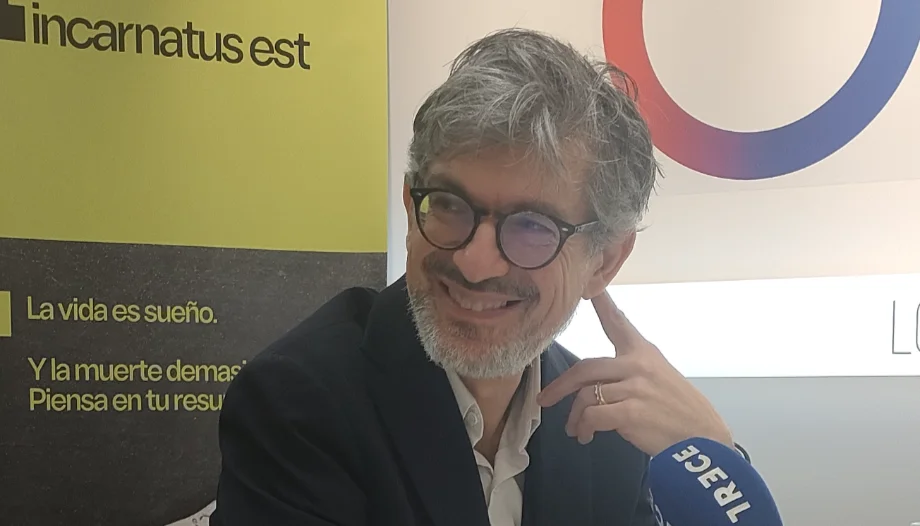
In September 2026, philosopher Fabrice Hadjadj will launch the Incarnatus est Institute, an international Catholic-inspired center dedicated to the integral formation of young adults, where the students, like medieval university colleges, live in the center with their teacher. Hadjadj is one of today's leading philosophers and his project proposes a nine-month academic course of study in community life for forty students.
The innovative project (something like a master's degree in Humanities for an entire academic year, and on a community basis) will be developed at the headquarters in Boadilla del Monte (Madrid), in a former convent.
When presenting the project, its promoters speak of an integral formative proposal “structured in a year of intensive ‘retreat’”, based on three foundations: spiritual life, intellectual life and community life.
Students will study philosophical and theological anthropology, with an academic program totaling 60 ECTS credits, distributed in courses, thematic modules and experiential sessions. The program is supported by the Francisco de Vitoria University, where students will have academic activity one day a week. Among the faculty, apart from Hadjadj, are professors such as Higinio Marín, Salvador Antuñano and Ángel Barahona.
As for spiritual life, the program for students includes Mass and daily prayer, Lectio Divina, Gregorian chant, Holy Hour and spiritual direction in the schedule. It is not exclusive to Catholic students, but, because of the program, Hadjadj said, they must at least be “Catholic".“catholic-friendly".
Fraternal life will be developed in daily living from Monday to Friday. On weekends, the students will return to their homes, if they wish. With the idea that in order to be together with the heart, it is also necessary to In addition to ordinary household chores, the students will also be able to take part in various workshops, mainly in vegetable gardening and carpentry, and others in sewing, ceramics, painting, poetry and basic handicrafts. During the presentation, Hadjadj highlighted two rooms at the center that play an important role in community life: the Taberna Feliz, a bar-cafeteria staffed by people with disabilities (Down syndrome); and the Lab-oratory, which houses artists' studios and a meeting center for contemporary thinkers.
In this sense, coexistence will be extended in the pilgrimages planned to Covadonga or Guadalupe (Extremadura), among others, with a deeper meaning than mere tourism.
Inspired by a project in Switzerland
The whole project is inspired in some way by the Philanthropos Institute in Fribourg, Switzerland, of which Hadjadj himself has been director for the past thirteen years. There he developed a pedagogy that integrates intellectual life with artistic experience, manual work and community life. According to Hadjadj himself and Miguel Gabián (one of the promoters), it is aimed at young people between 18 and 28 years of age, although there may be some older students. They are offered “a formative experience that integrates the intellectual, community and spiritual dimensions, understood as inseparable aspects,” according to information from the Institute.
In this sense, Hadjadj emphasized that the institute proposes to create “horticulturists of culture,” in the sense of the etymological relationship between culture and cultivation. For the French philosopher, “we Catholics must rid ourselves of the mentality of a ‘besieged fortress’. Christ is already victorious, the only question is whether I will be in victory with him. The goal of the institute is ”to prove the positive of the culture linked to faith, a cultivated culture as the monks did in times of barbarism: they did not fight wars, they dedicated themselves to copy books - also pagan - to preserve them, and to cultivate the countryside“.
Rather than attacking or denouncing artificial intelligence, Hadjadj proposes “to test natural intelligence, and to propose hope to the enemies of faith, who are dying of despair”. That is, “the school as a place of practical hope and living proposition. Not with the military logic of battle. It is good to know in order to know, not only to polemicize. The taste of knowledge”, concludes the philosopher.
Fabrice Hadjadj has developed in recent years his academic work as director and professor at the Philanthropos Institute in Fribourg. He is a Sephardic Jew of Tunisian descent. His parents brought him up in Maoist ideology. He grew up as an atheist and anarchist, until he converted to Catholicism in 1998. He is married to the actress Siffreine Michel, with whom they have ten children. Since last August he has been living in Madrid with his wife and seven of their children.
Institutional support
The Incarnatus Est Institute arose from the initiative of lay people of different origins attracted by the figure of Hadjadj, who decided to transfer the Philanthropos Institute to Spain, also with the idea of its expansion and diffusion in Latin America.
It is set up as a non-profit entity, which will be financed by the fees charged to the students, who must pay not only for their studies, but also for their internal stay in the residence for an entire academic year. They are planning to receive aid - a campaign is planned for crowdfounding- for scholarships. The Institute has the support of the Diocese of Getafe and plans to collaborate with other Spanish universities.
For Latin America
In his appearance before the press, Hadjadj stressed the fact that the Institute is being developed in Spain: “I am not here to give lessons, but I want to unearth a treasure, the Spanish treasure. It is a way of reconquering the sense of a globalized world, with an apostolic sense.” “It is now time to showcase the Spanish-American, a culture born of the Castilian genius itself.
The French philosopher denied that the arrival of Incarnatus est should be read through the prism of the so-called “culture war”. He explained why this concept is mistaken: “first, for believing that we are still in modernity and that the modernist polarities are still in force. No, modernity, in losing the vision of faith, has lost reason”.
“Second, he continues, it is a mistake to believe that there are two cultures: one, Catholic, and the other opposite, with which to fight or dialogue. This is not so. The battle is culture against dataism, the reduction of everything to parameters, to a calculation”.
And finally, says Hadjadj, “culture is a garden to cultivate. If we put everyone as soldiers in front of the garden, where are the gardeners? There is no need for ”defenders of Christ“, argues the philosopher, in the sense that Christ has already conquered, ”the goal is to prove the positive of the culture of faith, to communicate hope“.




 Español
  English
  Italiano