



 Caring for people with disabilities: a perspective on the meaning of life.Disability as a gift: a call to rebuild humanity
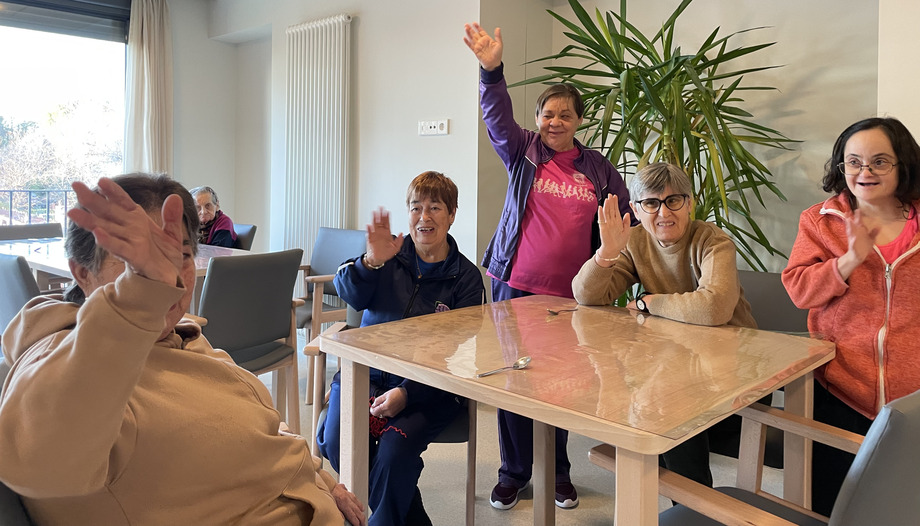
“Center for Women with Extraordinary Abilities”, is the self-described name of the Astier Foundation on its website, and it is something that is not far from reality. When we arrive at this house, we are invaded by an enormous warmth, which quickly dilutes the cold outside. Greetings that come forward and hugs that do not ask for permission. A new face is a novelty, and questions multiply as we begin to talk.
Astier is home to 149 women with disability The intellectual and professional staff is made up of around 120 professionals and some 60 volunteers. But, beyond these numbers, there are concrete -and smiling- faces that welcome us. With a strong Mercedarian charisma, this center has 134 years of history and a long life ahead of it.
Isabel approaches with her briefcase of paints and waits for us. Because, for the interview, we have occupied the room where she usually comes to paint at this time and, of course, routines are routines. She shyly greets us and obeys our request to go somewhere else and see us later, just for today. However, she stays in the hallway and, every now and then, takes the opportunity to peek in and ask how much longer.
Wiping away all tears
What we know today as the Fundación Astier Centro San José had its beginnings in 1892 when Doña Sofía Astier y Balboa, a sensitive, committed and kind-hearted woman, contemplating the social inequalities of her time, founded the Asilo San José at 49 Ayala Street, for “handicapped” women who could not fend for themselves.
Years later, in 1913, the Congregation of the Mercedarian Sisters of Charity, in keeping with the charism of redemptive charity bequeathed by their founder, Blessed Juan Zegrí, took charge of this social work.
In 1972, given the number of residents and the demands of the center, they decided to move to where they are located today, in Alcalá de Henares, Madrid. Nineteen sisters with 192 women carried forward the foundation of the Centro San José.
“The mission proposed by Father Zegrí was to ”cure all wounds, remedy all ills, soothe all sorrows, banish all needs, wipe away all tears, not to leave, if possible, a single abandoned, afflicted, helpless person in the whole world, without religious education and without resources". Loli, a nursing assistant for 25 years and a member of the pastoral team, remembers it.
In those years there was no universal social security and disability was hidden behind curtains. Zegrí was a “visionary” in his time: he understood that the first poverty is the lack of recognition and decided to give these women the dignity they deserved.
Dignity before welfarism
For decades, the center functioned as a large family: those who had more autonomy helped, together with the sisters, those who needed more support. With the passage of time, and after more than half a century of history, complete professionalization became essential. Astier has experienced the transition from a traditional care model to a person-centered one.
Borja Lucas González, the first lay director of the center, is in charge of its management. Under his direction, three areas form the backbone of the house, guided by a Board of Trustees still made up of Mercedarian nuns. First, the technical part (social, psychosocial and health), development (communication, alliances, innovation and quality) and welfare (personnel, services and maintenance). Order and professionalization at the service of something much deeper: dignity.
“There used to be a different view of care,” Borja explains. “It was essential to prevent diseases, that they were clean and cared for. That is still important. But now we understand that what is essential is what makes each person a person, what their life project is.”.
It is no longer just a matter of providing care, but of recognizing the existence of each woman and giving them a place in society. It seeks to promote the dignity and advancement of women with intellectual disabilities.
Leading with closeness
Borja came to the foundation in 2008 as a nurse. “I fell in love with this house and the congregation, which has a deep vocation of service to others,” he confesses. Five years ago, he took over the direction of Astier. He tours the wards every day, talks with teams and residents, detects needs on the ground. “It's a beautiful and very vocational job, but it's also hard and intense”.
After having worked in different areas of the hospital, she recognizes that the foundation allows for a broader vision of health, including prevention and community care: “Here you understand what dimensions make each person a person”.
She speaks of close leadership, mentoring in the culture of change and humanizing the residence: each woman must be the protagonist of her own life project. “I would like Astier's example to inspire the sector to move towards the only possible path: treating people with disabilities as people.”.
In a corporate world where masks abound, Borja vindicates the naturalness of the residents. “They are spontaneous in a world where we all put on masks for everything”. And although he admits that, of course, there are difficulties, he highlights the capacity for affection and sensitivity that the women at Astier have.
A day at Astier
“No day is the same here,” smiles Loli. Then she lists a series of routines: getting up, taking a shower, getting dressed, having breakfast, attending workshops according to each one's abilities. Daily habits that build autonomy: brushing teeth, grooming, tidying up one's own space.
On Sundays there are Mass in the chapel. Liturgical seasons and activities are celebrated with the Mercedarian community and many families accompany. Faith and the Mercedarian charism sustain the house. “The sisters are the ones who taught us how to do our work,” says Loli.
But life at Astier is not only inside the center. The residents visit universities, institutes and companies. They give testimonials, explain who they are, break down prejudices.
They also have an auditorium where there are performances, music, dance, always promoting friendship and good relations: “We seek to create spaces in which the atmosphere is as cordial, pleasant and fun as possible. Here we sing, dance and do everything”, describes Loli.
When a new woman arrives - often because her parents have aged and can no longer care for her - the initial fear usually dissipates quickly. “Experience tells us that they find relationships with equals, a world to discover,” says Borja.
An extension of the family
Loli's work, although it is rather “practical”, often also has to do with “wiping away many tears” as taught by Father Zegrí. She is passionate and dedicated to the task, and does not want her retirement time to come.
When she speaks, her eyes water: “Today I wouldn't change this job for the world. She recalls that she sent in her resume without knowing anything about disability. Now Astier is not only her job, it is also her refuge: ”Many times I come here with worries... but when I walk through that door, I forget everything“.
She says that the residents detect her mood with surprising finesse: “If I come in with a bad face, they immediately ask me what's wrong with me. Some recognize her footsteps in the corridor and call out her name before they see her. A kind of sixth sense that is part of these ”extraordinary abilities“.
He has learned a lesson that he repeats almost as an examination of conscience: to do good at the right time. He recalls a deceased resident to whom he was unable to grant a small favor on the last day. “You always have to do things at the time because later it may be too late.” At Astier, tears are wiped away, yes, but more joy is received than given.
For Loli, the inmates are part of her family: “I love them like my family, I really do, because of course I know them and they know me,” she says, and emphasizes how they have taught her to value every moment and to be a better person.
Courage and humor
Charo is 72 years old and has lived in Astier since she was 18. She arrived just as the house was moving to Alcalá. She is blind due to a stroke. She used to scrub stairs from end to end; now she knits with an astonishing precision: “Everyone tells me that it looks like I'm doing it by machine”. Her new condition made her develop new manual and memory skills but, above all, a positive attitude towards life.
She remembers how, when she was young, they helped the younger ones: bathing them when there were no showers, dressing them, making beds if there was time: “This house we have managed with my companions who are in heaven and with the sisters. After losing her sight she developed tactile memory and an amazing ability to order colors in her head. ”In my life there are many important things: my cane and my illusion,“ she says.
She is the one who always says ‘yes’ to all activities: she has been a guide on tours of the city, she has been filmed for documentaries and always goes out when there are events. She is the natural ambassador of the house. At Christmas and summer she goes with her brothers and nephews; the family is always there. “For me, Astier is like being at home. I don't miss anything here. There are people who have nowhere to shelter; for me this place is welcoming.”.
When asked about his joy, he laughs and answers: “That's my character. With difficulties you have to have courage and humor. And he offers practical advice for those who lose their sight: ”Don't lose your memory, your sense of touch, your intelligence or your joy.
Extraordinary capabilities
The cultural change in Astier is also noticeable in the environments. With the latest renovation, the ‘Villa Delta’ involved them. “What would you like your home to be like?”, we asked the residents, says Borja. Each was encouraged to personalize her room and take care of it. Not as something decorative, but as an affirmation of identity.
For years, disability was taboo. Today these women visit companies, universities, parishes. They show themselves without complexes. The Foundation also works on external communication so that families and institutions get to know the model and adapt it. Social integration is a daily practice.
“The most disadvantaged are God's favorites,” Loli reminds us. Here that phrase translates into health care, psychological support and spiritual accompaniment, guided by strong professional leadership. It's about being family.
The Foundation has received recognition without seeking it. Professionals in the sector have stated, “What I have seen here I don't usually see anywhere else.” The person-centered model is beginning to be replicated. The knowledge generated serves other centers and families seeking guidance.
In times that measure value in productivity, Astier insists on something more radical: every life, with or without disability, has infinite value. And when it is given space to unfold, extraordinary capacities flourish - to a great extent.




 Español
  English
  Italiano