



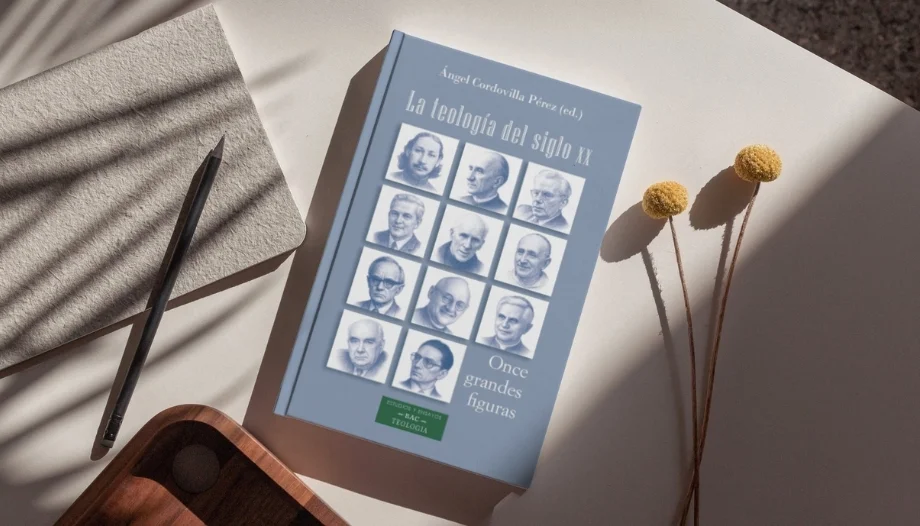
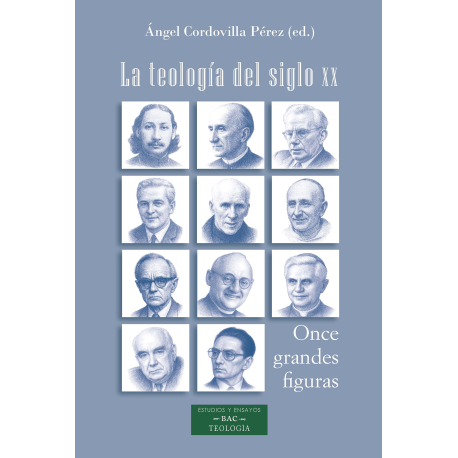
Professor Ángel Cordovilla Pérez (Salamanca, 1968), ordinary professor of dogmatic theology at the Pontifical University of Comillas, has chosen a group of professors from that university to select and write up the lives and discoveries of eleven great theologians of the 20th century, so that what could be the main lines of force of what will undoubtedly be the history of theology in the 21st century can be enunciated.
Why these theologians?
First of all, we must emphasize that they are not all those who are, nor are they all those who are, since any of us could have come up with other names of great theologians and, of course, we would have agreed on some of the authors selected.
Likewise, more authors should have been selected, distributing them by areas of research, since it is logical to think that some historian, cardinal or canonist should have been selected, since the history of theology has also been made from these environments, and a good one: it would be enough to think, for example, of the unforgettable figure of St. John Paul II.
It is worth remembering, in agreement with our author, that we will discover many interesting questions throughout these pages, since: “It is probable that the 21st century will not be one of great theological renewal compared to the previous one, that is, a point of arrival of previous movements and ideas that demand a maturation and emergence in a new ecclesial and cultural environment” (2-3).
In any case, in our selection, we have omitted some of the authors selected by Cordovilla for the simple reason that it is not possible in these brief lines to talk about everything and everyone who appears in the book, but to synthesize something that encourages the reader to buy and enjoy so many interesting ideas and people.
In fact, we have not included anything in our summary of Protestant or Orthodox authors, simply because their ideas do not spring from the primordial source of Christian revelation given to the magisterium of the Church to be handed over to us so that we can deepen our understanding of both oral and written Tradition, because if anything has characterized the theology of the 20th century it has been the return to the sources and especially to Scripture and Tradition, as the Constitution “Dei Verbum” of the Second Vatican Council repeatedly emphasized.
Romano Guardini
It is striking that what is emphasized in this volume about Romano Guardini (1885-1968), in my opinion, is incomplete, since Guardini's magnum opus, “The Lord”, has a very cursory treatment, surely because it is considered dogmatically of less value than other works, when in practice it is the most edited work together with the “Spirit of the Liturgy”.
Undoubtedly, Guardini contributed much to the theology of his time and, through Ratzinger, of ours. It is worth returning to how he taught and enriched the exegetical theology of his time by contemplating the life of Jesus in a way that makes the movement “What does it mean to be Christian?” Christocentric. That is to say, in the face of the secularized and insignificant theology of the time, he will propose the “Catholic contemplation of the world”, that is to say, “to look at the one who has been pierced” (40).
Erik Peterson
Precisely Erik Peterson (1890-1960) will be representative of the importance of theology as a source of historical knowledge and of theology as a result of the renewed study of Scripture and Tradition: “I realized that, if we are left alone with human history, we face a meaningless conundrum” (114).
At the same time, according to an autobiographical text, he will recall the importance that Kierkegaard had in his conversion to Catholicism due to the intense search for the experience of personal prayer, above all, through the fathers of the Church (115).
Undoubtedly, Peterson's theological method is full of very interesting intuitions, but in an unsystematic theological framework, which will allow him great creativity and a shortage of disciples (128).
Henri de Lubac, Yves Congar and Hans Urs von Balthasar
One of the most suggestive chapters of this book is the one dedicated to the Jesuit Henri de Lubac (1896-1991), one of the founders of “Sources chrétiennes” and of the “Nouvelle théologie” with a strong patristic charge (149). In 1960 he was appointed member of the Theological Preparatory Commission for the Council (151).
His Christocentrism is very important and will fill, as the cornerstone, his theological work: “God is love, and in a great gesture of Love he comes to take the sinful and miserable man. Man and God embrace each other in Christ. The unique intellectual fecundity of this gesture: it is filled precisely with the whole of Christian dogmatics” (159).
Next, the immense figure of the Dominican Yves Congar (1904-1995) will be presented, who was also appointed to the Council's Preparatory Commission and who will stand out precisely in his work on the theological figure of the Church and, therefore, on the dogmatic Constitution “Lumen Gentium" of the Second Vatican Council, his research topic (195).
Likewise, we could not miss an extensive reference to Hans Urs Von Balthasar (1905-1988) and especially to the important circular theological method that he imposed in his time and through his disciples and colleagues up to our days (255). We cannot leave this question without a brief reflection on the Christological importance of his theology of history (269).
Josef Ratzinger and Adolphe Gesché
Undoubtedly in this book emerges with great force the figure of Joseph Ratzinger-Benedict XVI (1927-2022), and his fundamental works that marked the theology of his time and continue to fertilize many current theologians. To this must be added his fundamental contribution to theology as prefect of the Dicastery of the Doctrine of the Faith for years and, finally, from his papal magisterium.
I would like to end this brief review with a reference to a theologian less known by the general public but highly valued by theologians, the Belgian Adolphe Gesché (1928-2003), professor at the Catholic Theological Faculty of Louvain and member of the International Theological Commission from 1992 to 2002. His study on the nature of theology is very important: “the intellectual service of faith” (229).
The theology of the 20th century




 Español
  English
  Italiano