


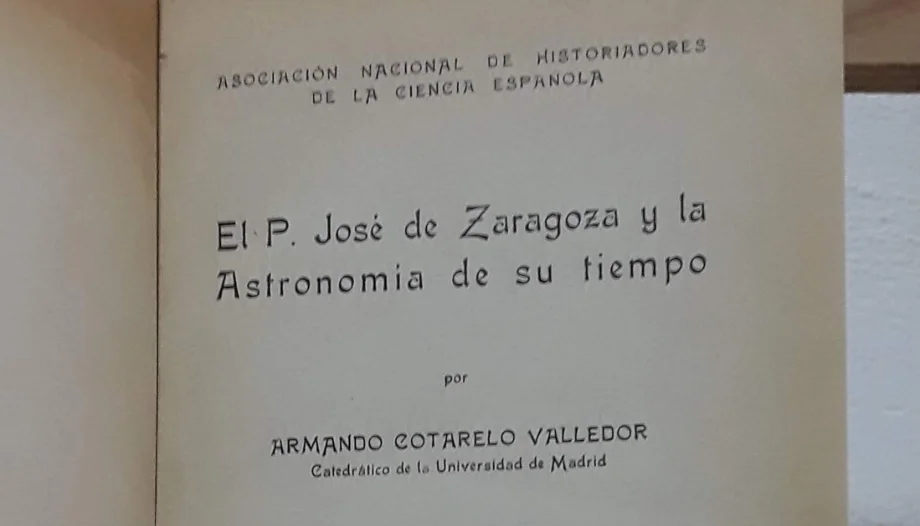
José de Zaragoza (Valencia, 1627 - Madrid, 1679) was a Spanish Jesuit, mathematician and astronomer of the 17th century, linked to the movement of the novatores, who sought to renew Spanish science through more empirical and rational methods than those in use at the time.
His training began at the University of Valencia, where he obtained a doctorate in philosophy. He was later offered the possibility of taking the chair of mathematics at the university, but he turned it down because he was more interested in theology, which reflects the deep commitment to his Catholic faith that would guide his entire career.
In 1651 he joined the Society of Jesus. Through this institution he taught in different schools of the order, in cities such as Calatayud, Mallorca, Barcelona and Valencia itself.
He also acquired other positions: in 1667 he was appointed member of the Royal Board of Mines, a year later he was a qualifier of the Holy Office, and, from 1670, he taught mathematics at the Imperial College of Madrid, where he had as a student the viceroy Diego Felipe de Guzmán, Marquis of Leganés, who became his protector. The queen even appointed him mathematics professor to her son, Charles II. This is not strange if we take into account that he published several mathematical works with didactic and innovative intentions, among them Arithmetica universalis (1669), Trigonometry (1672) y Logarithm tables (1672). In addition, he also wrote works of research type, among which we can emphasize Geometría magna in minimis (1674), where he introduced the concept of the minimum center of a point system, which serves to obtain results such as Ceva's Theorem. As an astronomer, he stood out for his empirical and observational approach. He built powerful telescopes to study comets (he was the first to spot the one in 1677) and other celestial phenomena, reporting his observations to the Académie des Sciences of Paris. Finally, his treatise Esphera in common celestial and terrestrial (1675) reflects a modern approach, based on observational data, and shows his critical stance towards classical cosmology, although he always maintained a cautious approach to heliocentrism.
Public University of Navarra. SCS-Spain.





 Español
  English
  Italiano