



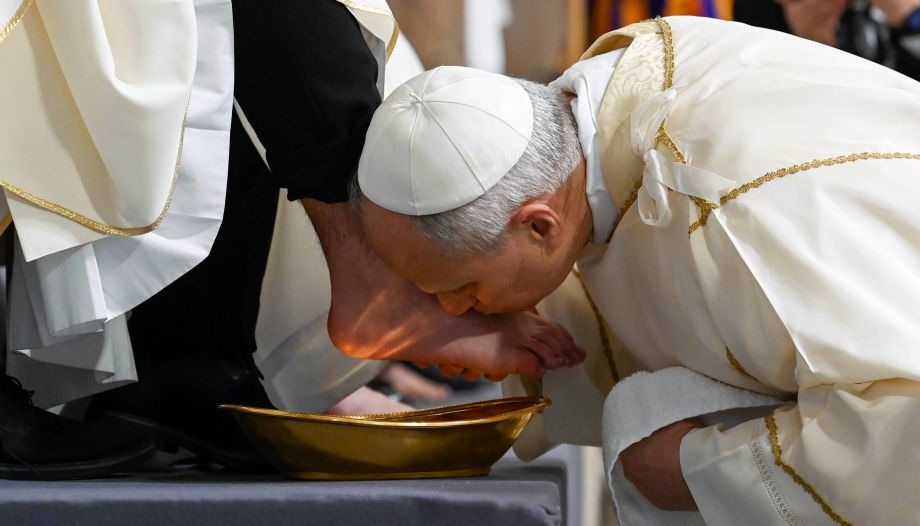
During the Holy Chrism Mass celebrated in St. Peter's Basilica on Holy Thursday morning, Pope Leo XIV began his homily by pointing out the importance of reliving the Passion, Death and Resurrection of Christ. Resurrection of Jesus. Through the celebrations of the Easter Triduum, the Christian realizes that “the freedom of Jesus changes the heart, heals wounds, perfumes and brightens our faces, reconciles and reunites, forgives and resurrects”.
This freedom is what allows us to participate in “the Christian mission, the same as that of Jesus”. Each one takes part in it “according to his own vocation and in a very personal obedience to the voice of the Spirit, but never without others, never neglecting or breaking communion!”.
It is this mission that gives the Church its name “apostolic”, for it is a “Church that is sent, not static, driven beyond itself, consecrated to God in the service of his creatures”.
The importance of origins
To begin this “sending forth,” the Pope emphasizes, a “kind of emptying in which everything is reborn” is needed. It is necessary to find a balance, because “our dignity as sons and daughters of God cannot be taken away from us, nor can it be lost, but neither can the affections, places and experiences that are at the origin of our life be erased”.
Leo XIV underlines the importance of the origin, where we recognize that “we are heirs of so much good and, at the same time, of the limits of a history in which the Gospel must bring light and salvation, forgiveness and healing”.
For this reason, the Pope continues, “mission begins with reconciliation with our origins, with the gifts and limits of the formation we have received”. However, we must not forget that “there is no peace without the courage to set out, no conscience without the audacity of detachment, no joy without risk”.
Emptying to fill
The Church truly shows that she is the Body of Christ when “we set ourselves in motion, going out of ourselves, making peace with the past without remaining prisoners of it: everything recovers and multiplies if we first let go, without fear”.
This “readiness to lose, to empty oneself”, the Holy Father emphasizes, “is not an end in itself, but a condition for encounter and intimacy”. In fact, the Pope affirms that “the great missionaries are witnesses of careful approaches, whose method consists in sharing life, selfless service, the renunciation of any calculating strategy”.
In the same vein, Leo XIV speaks of the importance of inculturation: “We are guests: we are guests as bishops, as priests, as religious men and women, as Christians. In fact, in order to welcome, we must learn to let ourselves be welcomed”.
The shipment
Finally, the Pope points out another essential part of the mission: “the cross”. It is the moment in which “the sending becomes more bitter and frightening, but also more gratuitous and revolutionary”. However, this cross cannot fill us with fear, but the example of Christ must fill us with hope, for “the poor, imprisoned, oppressed Messiah plunges into the darkness of death, but in this way brings to light a new creation”.
Pope Leo XIV concludes by sending all Catholics out into the world, for “saints make history” and “in this dark hour,” it is God himself who “has willed to send us to spread the fragrance of Christ where the smell of death reigns.” The Holy Father encourages us to “renew our ‘yes’ to this mission that asks us for unity and brings peace”.
A God who serves
During the Evening Mass of the “Lord's Supper”.”, On Holy Thursday evening in the Basilica of St. John Lateran, Pope Leo XIV, quoting Pope Benedict XVI, explained that “we are always tempted to look for a God who ‘serves us’, who makes us earn, who is useful like money and power”.
God's logic, however, is different, for he “serves us, yes, but with the gratuitous and humble gesture of washing our feet: this is the omnipotence of God”. With this sign, “the will to dedicate one's life to the one who, without this gift, cannot exist” is fulfilled. This is why “the Lord kneels down to wash man, out of love for him. And the divine gift transforms us”.
The example of Christ
With the washing of the feet, “Jesus not only purifies the idolatries and blasphemies that have sullied the image we have made of God, but also purifies our image of man, who perceives himself as powerful when he dominates, who wants to conquer by killing those who are equal to him, who considers himself great when he is feared”.
The Holy Father points out that we need the example of Christ “to learn to love, not because we are incapable of it, but precisely to educate ourselves and others in true love”. However, the Bishop of Rome warns that “learning to act like Jesus, the Sign that God imprints on the history of the world, is the task of a lifetime”.
For this reason, Christ “is the authentic criterion”. We only have to see it in the gesture of the washing: “the Lord does not love us if we allow ourselves to be washed by his mercy; he loves us, and therefore he washes us, so that we can correspond to his love”. “Letting ourselves be served by the Lord is, therefore, a condition for serving as he did,” the Pope insists.




 Español
  English
  Italiano