



 Pope stresses that the light of Easter overcomes hatred and renews the world
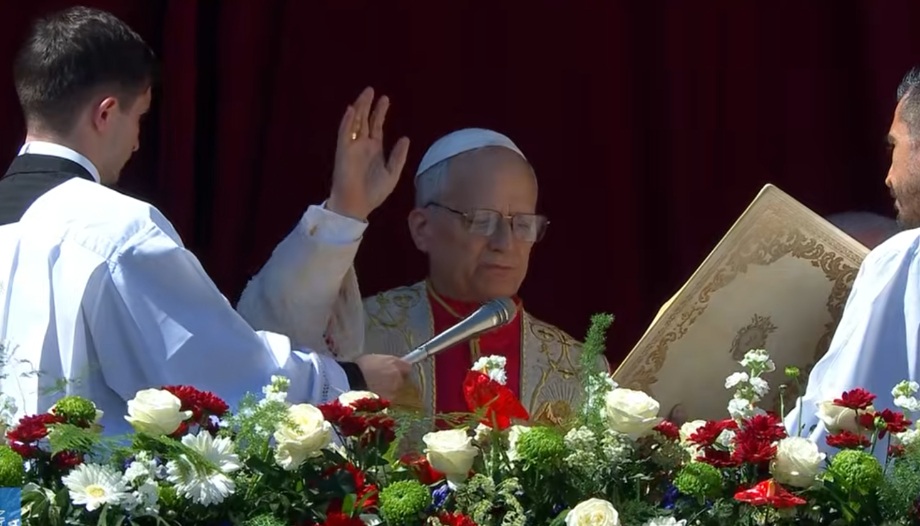
On the bright morning of Easter Sunday, Pope Leo XIV addressed his Easter message to the world with his traditional blessing Urbi et Orbi, He centered his preaching on two deeply intertwined axes: liberation from sin through the victory of Christ and the urgency of an authentic peace that springs from the interior of the renewed man.
From the central loggia of St. Peter's Basilica, the Pontiff solemnly proclaimed the core of the Christian mystery: “Easter is a victory: of life over death, of light over darkness, of love over hatred.” With these words, Leo XIV placed his message from the outset in the key of spiritual triumph, not as a mere symbol, but as a real event that transforms human history.
Freedom from sin
The Pope developed in depth the redeeming meaning of the Easter, emphasizing that Christ's victory is neither individual nor abstract, but universal. He recalled that Christ, “as the true sacrificial Lamb, took upon himself the sin of the world and thus freed us all, and with us also all creation, from the dominion of evil”.
This affirmation, of great theological density, emphasizes the cosmic dimension of redemption: not only man, but all of creation is freed from the power of sin. In this line, the Pontiff insisted that Christ's victory was not achieved through imposition or violence, but through loving obedience: “Christ, our «victorious King», fought and won his battle through trusting surrender to the will of the Father, to his plan of salvation”.
In his homily at the Easter Sunday Mass, Leo XIV descended into existential terrain, realistically describing the interior experience of sin and its consequences. “Within us, when the ballast of our sins prevents us from taking flight; when the disappointments or loneliness we experience exhaust our hopes; when worries or resentments suffocate the joy of living... then we seem to have fallen into a tunnel from which we see no way out.”.
In the face of this inner darkness, the Pope presented Easter as a living and present force, capable of breaking any confinement. Quoting his predecessor, he recalled that the resurrection “is not something of the past. It is an unstoppable force,” a reality at work today in the midst of human darkness.
True peace: without violence, from the heart
The second major thrust of the papal message was peace, understood not as the absence of conflict or external imposition, but as the fruit of a profound inner transformation. Leo XIV offered a particularly eloquent image to describe the power of the risen Christ: “The power with which Christ rose from the dead is not violent. It is like that of a grain of wheat which, withering in the earth, grows, breaks through the clods, sprouts and becomes a golden ear”.
Moreover, the Pope made this power concrete in everyday human experience: “It is even more similar to that of a human heart that, wounded by an offense, rejects the instinct of revenge and, filled with goodness, prays for the one who has offended it”. In this way, he directly linked world peace to personal conversion, pointing out that reconciliation begins within each person.
“Brothers and sisters, this is the true force that brings peace to humanity,” he said, explaining that this force “generates respectful relationships at all levels: between individuals, families, social groups and nations.” It is a peace that does not seek to impose or dominate, but to build: “It does not seek particular interest, but the common good; it does not seek to impose its own plan, but to contribute to designing and implementing it together with others.”.
Against the “globalization of indifference”.”
In one of the most incisive moments of his message, the Pontiff forcefully denounced the growing insensitivity to human suffering. “We are becoming accustomed to violence, we resign ourselves to it and become indifferent,” he lamented. He listed precisely the forms of this indifference: “Indifferent to the death of thousands of people. Indifferent to the aftermath of hatred and division that conflicts sow”.
The Pope warned that this attitude is not only morally unacceptable, but profoundly dangerous for humanity, alluding to an increasingly widespread “globalization of indifference”. Recalling the words of his predecessor, he noted, “How much willingness to die we see every day in the many conflicts that affect different parts of the world.”.
In the face of this reality, Leo XIV launched a direct appeal to personal and collective responsibility: “We cannot remain indifferent! We cannot resign ourselves to evil!” And, quoting St. Augustine, he offered a spiritual key to overcome the fear that paralyzes: “If dying makes you afraid, love the resurrection”.
An urgent appeal for peace
The message culminated with a concrete and urgent appeal for peace, addressed to both individuals and policy makers. “In the light of Easter, let us allow ourselves to be surprised by Christ! Let us allow his immense love for us to transform our hearts!” he exhorted.
In a particularly direct tone, he called for the disarmament of hearts and hands: “Let those who have weapons in their hands abandon them! Let those who have the power to unleash wars choose peace!” But he immediately specified the type of peace he proposes: “Not a peace imposed by force, but through dialogue. Not with the will to dominate the other, but to find him”.
Finally, he invited all the faithful to unite in prayer: “I invite everyone to join in the prayer vigil for peace that we will celebrate here in St. Peter's Square on Saturday, April 11”.
In a context marked by conflicts, divisions and spiritual weariness, his words resound as a call to rediscover the silent but unstoppable power of the resurrection: a power that does not destroy, but regenerates; that does not impose, but convinces; that does not dominate, but reconciles.




 Español
  English
  Italiano