



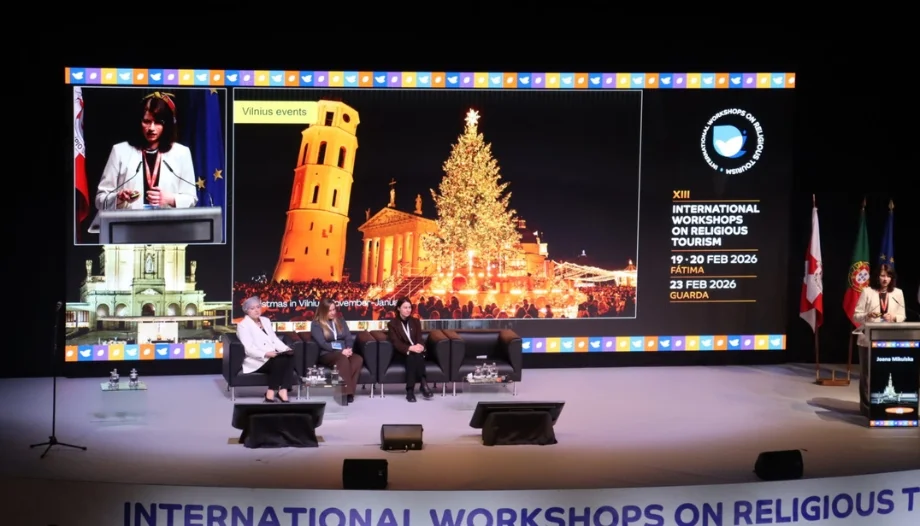
Many may find it surprising that religious tourism - Catholic - is possible in Lithuania. Or in Egypt. Or in Brazil. Or that there are Catholic routes in Colombia. Or that Guatemala hosts a Holy Week that is an Intangible Cultural Heritage of Humanity. A place as paradigmatic as the sanctuary of Fatima, which receives six million pilgrims a year, was the setting for the 13th edition of the International Religious Tourism Seminar (IWRT), an opportunity to learn about Catholic religious tourism destinations around the world. This type of travel moves millions of pilgrims every year around the world, with a significant impact on the economy of the destination countries.
The theme of the meeting was already indicative of the reality of religious tourism: “Places of faith: memory, spirituality and the pilgrim's experience. An essential feature of religious tourism is that it is something ”that does not fit into statistics alone: it is spirituality, memory and the meaning of the trip,“ according to one of the participants, Rui Ventura, of the Tourism Promotion Agency of Portugal Centro. The tourist agents in Fatima were aware that, in addition to the business, they are helping to meet the spiritual needs of thousands of people.
Proof of the importance of this branch of tourism are the figures for this thirteenth edition of the International Workshops on Religious Tourism (IWRT)): representatives from 42 countries, with 132 agencies and tour operators and 136 companies or entities offering their services. More than 5,200 one-on-one meetings were held over the two days of the meeting. About five hundred people attended the Paul VI Pastoral Center in Fatima, including, in addition to the congress participants, members of the public such as students and researchers.
Six and a half million pilgrims at Fatima
The sanctuary of Fatima itself is a representation of the impact of these trips. In 2025, according to official data, it welcomed 6.5 million pilgrims. “Fátima continues to assert itself as a global destination,” stressed Pedro Mafra, president of ACISO (Ourém-Fátima Business Association, promoter of the meeting).
The Portuguese sanctuary is the most visited in Europe. “It receives visitors from all continents, all year round. It is a destination, but it is also a gateway. It is a gateway to the Middle Tagus, to the center of Portugal, to the interior, to our cultural and landscape diversity,” said Rui Ventura. In fact, as Alexandre Marto, president of the main hotel company in Fatima, told OMNES, religious tourists cannot be distinguished from gastronomic or cultural tourists. “They come here for a spiritual motivation, but then they extend their trip in other areas.” According to Marto, the political authorities have been able to understand the importance of religious tourism, overcoming the prejudices that some might have towards the spiritual.
Lithuania came as a guest destination. The Baltic state is the birthplace of the Apostle of Divine Mercy, St. Faustina Kowalska (she considered herself Polish, but when she was born, Poland did not exist as a nation). Her birthplace is preserved there. The Hill of Crosses is also located there, north of the city of Šiauliai, a small mountain where the faithful have placed hundreds of thousands of crosses as a symbol of faith and resistance to the Soviet occupation, and which was visited by St. John Paul II. Also the sanctuary of Siluva, site of the first apparitions of the Virgin Mary recorded in Europe, in 1608.
Lidija Bajarūnienė, vice-president of the European Commission for Tourism and representative of the Ministry of Economy and Innovation of Lithuania, explained the motto that the country exhibits in its tourist offer: “Land of Hope, Mercy and Living Faith”. She also informed about the World Apostolic Congress on Mercy, This year's event, which will take place in the capital, Vilnius, from June 7 to 12, will welcome hundreds of participants. The capital is presented as “The City of Mercy” (www.cityofmercy.lt).
From America
The sanctuary of Luján, in Argentina, is one of the five most visited in America. He presented the first Ibero-American Forum of Marian Cities that will take place in October. This forum brings together representatives of cities of Spain, Portugal and other 19 American countries, with the most known centers of religiosity: the Pilar of Zaragoza, Fatima in Portugal, Aparecida in Brazil, Caacupé in Paraguay, Guadalupe... It intends to study the relationship between cities and sanctuaries, and points of integration and fraternity.
In Ibero-America, Brazil has many religious tourism destinations, perhaps little known outside its borders. There were several exhibitors at the congress. The agency Catedral Viagens presented proposals such as pilgrimages to the sanctuary of the Eternal Father, the only one in the world with this dedication, in the town of Trindade (Goiás), known as the “capital of faith”; to Aparecida (its Marian sanctuary receives twelve million pilgrims a year); to the sanctuary of Santa Dulce, in Bahia; tours through the region of Minas, with great religious heritage, including the grand sanctuary of Caraça; the basilica of Our Lady of Nazaré, in Belém.... There is also, in the north of the state of Paraná, the Nova Fátima sanctuary, in the image of the original Portuguese one; and that of Frei Galvao, the first Brazilian saint (canonized by Benedict XVI), in Guaratinguetá, which also houses a museum, a seminary and the saint's birthplace.
In Colombia there is a “Journey to the heart of faith”, in the region of Valle del Cauca. There, this March, in Guadalajara de Buga, the ICV National Congress of Religious Tourism and Heritage will be held.
The Dominican Republic also has a presence in the international network of religious tourism, as well as in the Guatemala. The small Central American nation exhibits a Holy Week of great richness in the processional steps, the carpets of flowers or sawdust, the music, the temples. With more than 500 years of tradition, in 2022, it was declared Intangible Cultural Heritage of Humanity by UNESCO.
Guatemala has also created the Holy Route of the Pilgrim to the Black Christ of Esquipulas, the venerated image visited by thousands of faithful.
Even Egypt had a presence in Fatima. There, religious tourism is centered on the route of the Holy Family, which Jesus, Mary and Joseph supposedly traveled in their flight from the persecution of King Herod.
Nevertheless, one of the Meccas of religious tourism is the Holy Land, which continues to attract thousands of pilgrims, Catholics, Christians of various denominations and other religions. Its challenge is to continue attracting the faithful. Blanca Ramirez, the representative of Saxum, a multimedia center located near Jerusalem, promoted by Opus Dei, which helps visitors to deepen their knowledge of the Holy Land in an interactive way, told OMNES: “We are true representatives of hope. We trust that a lasting peace will come”. Saxum has experienced the COVID, as soon as it was inaugurated, which was followed by the war, the Hamas massacre of October 7, 2023. They are confident that visitors will return, but the war with Iran raises fears that it will not be easy.
The councilor of the Portuguese municipality of Guarda, Cláudia Guedes, summarized the transcendence of religious tourism: “Places of faith are bridges between the visible and the invisible. Memory is the thread that connects generations. Spirituality is the force that drives the human search for meaning. And the pilgrim's experience is the concrete expression of that search.”.



 Español
  English
  Italiano