



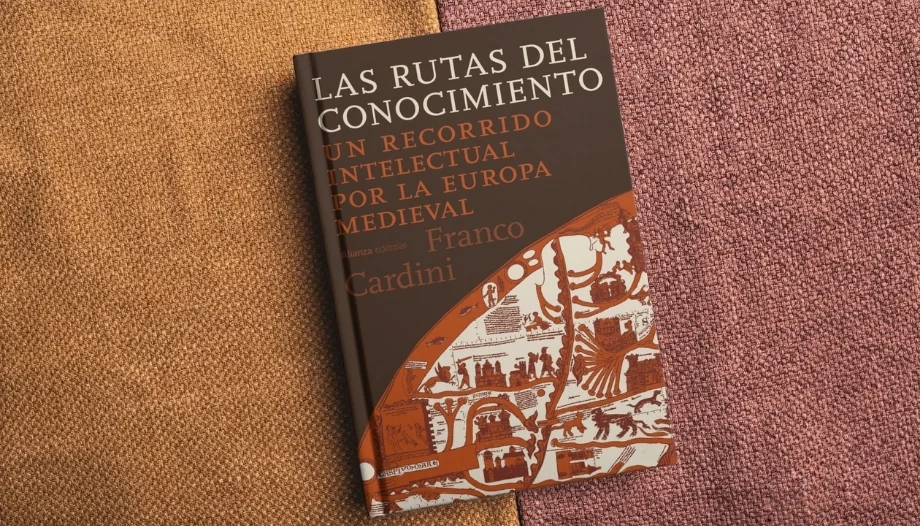
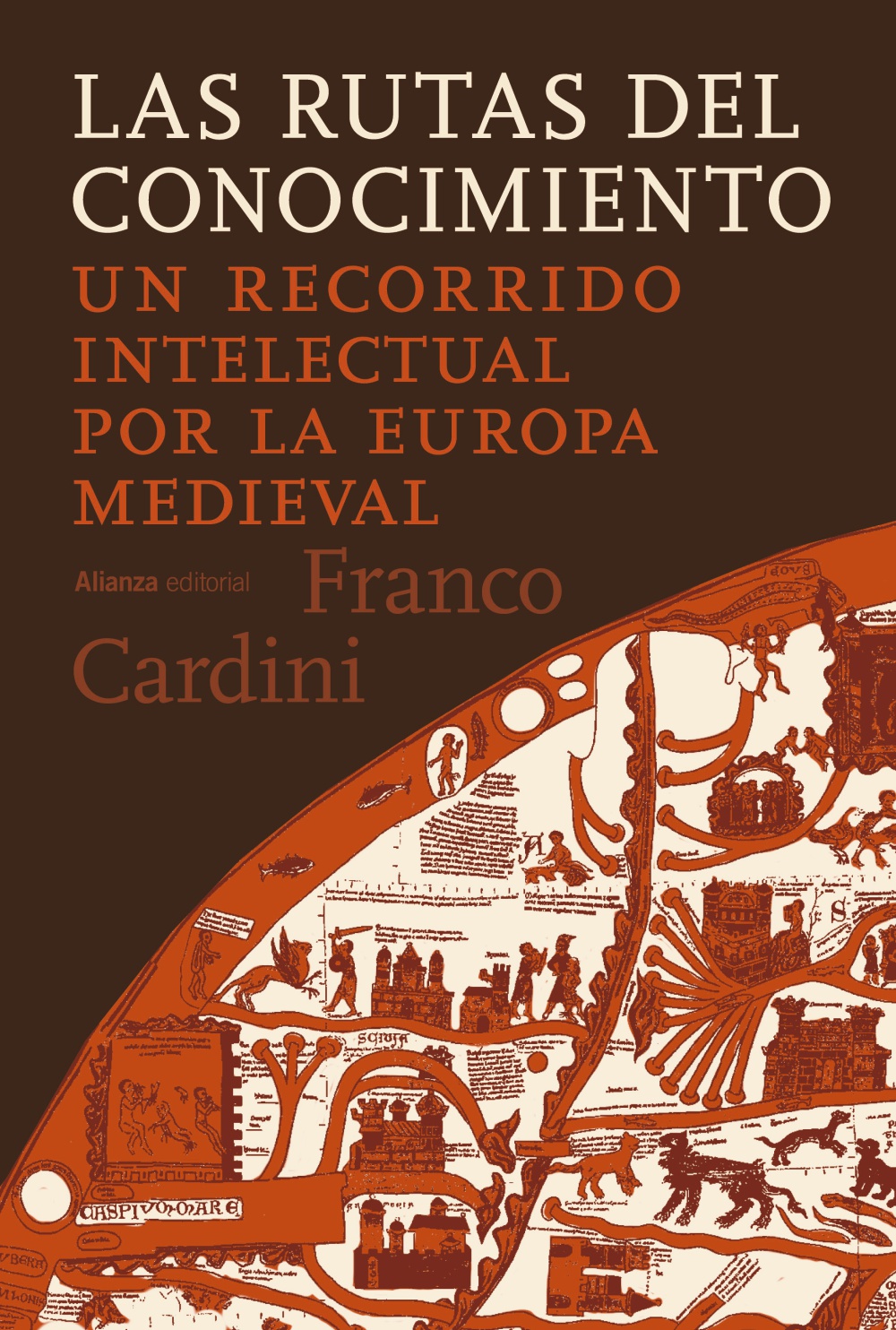
If a picture is worth a thousand words, it is worth imagining what a book with pictures and words is: a true encyclopedia of wisdom and science. This is the work of Franco Cardini (1940), professor of Medieval History at the University of Florence.
Images that speak
Professor Cardini gathers in this work that we now present, a small part of his knowledge and images accumulated and selected throughout his academic life, to make a magnificent intellectual journey through Medieval Europe and to be able to explain what he simply calls: “the routes of knowledge”.
It must be recognized that Professor Cardini is a tireless disseminator, capable of bringing to the public at large issues and details hitherto reserved for a minority of tireless researchers.
Undoubtedly, this work has fallen short, very short, because to take advantage of the text would have required a full color edition of maps, engravings, images taken from museums, archives and libraries so that the reader could read this delicious text as an explanation and commentary of a history of art and culture from the great cities of the Middle Ages and their contribution to Western civilization.
Cultural bridges in the Middle Ages
Our author will begin by glossing in the introduction the concept of travel, of freedom, of the interconnection of cultures and cities of the Middle Ages, since the Christian faith was the bridge of unity of all of them and, therefore, there are many intellectual connections of the traveler in any place of Western civilization.
At the same time, diversity is seen as richness, as a broadening of the soul and the origin of wisdom and understanding. Unity is useful and necessary and uniformity is neither useful nor necessary.
Artists, patrons and key cities
I will now dwell briefly on the chapter dedicated to Renaissance humanism from the 14th-15th century onward, for simple reasons of academic urgency and to enjoy Professor Cardini's comments. In fact, we will not be disappointed but enriched by the comments, images and suggestive references to one of the artistic, cultural and philosophical movements of our already long history.
The Renaissance would be characterized “by a more strictly elitist dynamic and a clearer commitment to the freedom of its protagonists in terms of literary and artistic production, but at the same time by a greater interest also with respect to the cultural dimensions in the technical and scientific fields and by a close relationship between the artist and the client” (245).
Our author will be outlining the transformation of the small French city of Avignon into a place of world importance: “The court of Avignon also saw the presence of characters such as Francesco Petrarca and Simone Martini, who contributed to making it a center of attraction for prestigious cultural forces. The popes of the Avignon period were often shrewd politicians and generous patrons, as well as competent financiers; in fact, the French city became the destination of the greatest bankers of the time” (249).
He will then focus on the triangle Avignon, Florence and Rome to delineate the great transformation of the decadent Europe of the fourteenth century, spectator of the fall of Constantinople in 1454, to become a movement of return to the Greek and Latin classics and permeate the European courts with a pagan humanism in just a few years.
Humanism that changed the world
With great skill Franco Cardini reconstructs the birth of humanism: “the prince expected celebrity and glory from the poet or the architect whom he protected and financed, and in fact most of the works of art of the fourteenth and fifteenth centuries, including the best ones, are celebratory works commissioned (...). In short, the freedom, independence of judgment and audacity of certain humanist cultural projects were born no longer in confrontation with power or behind its back, but, on the contrary, protected by its shadow” (251).
He would then focus on the figure of Lorenzo Valla who in 1440 would publish his famous treatise “de falso credita et ementita Constantini donatione” which denied the historical veracity of the “Constantinian donation” that would produce an undoubted alteration in the Italian political chessboard. If the pontifical legates for the Papal States since Cola di Rienzo and Cardinal Albornoz between 1343 and 1354 had promoted the renewal of the Papal States (249), now they had to stand firm to avoid disintegration (257).
The author's conclusion
Our author's conclusion is that Renaissance and civic humanism became convergent: “times were rapidly moving towards a concentration of both wealth and power and, therefore, more and more towards elitist, oligarchic and autocratic political forms; on the other hand, the literati and artists needed the protection of noble lords or rich businessmen, of patron-fathers who would protect them and support their costly work” (258).
He will also tell us about the close link between “humanist and Renaissance culture and the exercise of power, already emphasized, explains how in the course of the fifteenth century a series of inventions and discoveries were made that literally changed the face of what had been the known world until then” (259).
The Renaissance world would change radically after the discovery of America and the entry of Holland and England into the naval world. Oceanic voyages would change humanism: “the great epoch of oceanic exploitations was the result of the advancement of practical techniques, technologies, graphic representation capabilities and theoretical reflections” (268).
The routes of knowledge. An intellectual journey through medieval Europe




 Español
  English
  Italiano