



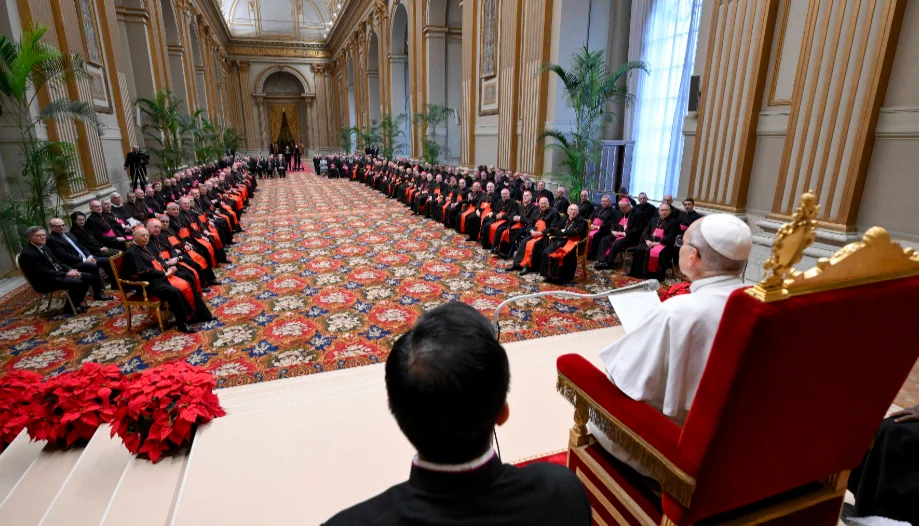
Mission and communion seem like abstract concepts, but they are deeply rooted in theology and canon law. Understanding this connection is crucial to living as missionary disciples of Christ in today's world.
Mission and communion, two inseparable realities
In his address to the Curia, Pope Leo XIV emphasized that the Church exists for mission: to go out to meet the world, to proclaim the good news, and to invite everyone to the banquet of the Kingdom of God. This «new evangelizing outreach» is not accidental; it emerges from the very heart of God, who in an act of radical love sends his Son to reconcile humanity with himself. The Pope expressed it this way: God makes a true «exodus» toward us, he goes out to seek us.
The mission is linked to communion. As the Holy Father emphasized, communion is a reality that springs from the heart of the Trinity and unfolds in a concrete way throughout the Church. Communion is not a feeling; it is the bond that constitutes us as the body of Christ, making each of us a member of the same Body and calling us to be builders of communion. Pope Leo XIV specifies that this communion constitutes today «a task more urgent than ever,» both ad intra (within the ecclesial community) as ad extra (in testimony before the world).
Communion: the primary duty and compass of all the rights and duties of the Christian faithful
The second book of canon law «of the people of God» begins in its first part with a section dedicated to the obligations and rights of all Christian faithful (ChristifidelesAll those who are baptized and incorporated into the Church through baptism possess a fundamental equality that is nuanced by a functional differentiation (hierarchical principle), which determines both the manner of participating in Christ's mission and the particular path of sanctification for each believer.
Here is a notable aspect of the 1983 Code of Canon Law: communion is a primary duty and a right of all the baptized, and more decisively, it becomes the criterion and limit for the exercise of all other rights. This marks a radical difference from individual rights in civil constitutions. In the secular world, rights are often exercised in an individualistic manner: each citizen exercises his or her rights on a personal basis within the civil regulatory framework.
In the Church, however, no individual right can be exercised against ecclesial communion. If it does, it loses its meaning and legitimacy. What are the concrete bonds of this communion? Canon 205 lists them:
(1) profession of faith—adherence to the deposit revealed in Scripture and Tradition, interpreted by the Magisterium;
(2) unity in the sacraments;
and (3) hierarchical communion. The Church is a hierarchically organized society (C. 207). Only when we all maintain these bonds do our rights and obligations take on true meaning and contribute to the common good of the Church.
The universal call to holiness: a «revolutionary» call»
Canon 210, on the duty and right of the faithful to holiness, precedes—and this is significant—the canons referring to the duties and rights of all Christian faithful (canons 208-223) and therefore constitutes a criterion of interpretation: «All the faithful should strive, according to their own condition, to lead a holy life, as well as to increase the Church and promote its continual sanctification.» The rights and duties of the faithful to worship (C. 214), to association (C. 215), to Christian formation and education (C. 217), to private life (C. 220), etc., only make sense if they are read under the paradigm of communion and the common good.
Herein lies one of the most profound contributions of the Second Vatican Council, expressed in Lumen Gentium: the universal call to holiness. This notion leaves behind an old ecclesial conception that saw different levels of holiness according to the state of life of each believer and according to which there was a «state of perfection,» for example, religious who, through their evangelical profession with vows, were called to the fullness of Christian life. As if some believers had a duty to holiness and others did not.
This exhortation to holiness by the Second Vatican Council, expressed in the Code of Canon Law, was the result, among other things, of the re-reading of many spiritual authors (from St. Augustine to St. Thérèse of Lisieux) but decisively by St. Josemaría Escrivá de Balaguer, who concretized this concept in the prelature of Opus Dei and in its mission: to spread the universal call to holiness in the midst of the world, especially through the sanctification of ordinary work and the common circumstances of life.
As the Magisterium emphasizes, and as Pope Leo XIV has now underscored, holiness and communion are not lived in the abstract. The pursuit of Christian perfection does not consist in escaping the world or denying earthly responsibilities. On the contrary, each believer pursues holiness according to the demands of his or her state of life and personal vocation. The pursuit of personal holiness and the growth of the Church's sanctification are linked, for the Church bears fruit and grows when the faithful strive in their daily lives to attain the fullness of Christian life.
Pope Leo XIV reminded the Church that mission, communion, and holiness are not abstract aspirations, but realities that must be embodied in daily life, and that these realities are protected by canon law. «We are not little gardeners dedicated to tending our own gardens, but we are disciples and witnesses of the Kingdom of God, called to be in Christ the leaven of universal brotherhood among different peoples, different religions, among women and men of every language and culture. And this happens if we are the first to live as brothers and sisters and make the light of communion shine in the world» (Leo XIV, Address to the Roman Curia, December 22, 2025).




 Español
  English
  Italiano