



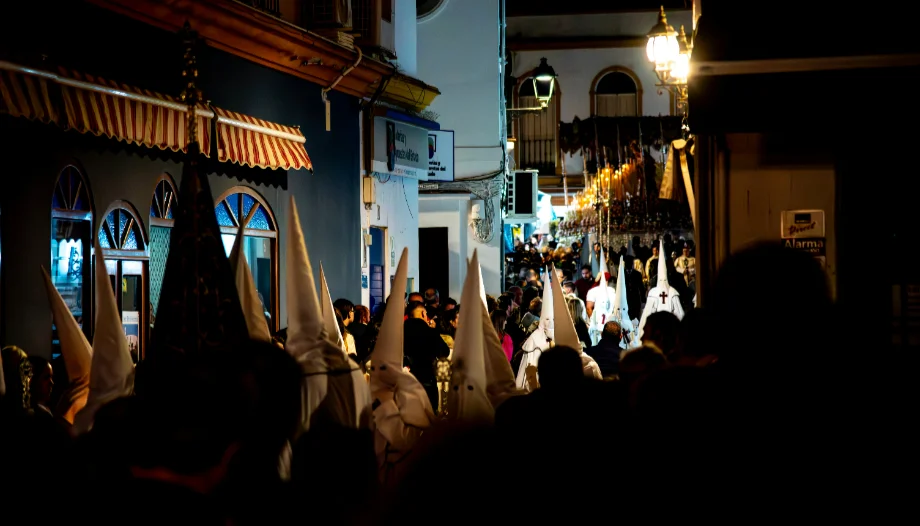
The decision of the Confraternity of the Immaculate Blood of Sagunto to maintain the exclusion of women in its ranks has reopened a debate that in Spain never quite closes: the difficult balance between equality and religious freedom. The internal vote, in which a majority of confraternities once again rejected the admission of women, has had immediate consequences -such as the possible withdrawal of the tourist recognition of the local Holy Week-, but above all it has brought back to the center a fundamental question: can the State impose criteria of equality in the internal organization of a religious entity?
The case is not isolated. It refers directly to the recent doctrine of the Constitutional Court in the conflict of the Cofradía del Cristo de La Laguna in 2024, a resolution that has been much discussed in the academic field. Among the critical voices is that of Santiago Cañamares, professor of State Ecclesiastical Law at the Complutense University of Madrid, and author of a publication on sex discrimination in religious entities (Dykinson, 2026, pp 145-169).
Confusion and misunderstandings
The problem is not so much the sentences issued, but the approach adopted by the courts. From this perspective, the first error is one of legal qualification. «The confraternities are not civil or cultural associations, but public associations of the faithful integrated into the structure of the Church,» explains Cañamares. This difference «implies that the laws that should be applied to them are not those of civil association law, but those of ecclesiastical law». However, says the professor, «the Constitutional Court would have treated these entities as if they were ordinary private associations, applying categories of civil law that do not correspond to them».
This confusion is compounded when the court justifies its intervention with the idea that the activities of the confraternities have a cultural dimension. «It is true that the processions are part of the historical and social heritage, but reducing them to that level means, in practice, stripping them of their religious significance,» says Cañamares. The fact that something has a cultural impact does not make it a cultural entity. Processions are cultural because they are religious, not the other way around.
An important precedent
As this line of criticism warns, the court ends up substituting the criterion of the religious entity itself for an external one, which directly clashes with the principle of neutrality of the State.
In essence, what is produced is a reinterpretation of freedom in an expansive key. It is understood that the right to equality must prevail even in areas where a wide margin of autonomy has traditionally been recognized, such as religion. But this view poses obvious problems. Equality, as case law has repeatedly pointed out, does not imply absolute uniformity, nor does it prohibit all differences in treatment, but only those that lack reasonable justification.
Cañamares considers that «the precedent of the Alarde de Irún is particularly illustrative». This festivity, which commemorates a military victory in 1522, maintains a traditional model where men parade as soldiers. In the late 1990s, the conflict over the exclusion of women reached the courts and ended up in the Supreme Court (SC), which established a key distinction in 2008.
According to the SC, not all exclusion on the basis of sex is unlawful if it occurs within the scope of private entities. The key was to distinguish between public and private: when the event is organized by an administration, equality is strictly enforceable; when it is organized by a private entity, freedom of association prevails. Thanks to this doctrine, different models coexist today without one being imposed on the other.
Applied to the case of the confraternities, the parallelism is clear. The Church does not prevent the existence of mixed or even exclusively female confraternities. Forcing a particular confraternity to modify its statutes does not extend rights, but rather restricts the freedom of its members.
The ECtHR opinion
Here appears one of the most delicate but also most revealing arguments. If the State can impose the admission of women in a religious entity, what would prevent it from demanding in the future the admission of non-believers, excommunicated or even contrary to the doctrine that the entity claims to defend? The question ceases to be one of gender equality and becomes a structural problem of who defines the identity of religious communities.
It is no coincidence that this debate has transcended the national sphere. The case of the Canary Islands has already been brought before the European Court of Human Rights, whose jurisprudence has traditionally been clear in defending the autonomy of confessions. This court has reiterated that religious communities have the right to organize themselves according to their own rules, the definition of their doctrine or the selection of their members, as an essential part of collective religious freedom.
From this point of view, the intervention of the Constitutional Court is more than problematic. It is reproached for having applied a logic alien to the religious phenomenon, for having confused the cultural with the doctrinal, and for having taken the principle of equality beyond its reasonable limits. In short, it has intervened in an area where the State should maintain a position of neutrality.
The explanation for this phenomenon for Santiago Cañamares is clear: «the Constitutional Court is currently highly politicized», which facilitates a hegemonic and biased interpretation in some of its rulings.
The case of Sagunto, therefore, is neither a simple local controversy nor an internal dispute of a confraternity. It is one more episode in a larger debate about the limits of public power in a pluralistic society.





 Español
  English
  Italiano