



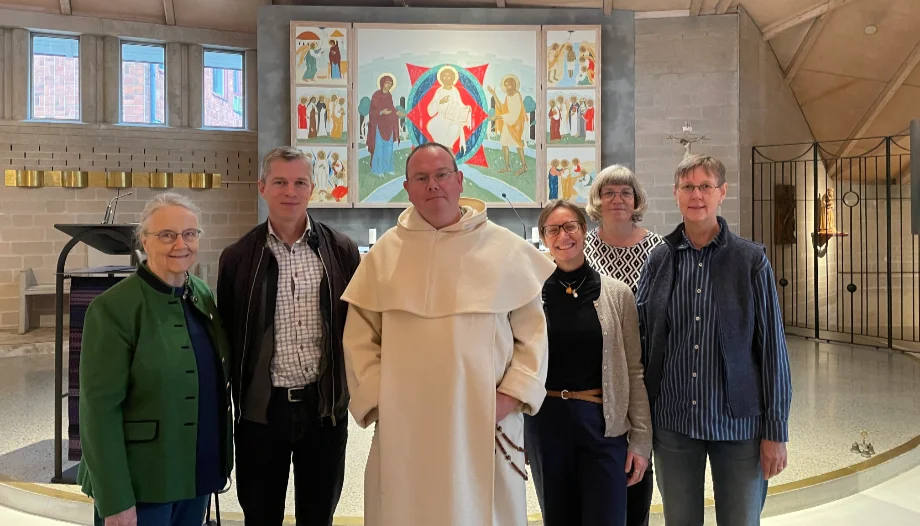
Many parishes in the Catholic Diocese of Stockholm report a great deal of interest in the Catholic Church. The number of participants in adult faith formation has increased significantly and the number of baptisms of young people over the age of sixteen and adults is growing rapidly. How are the parishes coping with this great interest?
When, after many years of reflection, in 2008 I realized that the time had come, I knew where to turn, thanks to two priests whom I had met and whom I deeply admired. Franciscan Friar Henrik Roelvink welcomed me with great warmth and gave me a lot of good advice. «But you should talk to someone closer to where you live,» he finally told me.
So I sought out Father Erwin Bishofberger at St. Eugenia parish in Stockholm and said, «Here I am, how can I help?» «Look around a bit first,» he suggested with a smile, and then I patiently began his legendary course. The doctrine and life of the Church.
A partly new group
Today there are many more people interested in the Catholic faith than there were then; some parishes even speak of a tripling of the number in just a few years. According to Deacon Sten Cedergren, ten to twenty people used to attend adult formation in the cathedral parish each year, while now the group numbers sixty-five participants.
Several parishes also point out that this is partly a new type of person approaching the Catholic Church. Father Jan Byström, responsible for adult education at St. Lars parish in Uppsala, explains that they are younger and more often lack a church background. Some have simply «tried out» different churches and today perceive the Catholic Church as a natural part of the Swedish religious landscape. They come to us because they want to be Christians, not primarily because they want to become Catholics.
This breadth, between those who have grown up in secular homes and those who are already well acquainted with the differences between the various Christian denominations, should present a special challenge to those organizing the groups. However, Sten Cedergren explains, these differences become more balanced when it is more a matter of «getting into the Church» than going through a series of doctrinal formulations.
Of course, all of the course leaders contacted by the envoy of KM stress that both doctrine and life are necessary. But in an age when theoretical knowledge is readily available in many formats, the need for the parish to work actively to welcome people into the internal and daily life of the community increases. Let the faith move, so to speak, from the head to the heart to the hands.
Creative variations
If one could bring together the best of the existing good examples in the various parishes, what would it look like? Accessibility would increase if the course, as in Our Savior's parish in Malmö, could also be followed online.
«It started during the pandemic and then we have continued,» says Father Fermin Landa, who is responsible for the formation of converts in the parish.
Lay participation in teaching also helps participants establish contacts more quickly in the parish. At St. Lars, at each meeting someone gives an initial presentation, followed by lay-led group discussions.
«And then we priests withdrew,» explains Father Jan Byström.
At St. Thomas in Lund, three lay people have taken over the teaching from Father Anders Piltz, who was previously in charge of the courses. They are, by the way, a professor of systematic theology (Gösta Hallonsten), a professor of exegesis (Sten Hidal) and a secondary school religion teacher, reports the latter, Malin Loman.
In the past, two years of formation were offered at St. Eugenia with meetings every two weeks: one year with the pastor in charge and the other with a deacon. Now, on the other hand, they meet every week, alternating the pastor and the deacon. The idea is, on the one hand, to move forward a little faster with those who are prepared and, on the other, to alternate doctrine and life, explains Deacon Ronny Elia.
At Christ the King in Gothenburg, the topics for the various introductory course sessions are posted on the website and outside speakers are often invited. At the same time, the rest of the parish is invited to participate in these evenings, according to Paddy McGuire, who is responsible for the training. In this way, course participants also have the opportunity to meet other members of the parish community.
Difficulty integrating into the community
Even after reception into the Church, it is not always easy to integrate into parish life, where many have known each other for years. In the cathedral parish, under the leadership of Deacon Sten Cedergren, the creation of an association named after the convert of converts, Paul, is now being tested. The aim is to support those who are new to the Church and those who wish to spread information about the conversion process. The first meeting took place on January 25, the feast of the conversion of the Apostle Paul.
Even if it is not possible to personalize the accompaniment when there are between fifty and one hundred interested parties, the method of Deacon Conny Strömberg at St. Ansgar's parish in Södertälje is inspiring: starting from the point where each person is in his or her faith journey and offering formation from there.
Perhaps even large groups could be divided according to starting point. Thus, those who wish to discuss more «specialized» issues could do so among themselves, while those who are completely new to the church setting could begin with a study circle, for example, with the book and video series Sycamore of KPN.
Between St. Benedict and the missionary mandate
Chapter 58 of the Rule of St. Benedict deals with the admission of new monks: «If someone comes and perseveres in calling, and after four or five days shows patience in enduring the difficulties and roughness of access, and perseveres in his request, he will be granted entrance and will remain a few days in the hospice» (Rule of St. Benedict, Editorial Veritas).
I think of this prudent monastic tradition, seeking deep discernment, when I visit the websites of larger parishes looking for something along the lines of, «Welcome, you who are curious about Catholic life; what a joy; here's how you can get started.».
For extroverted people, finding the right path is rarely a problem: they ask and they get there. And those who approach the Church because they have a Catholic family member or friend - half of those interested, according to one study - also have someone to ask. But what about shy, introverted people?
It is easy for any group to end up communicating primarily with those who already belong to it. In light of Jesus« command to »go into all the world and make disciples of all," the invitation to newcomers should have an obvious place on every parish website, on the same level as invitations to parish flea markets, and be a regular item on pastoral councils, on the same level as real estate issues. Considering the treasures the Church has to offer and all the qualified people involved in adult formation, the mission deserves greater visibility.
This article was originally published in Revista Katolsk Magazin from Sweden. Reproduced here with permission of the publisher.
Stockholm




 Español
  English
  Italiano