



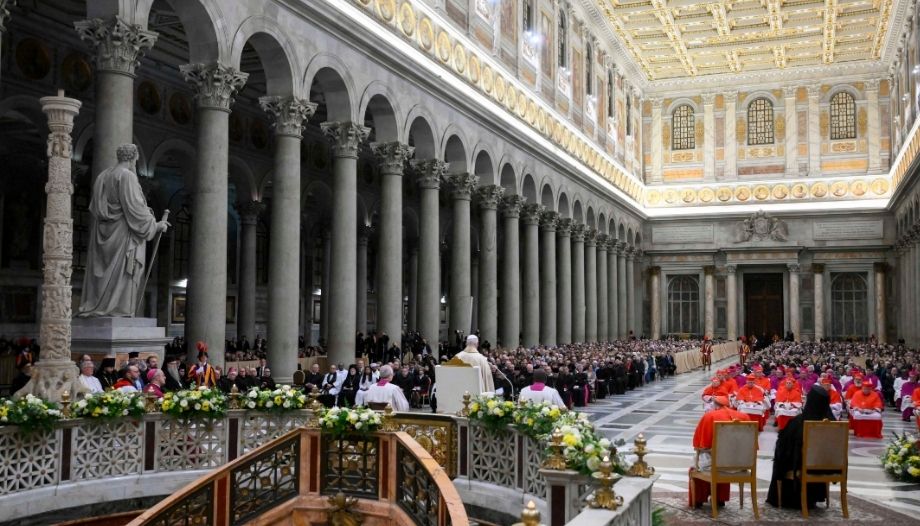
Pope Leo XIV has continued to reflect on the Audience This Wednesday on the Dogmatic Constitution Dei Verbum of the Second Vatican Council. He stated that “Sacred Tradition and Sacred Scripture are intimately united and interpenetrated. For both springing from the same divine source, they merge in a certain way and tend to the same end” (DV, 9).
The catechesis took place in Paul VI Hall, and the Pope referred to “the dear people of Mozambique, affected by devastating floods. As I pray for the victims, I express my closeness to the displaced and to all those who offer their support. May the Lord help you and bless you”.
Understanding the Scriptures
On the liturgical feast of St. Thomas Aquinas, Pope Leo XIV referred to Aquinas at various points in his catechesis, for example when addressing French-speaking pilgrims, students from various schools and students at the Catholic University of Vendée.
“May St. Thomas Aquinas, Doctor of the Church, whose memory we celebrate today, guide us in understanding the Scriptures, which he commented on with such wisdom, so that we can understand how much God loves us and desires our salvation,” he encouraged.
Then, to the German-speaking people he spoke of Revelation and faith. “That St. Thomas Aquinas, whose liturgical memorial we celebrate today, may his works help us to understand divine Revelation ever better. May the example of this Doctor of the Church impel us also to seek the face of God, experiencing the beauty of faith”.
Example of St. Thomas Aquinas
Before giving the blessing, and after addressing Chinese, Arabic and Polish-speaking pilgrims, the Pontiff again referred to St. Thomas Aquinas in Italian, evoking the young, the sick and the newlyweds.
“Today we celebrate the liturgical memory of St. Thomas Aquinas. May his example impel you, dear young people, especially you, students of the Flavoni School of Civitavecchia and the Tirinnanzi Institute of Legnano-Cislago, to follow Jesus as an authentic teacher of life and holiness.”.
“May the intercession of this holy Doctor of the Church obtain for you, dear sick people, the serenity and peace obtained from the mystery of the cross, and for you, dear newlyweds, the wisdom of heart so that you may generously fulfill your mission in society,” he said.

The Word of God, “pole star” for our journey
In his catechesis on the Constitution Dei Verbum, the Successor of Peter stated that “the Word of God, thanks to the action of the Holy Spirit, branches out in history through the Church, which safeguards, interprets and incarnates this Word”.
The Apostle Paul repeatedly exhorts his disciple and collaborator Timothy: “Timothy, guard the deposit entrusted to you”. The Dogmatic Constitution Dei Verbum echoes this Pauline text when it says: ‘Sacred Tradition and Sacred Scripture constitute a single deposit of the Word of God entrusted to the Church’, interpreted by ‘the Church's living magisterium, whose authority is exercised in the name of Jesus Christ’ (n. 10).
“Deposit of faith”.”
“‘Deposit» is a term which, in its original matrix, is of a juridical nature and imposes on the depositary the duty to preserve the content, which in this case is faith, and to transmit it intact’, Leo XIV pointed out.
This “deposit” is still in the hands of the Church today and “all of us must continue to protect it in its integrity, like a pole star for our journey in the complexity of history and existence”.
The Pope quoted St. Gregory the Great, St. Augustine and St. John Henry Newman, before affirming that “the Word of God is not fossilized, but is a living and organic reality that develops and grows in Tradition. The latter, thanks to the Holy Spirit ( ), understands it in the richness of its truth and incarnates it in the changing coordinates of history”.
Leo XIV: against all forms of anti-Semitism
On the occasion of Holocaust Remembrance Day, the Pope has once again reaffirmed, as he has done on his X network account @Pontifex.es, his fidelity to the firm position of the declaration ‘Nostra Aetate’ against all forms of anti-Semitism, and the rejection of any discrimination or harassment on the grounds of language, nationality or religion.
A voice that adds to that of the Popes of the past, starting with Pius XII, who in his Christmas radio message of 1942 denounced that hundreds of thousands of people, “just because of nationality or lineage, are destined to death”, reported Vatican News.




 Español
  English
  Italiano