



Kimberley Heatherington, OSV News
The scene in the video shared on Instagram is fraught with tension: U.S. immigration agents wearing bulletproof vests and masks, some of them with egg splatter, are confronted by a silver-haired Catholic bishop on the steps of a gothic-looking church.
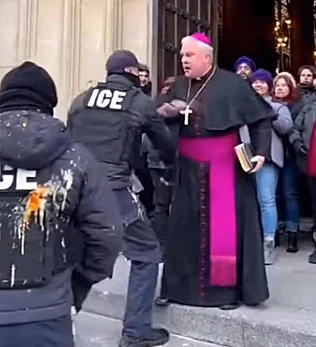
The prelate, easily identifiable by his amaranth-colored cassock, sash and trimmings, pushes aside an approaching agent as he waves a book and his pectoral cross swings around his neck.
«‘Get out! You are not welcome here!’ thunders the bishop, while the parishioners cheer him. ‘Not today, not in this church! I don't know what god you worship... but my God is love!'».
It's very dramatic, but it never happened.
Viralization in social networks
If the total absence of news about this incident is not a clue, the fact that the same script, word for word, appears in numerous other videos with other fake herds and other simulated shepherds confirms it: this is a deepfake generated by artificial intelligence.
But thousands of comments on Instagram, Facebook and TikTok reveal that many viewers were fooled by these AI-created videos, and they're not the only ones. Social media is rife with fake videos mimicking Catholic Church leaders, from fake prelates to Pope Leo XIV himself.
And some of these posts are not simply to get «likes», but there are also fraudulent posts aimed at scamming viewers who, moved by the situation, steal their money.
Priests supplanted
Father Rafael Capó, vice president for mission and ministry and dean of theology at the University of St. Thomas in Miami, Florida, knows what it feels like to discover that your online identity has been stolen.
«I have been present on social networks for a long time, evangelizing, especially to young people,» he explained to OSV News. «And because of that, people started appearing who were trying to impersonate my identity, my role as a priest, and my images, and using them.».
«They would create fake profiles on social networks and fake images,» he added. «And with that, they would start contacting people who followed those social networks, making them think it was me.».
Father Capó, a bodybuilder who also evangelizes through physical exercise, didn't notice at first. But then the questions started, especially when imposters began asking for money.
«I started getting messages from followers and people on social media asking me, ‘Father, is that you? Did you post this? Did you just ask this?’ And it became a disturbing trend.».
It wasn't easy to fix either. «It was very difficult,» he shared. «It became such a problem that I started contacting social media companies. They asked me to verify my profiles. And by verifying them, by taking that step, I started to notice improvement.».
But in an era of ever-multiplying AI-generated fakes and scams, even experienced influencers like Padre Capo may feel they are fighting against the tide.
AI and trust
«The problem today is not just impersonating a profile,» he noted. «It also involves creating videos. That takes everything to another level. And it's a very complex issue, because people are also using AI to create videos for positive purposes.».
Obviously, not all AI is malevolent, a reality that takes advantage of viewers' trust.
«It takes news, for example - Church news and current affairs - and manipulates it in such a way that people are confused about whether it is a legitimate news source,» Father Capó said.
At the University of St. Thomas, the institution is actively working to address these types of problems.
«We just passed our own standards for ethical AI,» Father Capó shared.
How to be well informed
Deacon John Rogers, vice president of Catholic services for Prenger Solutions Group, a technology and fundraising firm serving more than 100 dioceses in the United States and Canada, said there are ways the faithful can inform and protect themselves.
First, consult only the official or known channels of communication of the Church.
«You look for information such as ‘This is the official diocese of such-and-such a name,’ or that comes from the U.S. Conference of Catholic Bishops , or that is from an apostolate I know well,» Deacon Rogers advised.
Editing cuts - where scenes in a video jump around or something looks strange - are another clue.
«That's what everyone, especially in the digital world, calls ‘the uncanny valley’: when someone looks like a human being, but not quite enough,» said Deacon Rogers. «You always have to be on the lookout for things that don't look good.».
«And, frankly,» he added, «one of the best antidotes is simply to read more spiritual texts. If everyone would read five pages a day of solid, good quality Church documents ... they would be prepared to detect them on their own.».
It also affects the Pope
Following the online proliferation of numerous digital forgeries of Pope Leo XIV, the monthly email newsletter of the Vatican's Dicastery for Communication warned its readers that it receives «dozens» of such reports each day, in which fake accounts «increasingly use artificial intelligence to make the Pope say words he never uttered and to portray him in situations in which he never actually found himself.».
In a January 24 message on the occasion of the 60th World Communications Day, Pope Leo XIII acknowledged the problem.
«It is important that we inform ourselves, and educate others, on how to use AI intentionally,» the pontiff advised, «and in this context, protect our image (photos and audio), our face and our voice, to prevent them from being used in the creation of harmful content and behaviors such as digital fraud, cyberbullying and deepfakes, which violate people's privacy and intimacy without their consent.».
Other victims
Other prominent Catholic leaders who have been victims of deepfakes include Bishop Robert E. Barron of Winona-Rochester, Minnesota, known for his Word on Fire apostolate; Cardinal Marc Ouellet, retired prefect of the Vatican's Dicastery for Bishops; and popular speaker and author Father Mike Schmitz.
«Antiqua et Nova» (Note on the Relationship between Artificial Intelligence and Human Intelligence), a 2025 document from the Vatican's Dicastery for the Doctrine of the Faith and Dicastery for Culture and Education, was blunt: «AI-generated fake media can gradually undermine the foundations of society.».
Steven Umbrello, managing director of the Institute for Ethics and Emerging Technologies and editor-in-chief of the International Journal of Technoethics, asserted that the moral authority of the Church is under attack by artificial intelligence.
«For Catholics, this is especially serious because the faith is transmitted not only through ideas, but also through credible witnesses, through our testimonies. Deepfakes directly attack that credibility,» he said. «They can make it appear that a pastor endorsed something he never endorsed, or that the Church taught something it never taught.».
«And once doubt is sown,» Umbrello said, «the damage often persists even after a correction. The result is a culture where people assume, «I can't know what's real,» which is precisely the posture sought by those who act with bad intentions.».
Therefore, both the faithful and the Church must be vigilant and aware. «We must be honest in saying that the faithful do not need to become forensic experts, but they need a reliable workflow for verification and a moral standard that prevents them from spreading unverified claims,» he said.
Umbrella added: «Technically, the Church will need basic security measures, such as official channels that are constantly maintained and rapid response clarifications when something goes viral.».
Nor should obvious deepfakes be shared, as that only amplifies them. «When Catholics know where to look for the truth, deepfakes will lose their power,» Umbrella explained.
«Ultimately, the deepfakes are a test of whether we will allow technology to induce cynicism or whether we will respond with the virtues of prudence, justice and charity,» he reflected. «The authority of the Church is moral credibility, and moral credibility is defended with truth and the patient rebuilding of trust whenever it comes under attack.».




 Español
  English
  Italiano