



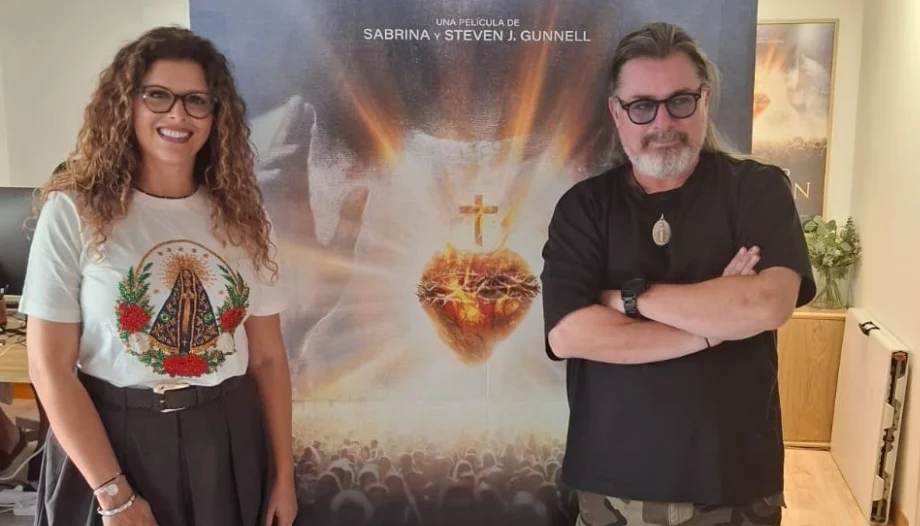
Devotion to the Sacred Heart of Jesus is one of the most widespread in the Church, reaching every corner of the globe. On the 11th, a documentary film with this title premiered in Spain, Sacred Heart, which combines historical reenactments and contemporary testimonies to explore the life of Saint Margaret Mary Alacoque and the message of the Sacred Heart of Jesus. The film’s directors, Sabrina and Steven Gunnell, who are of French origin, have drawn on their own faith experiences in the film. Both spoke with Omnes in Madrid during the documentary’s premiere.
What is the origin of this movie?
–SABRINA: This is the story of an encounter. In August 1923, we were at the Notre-Dame du Laus Shrine in the French Alps, and I went to hear the testimony of Father Marot, the former rector of the shrines at Paray-le-Monial, and of Alicia Beauvisage. The whole time, my heart was racing; I saw many similarities between their story and ours (Steven’s and mine), and I realized that the Sacred Heart of Jesus had truly been our life from the very beginning.
When we were done, I told Alicia that I had been making movies with my husband for several years. She took my hand and said, “I’ve been praying to meet Christian filmmakers.” At that moment, I understood what God wanted. That afternoon, as a family, we discovered that we could consecrate ourselves to the Sacred Heart—something we hadn’t known about, even though we were Catholic. Later, in Paris, for two months, we received clear signs from the Sacred Heart, whether in everyday life or when entering a store—things we hadn’t noticed that way before. Steven didn’t tell me what he was seeing, but after a month and a half, he said to me, “I think I’m seeing a lot of Sacred Hearts.”.
How did your family and close friends react to the news of this project?
–SABRINA: Many friends considered the Sacred Heart to be an outdated topic—one that no one talked about, one that was gathering dust, a thing of the past. But it spoke to us, and we felt that the Lord was calling us to explore it. Although we didn’t know how to convey the entirety of its spirituality—which is the heart of the faith—in 90 minutes, we felt a kind of inner cry urging us to do so. Then Steven had the idea for the film.
Are you referring to the poster?
–STEVEN: Yes. When I saw the posters for horror or satanic movies at airports and train stations, I imagined showing Jesus in all His Love, and I felt immense joy. And we said yes to Him. From that moment on, He helped us understand what we were going to do.
This is his ninth documentary; the film has already attracted over a million viewers worldwide and has been distributed in several countries. Did you expect it to be so well received?
–STEVEN: It took us over a year to make the film. And when we finished it, our distributor in France told us that the goal was to reach 20,000 tickets sold, since it’s a Christian, Catholic documentary—a specific niche—not meant for the general public. Controversy began to arise around the film, and we realized that French television didn’t want to run the posters because they featured a cross and were too religious in nature, which they didn’t like. Nevertheless, we put up posters, and that’s how many people found out the film was in theaters and started going to see it out of curiosity.
A Personal Story
Steven, you went from being part of a famous pop group to a very dark period in your life, and from there to making movies about faith. Is there anything about that fall from grace that continues to show up, in some way, in the stories you choose to tell?
—STEVEN: I was a member of the Boy Band Alliage And, overnight, I went from being anonymous to being rich and famous. When that ended, I lost everything. During that time in my youth, I had experienced the worst of all drugs: fame, because it brings with it power and the feeling that it will last forever.
I couldn't find a way forward in my artistic career, so I went to England, where I began digging my own grave. I wasn’t sleeping well and was in a bad place mentally. I was scared. Desperate, I called my mother, who asked me—before I did anything foolish—to go rest in a church. And, for the first time in my life, I obeyed her.
I went to a chapel in London and fell asleep on a bench there. Until then, I hadn’t been able to fall asleep, not even at night. When I returned home to Nice, my mother took me to a church filled with people, and as I gazed upon that scene, I felt a sense of inner presence, of discovery. “It is You whom I have been searching for all along,” I thought.
Did you have a hard time understanding what God was asking of you through the movie?
—STEVEN: The first few years of our marriage were difficult because the Lord was preparing us for our mission. In 2012, we received our first calling and discovered immense joy behind the camera—the joy of being able to share how God can transform lives. From that point on, everything took off, and we haven’t stopped growing since.
After my experience in the music world, where everyone abandoned me, the gift of wisdom was truly unique and awe-inspiring. It is mercy, once again. In the film, there is a scene in which Jesus Christ appears crucified, and when the soldier pierces His side with a spear, water flows from Christ’s lifeless body, symbolizing the inexhaustible source of divine life and God’s mercy. That heart from which water flows is truly the key—the solution for constantly renewing the heart.
France is a country deeply shaped by secularization. Do you think that this context is, paradoxically, part of the film's success?
—STEVEN: St. Jerome said, “Those who ignore history are doomed to repeat it.” Two thousand years ago, the Lord was rejected in many places, but He was welcomed in places where He could perform miracles. Centuries later, we find ourselves back at the same stories. In France and other countries, there are forces that deny this transcendence, but I am among those who believe that human beings are profoundly spiritual, and so they always find their way back to the source, since it is a constant search. I do not believe that one person can save another; that is why I am a Catholic—because it is God who saves me.
Do you think the film could challenge—and perhaps even lead to the conversion of—some viewers who are unfamiliar with this devotion?
—SABRINA: We are the first viewers of our films; we make movies that we would have loved as teenagers back then. We receive many testimonies from people who were moved by the screening—people who find a path of faith where they least expected it and ask themselves profound questions that lead them back to the faith of their childhood. They had this sense that Jesus Christ was calling them and asking, “Have you forgotten that faith?” It’s very moving to read their stories and see that, after watching the film, they no longer experience Mass in the same way. Now they hear the beating of that heart.
We are here to show God's grace, and then let Him work in people's hearts as He sees fit. Devotion to the Sacred Heart is by no means a thing of the past.






 Español
  English
  Italiano