



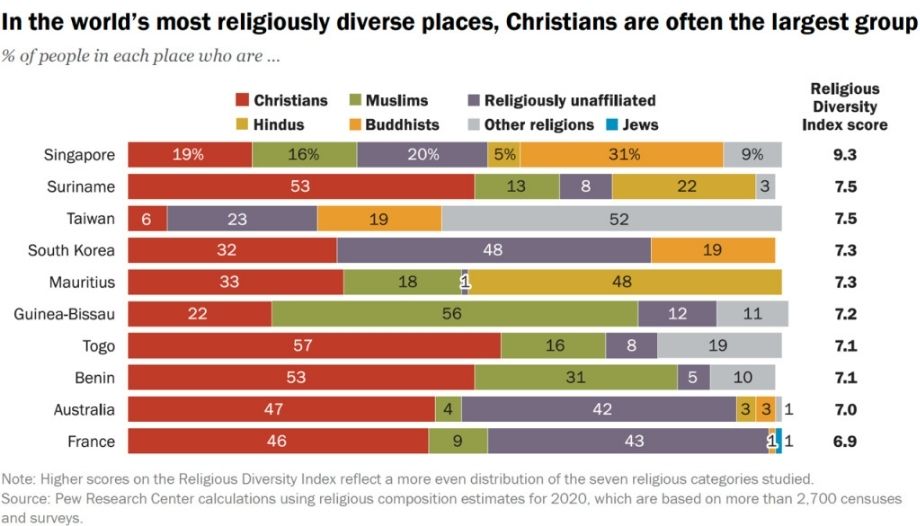
Most of the 10 most religiously diverse nations in the world are in the Asia-Pacific region (Taiwan, South Korea and Australia) or in sub-Saharan Africa (Mauritius, Guinea-Bissau, Togo and Benin). And Singapore is the most religiously diverse country on the planet in 2020, according to a new study of the Pew Research Center.
Buddhists (31%) are the largest religious group in Singapore, but its population also includes substantial proportions of people not affiliated with any religion (20%), Christians (19%), Muslims (16%), Hindus (5%), and followers of all other religions (9%), as can be seen in the graph.
France is the only European country in the top 10. Its population is mostly Christian (46%) and not affiliated with any religion (43%), with a sizeable Muslim minority (9%).
Seven categories in the Index of Religious Diversity (IDR), with 201 countries
The analysis The Pew Research Center divides the world's population into seven categories (Christians, Muslims, Hindus, Buddhists, Jews, followers of all other religions, and people with no religious affiliation). And it measures fairly how these groups are represented within each country or territory.
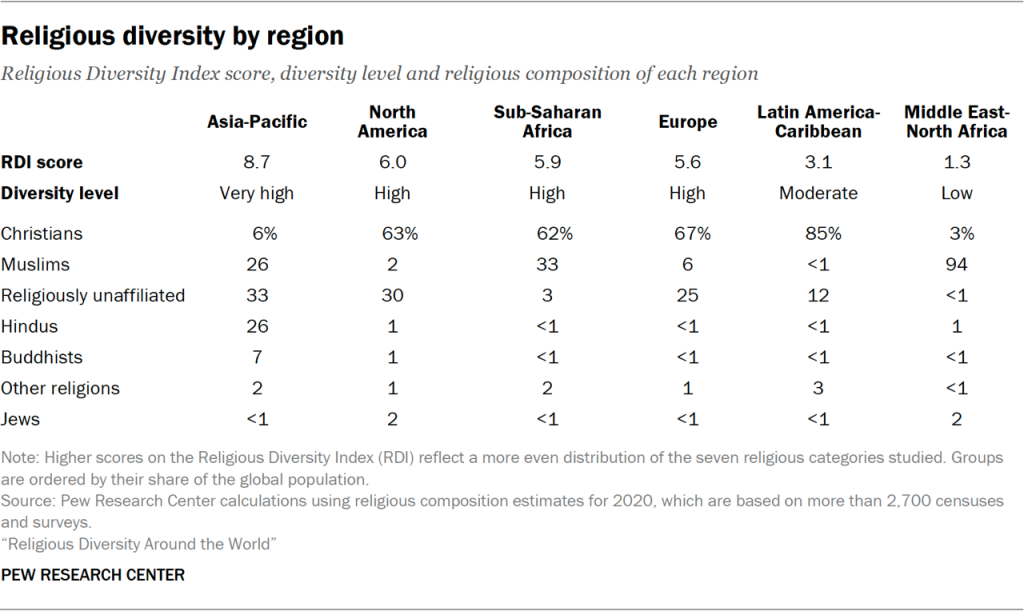
Pew has ranked a total of 201 countries and territories using its Religious Diversity Index (RDI). Possible scores range from 0 (for a country that has exclusively one religious group) to 10 (for a country with a perfectly balanced distribution of the seven groups, each representing approximately 14 % of the population).
With a score of 9.3, Singapore comes closer to an equal distribution of religious groups than any other country. By comparison, South Korea's score is 7.3, France's is 6.9 and the United States' is 5.8.
Suriname, Latin American country after Singapore
After Singapore, Suriname (capital Paramaribo), ranks second in religious diversity and is the only Latin American country in the top 10. Suriname is located in the north of South America and the Caribbean, has more than 633,000 inhabitants, and is the least populated independent country in South America.
Approximately half of Suriname's residents (53%) are Christians. The rest are Hindus (22%), Muslims (13%) and people with no religious affiliation (8%).
United States, the most diverse among the most populated countries
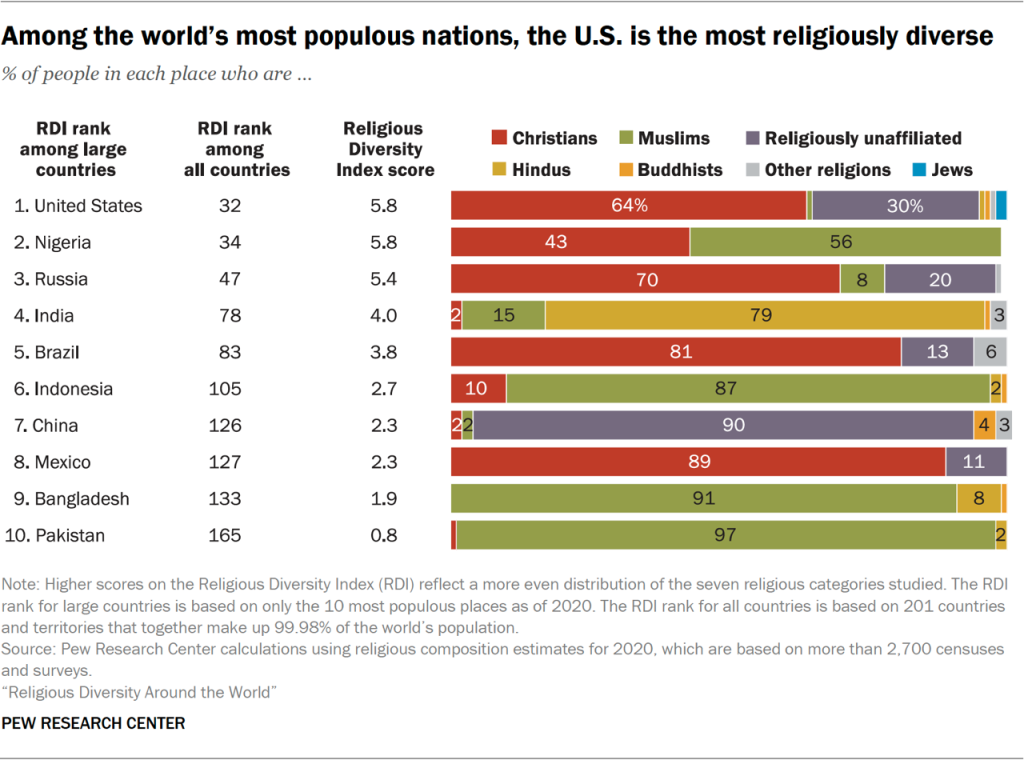
The United States is not among the top 10 most religiously diverse countries in the world (it ranks 32nd overall). However, if we consider only the 10 most populous nations, the United States ranks first in religious diversity, followed by Nigeria, Russia, India and Brazil, according to the report.
Christians are estimated to account for 64% of the U.S. population in 2020, while people with no religious affiliation account for about 30%. The remaining 6% are Muslims, Hindus, Buddhists, Jews, and people in the ‘other religions’ category, with each of these groups accounting for between 1% and 2%.
Muslims, majority in less religiously diverse countries
Nigeria is the second most religiously diverse of these large countries. Muslims and Christians, the largest groups in Nigeria, each represent more than 40% of the population.
Pakistan, where Muslims account for 97% of all residents, is the least religiously diverse of the 10 most populous countries.
Overall, Muslims account for at least 99% of the population in eight of the ten least religiously diverse countries and territories. The other two - East Timor and Moldova - have almost entirely Christian populations.
The IDR Index scores of the world's most populous countries span a wide range, from 5.8 in the U.S. to 0.8 in Pakistan. Together, these 10 countries account for nearly 60 % of the world's population.
European countries
In addition to France, mentioned above, the table Pew Research reflects the following rankings from most to least religious diversity in European countries. United Kingdom (12), Belgium (13), Netherlands (15), Germany (20), Sweden (22), Estonia (23), Switzerland (27), Luxembourg (33), Austria (40), Slovenia (43), Russia (47), Spain (53), and then Norway (56), and others.
Spain has, according to Pew, 69.5 percent of Christians, 3.6% of Muslims, 26.4% of unaffiliated, and the rest of religions, with a rate of less than 1 percent.
In 173 countries, two majority groups
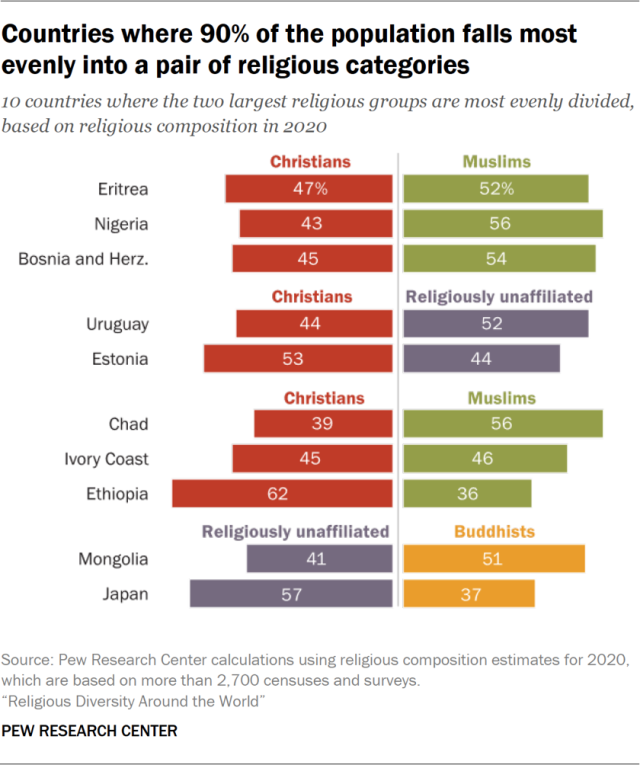
In 173 countries and territories, at least 90% of the population falls into only two of the seven religious categories cited above.
Eritrea ranks first on this measure, with an almost even split between Muslims (52%) and Christians (47%), as of 2020.
Nigeria and Bosnia and Herzegovina - second and third on the list, respectively - also have large proportions of Christians and Muslims.
Among the 10 countries with the most balanced religious composition, six have a division between Christians and Muslims. In the remaining four, the division is between Christians and unaffiliated (Uruguay and Estonia) or between Buddhists and unaffiliated (Mongolia and Japan).




 Español
  English
  Italiano