



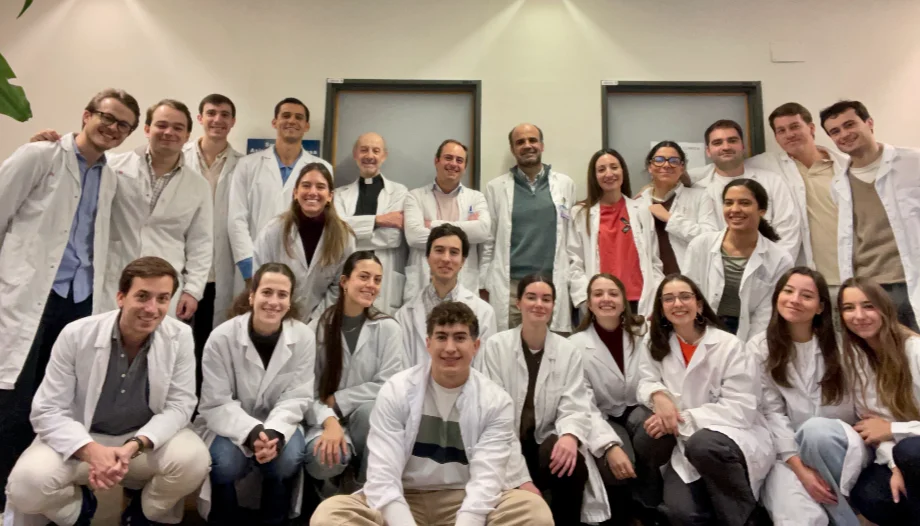
Ever since I left the hospital a few days after I was born in my mother's arms, I have tried as much as possible to avoid going back into one of them. I have not always succeeded. Since 2019 I go every Saturday morning I can, freely and on my own feet, to the Hospital Clínico San Carlos, aka “Elclínico”, all together.
The Clinic, which during the battle of the University City in the Civil War was the apex of the wedge of penetration of the national troops in the Republican Madrid, becomes for a few hours in a vertex of solidarity that goes beyond sides and ideologies. The same Hospital that was the scene of bloody fratricidal clashes - its position at the top of the university city was strategic for attackers and defenders - on Saturdays is the setting for a very human, very fraternal and, therefore, very Christian volunteer work, although sometimes even the volunteers themselves are unaware of it.
At that time, D. Hilario, a priest friend of mine, was the chaplain of the Faculty of Law at the Complutense and of the Castilla University Center that I directed. He began to go to the Hospital on Saturdays to help the chaplain on duty to distribute communion to the sick who requested it. A group of university students from the Catholic group of the Faculty began to accompany him and, months later, people from Castilla joined the accompaniment service that the Hospital Chaplaincy offered to patients.
The content of volunteering is very simple. It is about taking care of these people, listening to them, taking an interest in their lives, comforting them, encouraging them. It is surprising how dense and intense a human relationship can be in such a short time, how much good a smile, a different face, a detail of service can do.
Eventually a whatsapp group was formed with almost 600 participants, most of them university students or young professionals. Every Saturday of the year, vacations included, a group participates in this activity. From 3 members in August to 30 on Saturdays during the course.
This is not the time to make theoretical disquisitions on the difference between solidarity and Christian charity, or to discuss the limits of the social state. Jorge Bustos, in his book CASI, does it much better than I would be able to. What is clear is that Jesus, in the description of the Last Judgment in Matthew's Gospel, which Pope Francis has repeatedly encouraged us to consider, says “come, you blessed of my Father, for I was naked and you clothed me, sick and you visited me, in prison and you came to see me”. They should be, in the Pope's words, the Christian's identity card. It is not in vain that wherever Christianity has spread, hospitals, shelters, leprosaria, asylums, centers for people with disabilities... In general, institutions where, many times, those discarded by society have been treated as if they were Jesus Christ himself. At least, that has been the intention.
The motivations of the volunteers are very different: purely spiritual or Christian in some cases, philanthropic or humanitarian in others. In any case, I like to think that we are part of that “revolution of affection” to which the Pope called and which, in our case, begins on Saturdays at 11 o'clock at door G, next to the Emergency Room.
I have just published Stories that heal, The book contains a handful of stories and testimonials from chaplains, volunteers and nurses. They are not psychothrillers. There are no special effects. They are stories as real as they are simple, which I try to interpret from a Christian point of view. Sometimes I combine several stories in the same day to avoid repeating myself.
I hope that reading these pages will encourage many people to be revolutionaries of affection. That is my only intention. Time and the “Clinical Volunteers” whatsapp group will tell me if I have succeeded.
By courtesy of the author and the publisher, we offer a chapter with one of the stories.
AN ERITREAN MYSTIC
Martha is the first Eritrean-born person I know.
Ethiopia occupied it in 1952. Ten years later it declared it their province and the Eritreans responded with a war that lasted 30 years, the longest on the African continent. While Haile Selassie reigned in Ethiopia, the American government helped him fight the Eritreans and when Mengistu took power he was relieved by the Russians.
Martha was born in Asmara, the capital. I've never been there, but I trust Kapuncinski when in Ebony, a colorful chronicle of Africa, describes it as «beautiful, with Italian, Mediterranean architecture and a magnificent climate of eternal spring, warm and sunny. To save themselves from the napalm used by the Ethiopian army, Martha's compatriots built shelters, corridors and hiding places underground. In their subway state they had schools and hospitals, courts, workshops and armories.
The U.S. redeemed itself, at least partially, by taking in Martha's family as political refugees when she was 18. Now 50, she works as a social worker in Dayton, Ohio, where the weather is not eternally spring-like, but they don't usually drop napalm either. Everything has its pros and cons.
In August 2024 he came to Spain on vacation with his family. Shortly after arriving, she began to feel sick. They thought it was travel fatigue, jet lag or a change in his diet. He went to the emergency room and was admitted. He was diagnosed with metastatic melanoma. One of his sisters stayed in Madrid and the rest of the expedition, composed of other siblings and a sister-in-law, returned home.
I imagine Martha walking through those subway tunnels of her country. At a bend in the road she makes a mistake, the GPS goes crazy, the map twists on itself. She ends up dragged by the force of fate, of hardship, of pain, towards another tunnel, the one that the militiamen drilled under the Clinic to blow up the wing occupied by the rebels, and she ends up in the room where she is now wondering how she could have ended up there.
When we walked in, a nurse, who speaks neither English nor Eritrean, was trying to find out how long she had been admitted.
-Two months," Martha tells us in a voice that sounds like a sunset breeze.
She is sitting in a smurf blue skyblue armchair, with two pillows behind her back and a towel over her knees. A bandage covers part of her left arm and on her right wrist she wears a white strip of paper with her name and patient number. She is perhaps the first Eritrean patient to visit the Clinic and she has been awarded a distinction.
Martha has the physique of a marathon runner. It seems that at any moment she could take off running, freeing herself from the blue robe that envelops her, and reach the Casa de Campo, to join one of the groups of athletes who at this time of the day train on the tracks. However, her recent physical activity is reduced to a short walk she took the day before, supported by a volunteer.
Martha smiles. In doing so, she shows perfect white teeth that stand out against her black complexion. If smiling had therapeutic effects, she would have long since healed and returned to Dayton to stroll through the Hills & Dales MetroPark, which is 45 minutes from her home.
Martha is an evangelical.
-I am not afraid of death. The love of Jesus is stronger than death. If I die, I go with Him, otherwise He is still by my side," she says, smiling.
María and Miguel, a psychologist from Madrid and a Chilean ADE student who are accompanying me this Saturday for the first time, stare at me and blink.
If St. Justin had come with us that morning to volunteer -something complicated considering that he died a martyr in the year 168, far from the Cerro del Pimiento where we are -, he would have recognized in those words something more than the seeds of the Word of which he spoke. We were before mature fruits of the Word, of the second person of the Holy Trinity, in the soul of a non-Catholic woman.
Martha smiles again and adds:
-Behold the lamb of God....
I have a little trouble understanding Ohio English spoken by a native Eritrean, but I recognize the phrase: This is the Lamb of God who takes away the sin of the world.
-Martha, we Catholics repeat that phrase every time we go to Mass. You are almost catholic," I tell her.
-The blood of Christ cleanses us, purifies us," he continues, smiling again.
We are witnessing the revelations of a mystic; perhaps the first Eritrean mystic - from Asmara, to boot - in the history of Christianity who, at the age of 18, settled in Dayton, fleeing a war that was ravaging her country.
In her fragile and broken body she is the embodiment of faith and trust in God.
There is a knock at the door and her sister with an unpronounceable name enters. They look very much alike although she has more hair and is not as thin.
-The volunteers are our Spanish family. You are so kind! We are so grateful.
It is almost one o'clock and the orderly arrives with food for the two sisters. A smell of baked apples pervades the room. We promise to come back next week. Maybe I'll ask her for the bracelet and keep it with an heirloom before she leaves the hospital and returns to her village.
It took me three weeks to get back. At the check-in desk I met the same nurse who spoke neither English nor Eritrean, not even one of them even with an accent of the other.
-Martha was discharged on Thursday. She's going home. Don't kid yourself, though, she's going back to what she's going back to..." she says as she manipulates a plasma bag and adjusts the frame of her glasses on her nose.
Perhaps Martha will not run marathons, nor will she ever again walk among the white and red oak trees in the park she loves so much, but she is an athlete of God. As St. Paul said of himself, she has fought the noble fight, she has reached the goal - she is on the verge, at least, of reaching the definitive one, before which all the others are only partial, ambulatory - she has kept the faith.
Stories that heal

Lawyer and writer




 Español
  English
  Italiano