



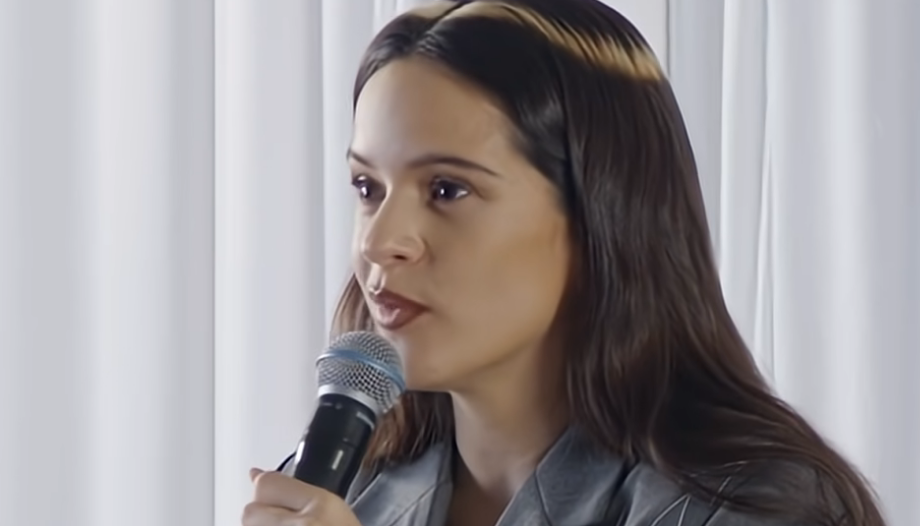
This is not some hack writer's thesis on the possible spiritual renaissance that is being predicted. Nor is it an advertisement for a podcast. It is a brief, and therefore subjective, selection of some of the ideas expressed by the four guests on the ViOne channel's program ‘Contrapoder.’ The episode lasts 1 hour and 43 minutes.
The presenter, Carlos Padilla, introduced the topic. What is happening? This is happening: there are artists who talk about God, films that touch on vocation, influencers who are approaching faith, and ’empty’ young people who are asking themselves questions again. This is no small thing, although the word has already come to the fore. mirage….
The panel analysts were unanimous: talking about “Catholic fashion”, a concept that is being put on the table, can be misleading. Here are some of his thoughts on the phenomenon.
1. Avoid the trap of calling Christian things “trendy.”
Writer and columnist Juan Manuel de Prada points out: “The Catholic faith has always been opposed to fads.” Therefore, if we talk about a resurgence of interest in religion, we should not do so in a superficial way: “If there is a Catholic fad, it is a falsification, a trivialization, a conversion into sentimental or pop merchandising.”.
For De Prada, insisting on the word “fashion” serves to defuse any possible real awakening, diluting it into the ephemeral. “Those who don't want this to prosper turn it into a trend to kill it before it's even born,” he warns.
“I'm a huge fan of Rosalía,” says Almudena C. Domper, a journalist specializing in corporate communications. “When asked if she's a fad, I think that if she is a fad, it will end soon, like all fads. But at the same time, I agree that she can't be just any fad.».
2. There is a spiritual restlessness, a thirst for transcendence, among some young people.
Although Juan Manuel de Prada rejects the attribution of “fashion” to the phenomenon, he acknowledges that “in alert sectors of youth, there may indeed be a vague desire to recover a religious tradition.” They are minorities, he stresses, because “the vast majority are subjugated by systemic slogans.” But this concern is real. In his opinion, “there is a greater need for God and a spiritual life; I believe that this is beyond any doubt.”.
Alejandro Rodríguez de la Peña, professor of medieval history at CEU, shares this analysis from his perspective. “There is a void, a disenfranchised youth, and that void must be filled. So, it can be filled in many ways.”.
3. There are precedents: this phenomenon has occurred before in various countries.
Professor Rodríguez de la Peña recalls that “in 1820-30 and 1920-30 there were already Catholic revivals in Europe: in France, as a reaction to revolutionary secularism, and in England with the Catholic Renaissance.” Each era, he explains, experiences these movements in a different way: back then, they were literary circles; today, they are media presence, social networks, or mainstream artists “who indicate that there is a market for the spiritual.”.
But the historian emphasizes a crucial point: all those past renaissances eventually disappeared. “If you look at what remains of the English Catholic Renaissance... nothing.”.
4. Identify the risks: identity politics? Fragility?
Rodríguez de la Peña warns that part of this resurgence may be linked to identity phenomena influenced by American “Christian nationalism,” where religion becomes a cultural symbol rather than necessarily a search for truth.
Almudena C. Domper adds: “It may have become cool to think about the human side of spirituality.” But a spiritual trend is just as fragile as any cultural trend: “How much does drinking matcha really mean to you, deep down?”.
Of course, what is described in this does not seem fragile. article: “The film (‘Los Domingos’) approaches the experience of faith, dealing with God “like a husband, like a boyfriend”, that is, in a real way. And it does so from the outside, but with a delicacy, dignity, respect—and perhaps a touch of wonder—that makes it completely believable.”.
5. Change is real: religion returns to the public square
Julio Llorente, journalist and writer, sees the fact that religion is once again part of public discourse as a positive sign: “In previous decades, religion was confined to places of worship. Today, it is discussed naturally.”.
“I will focus on Rosalía's album and ‘Los Domingos,’ because I think they are a good sign. We were talking about marketing effectiveness. Indeed, the fact that the Catholic religion is now considered a marketing strategy is a good sign. I wouldn't give Rosalía's album or the movie Los Domingos, which I liked, by the way, any more importance than they deserve. I enjoyed it very much.‘.
Phenomena such as Rosalía or Los Domingos function more as cultural indicators than as causes. ‘I don't know if there are mass conversions. I suspect not. But I do believe there is fertile ground,’ says Llorente.
“Rosalía has always talked about God,” says Almudena C. Domper. “But she has made an album that is clearly focused on the idea of God or spirituality. She has publicly stated that she has been studying the saints of the church for a year and a half, quoting thinkers, etc. She has been talking about the subject since 2017.”.
6. Distinguish between authentic conversion and superficial experiences
The speakers agree that many current approaches to Christianity are emotional or aesthetic. Julio Llorente observes “religious tourists”: people who attend worship services or events seeking inner peace without understanding that “the purpose of Christian life is not tranquility, but truth, which can be uncomfortable.”.
Along similar lines, Juan Manuel de Prada insists: “The Catholic faith is a persuasion of reason. It cannot be reduced to feelings.” And he warns against copying highly emotional evangelical models: “They are cheap imitations.”.
7. Back to basics: faith is transmitted from heart to heart
Here, the speakers are in complete agreement. Julio Llorente reflects: “Should we place our evangelizing hopes in the mainstream media, or should conversions be from heart to heart?”.
Juan Manuel Prada says: “Jesus Christ could have invented the telephone, television, or social media, but he didn't. He made it clear that faith is transmitted from heart to heart.”.
For the columnist, no digital strategy can replace personal encounters. The Church, he says, has always grown this way. On the other hand, he comments that any spiritual rebirth requires strong, even heroic witnesses: “The mortar of religious conversion is witness. Martyr means witness.”.
8. Rebuilding community fabric: without community, faith fades away
Rodríguez de la Peña is particularly clear: “The Christian faith is lived in community. The sniper will be here for a few years and then he will leave.”.
He put it this way: “It is clear that the Christian faith is lived in community. So, the sniper, the paratrooper, the tourist, will stay for a few years and then leave. Why? Because either you live the Catholic faith, which cannot be lived in any other way, in a community, whatever that may be, a parish, a movement... whatever each person chooses, or the faith dies.”.
In his opinion, Spain lacks an ecclesiastical structure to welcome young people who are approaching the faith for the first time.
9. Understand that digital technology helps... but it is not enough.
Although everyone agrees that faith cannot be reduced to the digital realm, Almudena C. Domper points out a significant fact: “Bible sales in the United Kingdom have risen by 611% in five years.” She adds: “There are real digital communities. They are not a panacea, but they are bringing many people closer together.”.
The speakers acknowledge that these tools can be a first step, provided that they lead to what is truly essential: sacramental life and human accompaniment.




 Español
  English
  Italiano