



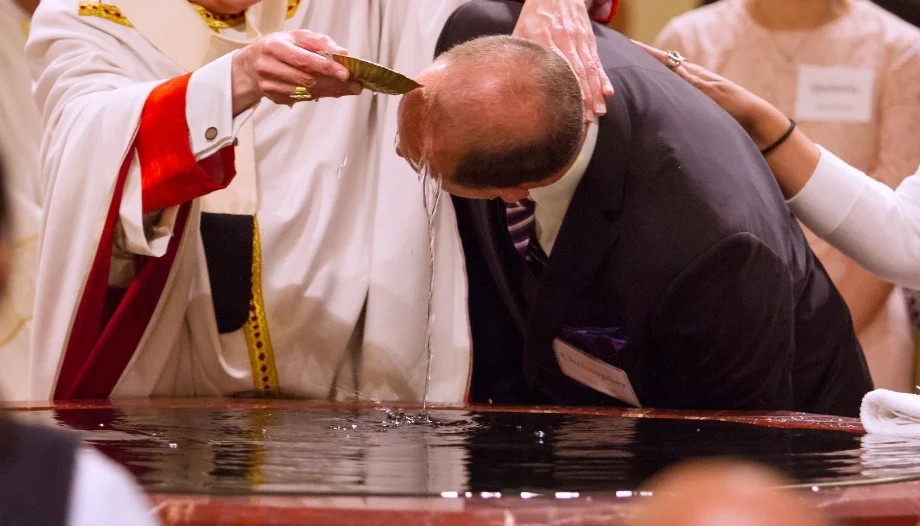
The number of adults being baptized in Spain is also growing (13,000). Catholic educational institutions save the state €5.067 billion, and almost four million people benefited from the church's charitable activities. These are some of the representative data from the 2024 Activity Report presented by the Episcopal Conference.
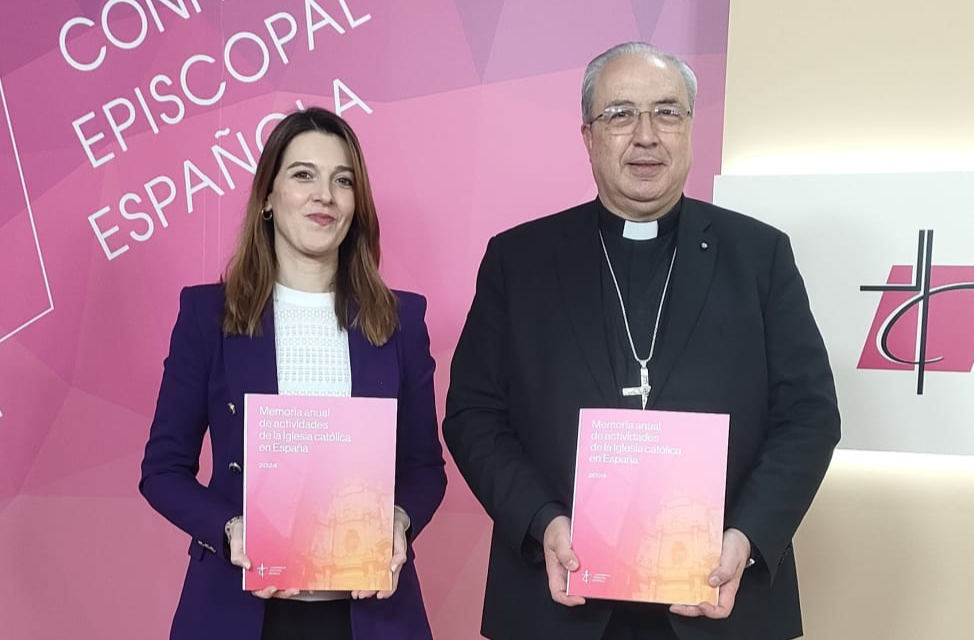
The Church is the largest face-to-face social network in our society, according to the 2024 Activity Report of the Spanish Episcopal Conference (CEE), presented at a press conference on November 11 by the secretary of the Conference, Monsignor César Francisco García Magán, and Ester Martín, director of the Conference's Transparency Office.
The Report is an “exercise in transparency and truthfulness towards the Catholic faithful, society, and institutions,” said Monsignor García Magán. There are quantitative data, such as the more than eight million people who regularly attend Sunday Mass, and other purely economic data, such as the fact that for every euro spent by the Church in its pastoral, social, and cultural mission, €1.65 is generated in the Spanish economy.
Participation in the sacraments
Among the data collected in the 2024 Report is the figure of 8.23 million people (over the age of 10) who regularly attend Mass on Sundays, representing a slight increase of 0.3% over last year's figure.
These figures highlight the 13,323 baptisms of adults, i.e., people over the age of 7, with an upward trend in recent years. This phenomenon is also recorded, in greater proportions, in European countries such as France and Belgium. «It should be noted that in Spain the number of child baptisms is much higher in comparison to the total than in those other countries,» Monsignor García Magán pointed out. In total figures, the report records 146,370 baptisms last year, compared to 152,426 the previous year.
In the area of sacrament administration, there was a slight overall decline in 2024: there were 154,677 first communions (162,580 in 2023), 103,535 confirmations (107,153 in 2023), 31,462 marriages (33,500), and 26,013 anointings of the sick (26,120).
This decline may be influenced, among other reasons, by the falling birth rate in Spain, according to Martín: «This is reflected in the number of people receiving the sacraments,» he said.
In terms of «human resources,» according to the report, in addition to the 8.2 million faithful who regularly practice their religion, there are 14,994 priests in Spain; 31,503 religious men and women (7,449 of whom are cloistered monks and nuns), 9,648 missionaries, and 1,036 seminarians, «with an increase in numbers,» according to the secretary of the CEE. In addition, there are 122 bishops, including emeritus bishops. There are 82,106 catechists and 34,494 religion teachers who contribute to spreading the Christian message.
Money matters
Among the economic figures, the Report highlights how the Church's expenditure on its activities is financed entirely by the faithful and taxpayers. The expenditure of the diocesan Church in Spain amounts to €1.428 billion, which is four times more than the amount contributed by the tax allocation.
In the words of the CEE secretary, this tax allocation is «an exercise in fiscal democracy. It is what taxpayers decide by marking the X on their tax returns. No one is forced to do so.».
Thus, in 2024, dioceses received €326.5 million through tax allocations. Another €399.7 million came from voluntary contributions from the faithful (direct donations, regular subscriptions, or other); €168 million from property income; and another €424.5 million from other current income, such as various types of subsidies and activities. Added to this is €66.6 million in extraordinary income from property and capital gains.
Ester Martín emphasized that the section on regular contributions from the faithful has grown by 11%.
Of the diocesan expenditure, 236 million (19 percent of the total) was devoted to pastoral and welfare activities in dioceses and parishes; 197 million (16 %) to priests' salaries; 257 million (20 %) to lay staff in dioceses; 35 million (3 %) on training centers, and the largest item, 419 million (33 %) on operating expenses and buildings. Added to this are 117.6 million in extraordinary expenses (new churches and others). The dioceses have increased the amount directly allocated to welfare activities by almost 7 million euros.
The activities carried out by Church entities have a socioeconomic impact on key sectors of the economy. Thus, for every euro spent by the Church in order to fulfill its pastoral, social, and cultural mission, €1.65 is generated in the Spanish economy, according to the report.
Savings on education
According to Ester Martín, the 2,527 Catholic schools represent savings for the state of €5.067 billion per year, with an increase of 30% over the last four years. These schools are attended by 1,482,503 students. More than 100,000 of them have participated in catechism groups, faith formation, and volunteer work.
In addition, there are 336 diocesan schools in Spain, with nearly 150,000 students.
In terms of charitable activity, four million people received assistance from the Church in more than 9,000 health and welfare centers. In the field of health, the 972 health centers, hospitals, outpatient clinics, and nursing homes took in 1,330,128 people.
Care centers account for the largest share, with 8,088 centers helping 2,482,107 people. Most of these centers focus on fighting poverty, with 6,282 centers serving nearly two million people. Other assistance centers aim to promote employment, assist immigrants and refugees, defend life and the family, rehabilitate drug addicts, and promote and protect women, among other goals.
In addition, the Prison Ministry has 159 chaplains and 2,047 volunteers who provide essential human and spiritual assistance in the chaplaincies of 84 prisons and 87 shelters. They maintain 1,237 religious, social, and legal assistance programs.
In this welfare activity, it is worth noting that 52,000 direct jobs have been created by the dioceses and the Episcopal Conference.
Heritage
The Catholic Church has had a decisive influence on Spanish culture. Proof of this can be found in the 3,161 cultural assets belonging to the Church. There are also, for example, 287 diocesan, parish, and religious museums. The Church takes care of this rich heritage, and to this end, in 2024, the dioceses allocated €91.2 million to 842 projects for the construction and conservation of buildings and monuments.
The Activity Report also highlights the impact of the Church on religious celebrations and festivals. In addition to the million members of religious brotherhoods in Spain, there are 171 Holy Week celebrations declared to be of tourist interest, out of a total of 426 religious celebrations and festivals such as pilgrimages and processions.
There are 638 shrines in Spain, including not only those that are emblematic due to their number of visitors, such as Montserrat, El Pilar, Caravaca de la Cruz, and Torreciudad, but also other smaller ones located in humble villages. In this regard, it is also worth mentioning the Camino de Santiago, which attracted 499,183 registered pilgrims last year.
The data from the 2024 Activity Report is available at the web of the Episcopal Conference and in that of the Transparency Portal.




 Español
  English
  Italiano