




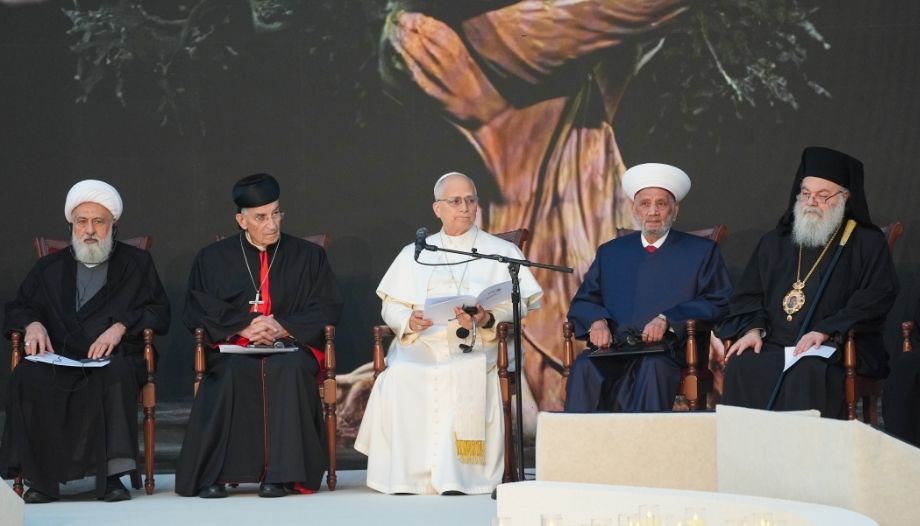
In the presence of a Sunni leader, a Greek Orthodox leader, a Shiite leader, a Syrian Orthodox leader, a Druze leader, an Armenian Orthodox leader, a Protestant leader, and an Alawite leader, the Pope praised Lebanon this afternoon. He did it. On Sunday, upon his arrival in Beirut, before the country's president and representatives of Lebanese society, and he repeated it again today, alongside leaders of religious traditions.
The Pope was welcomed this afternoon in a large tent in Martyrs' Square by the Syrian Catholic Patriarch, the Maronite Patriarch, the Sunni Grand Imam, and the Shiite Representative. They all witnessed how Leo XIV gave the olive tree, symbol of reconciliation and peace, the leading role in the meeting.
Intertwined with songs from a large children's choir, the leaders spoke about unity, openness, coexistence, and respect, until Pope Leo XIV placed the olive tree in the center.
Olive tree, symbol of reconciliation and peace
While Lebanon is famous for its majestic cedars, “the olive tree also represents a cornerstone of its heritage,” said the Pope. The olive tree not only adorns the space where we gather today, but “is also praised in the sacred texts of Christianity, Judaism, and Islam, serving as a timeless symbol of reconciliation and peace.”.
Their longevity and remarkable ability to flourish even in the most challenging environments “symbolize resilience and hope, as well as the constant commitment necessary to cultivate peaceful coexistence,” emphasized Leo XIV.
“From this tree comes a healing oil, a balm for physical and spiritual wounds, expressing God's infinite compassion for all who suffer.” In addition, «the oil also provides light, evoking the call to illuminate our hearts through faith, charity, and humility.».
Peacebuilders
The Lebanese people are scattered throughout the world, but united by the enduring strength and eternal heritage of their homeland, recalled Leo XIV.
«Your presence, here and throughout the world, enriches the earth with your ancient heritage, but it also represents a vocation. In a global world that is increasingly interconnected, you are called to be builders of peace: to combat intolerance, overcome violence, and eradicate exclusion; illuminating the path toward justice and harmony for all through the witness of your faith,” he said.
At the outset, the Pope acknowledged that he was “deeply moved and immensely grateful to be among you today, in this blessed land, a land exalted by the prophets of the Old Testament.”.
The universal vocation of the Church: dialogue with other religions
Then, the Holy Father quoted in his speech Pope Benedict XVI, who in his post-synodal Apostolic Exhortation ‘Ecclesia in Medio Oriente,’ signed in Beirut in 2012, emphasized that “the nature and universal vocation of the Church require that she be in dialogue with members of other religions.”.
“This dialogue in the Middle East is based on the spiritual and historical bonds that unite Christians with Jews and Muslims. This dialogue, which is not primarily dictated by pragmatic considerations of a political or social nature, is based above all on theological foundations that challenge faith» (n. 19).
Minarets next to church steeples
Then Pope Leo told the leaders that «your presence here today, in this extraordinary place where minarets and bell towers stand side by side, both rising toward the sky, bears witness to the unshakeable faith of this land and the steadfast dedication of its people to the one God.”.
«In this beloved land, may every bell and every adhān ring out together; may every call to prayer merge into a single hymn, raised not only to glorify the merciful Creator of heaven and earth, but also to implore from the heart the divine gift of peace.”.
How to overcome concerns about the Middle East
For many years, and especially in recent times, “the world has fixed its gaze on the Middle East, the cradle of the Abrahamic religions, observing the arduous path and the tireless search for the precious gift of peace,” Leo XIV had said at the beginning.
“Humanity sometimes views the Middle East with fear and discouragement, given such complex and protracted conflicts. However, amid these struggles, we can find hope and encouragement by focusing on what unites us: our common humanity and our faith in a God of love and mercy.”.
At a time when coexistence may seem like a distant dream, “the Lebanese people, despite professing different religions, are a powerful example: fear, mistrust, and prejudice do not have the final say, while unity, reconciliation, and peace are always possible.”.
Virgin Mary, Mother of Jesus and Queen of Peace
The Pope concluded by recalling “March 25 of each year, a national holiday in your country,” on which “you gather to honor Mary, Our Lady of Lebanon, venerated in her Shrine at Harissa, adorned with an imposing statue of the Virgin with open arms, embracing the entire Lebanese people.”.
“May this loving and maternal embrace of the Virgin Mary, Mother of Jesus and Queen of Peace,” Pope Leo XIV prayed, “guide each one of you, so that in your homeland, throughout the Middle East and throughout the world, the gift of reconciliation and peaceful coexistence may flow «like rivers flowing from Lebanon,» (cf. Song of Songs 4:15), bringing hope and unity to all.».




 Español
  English
  Italiano