



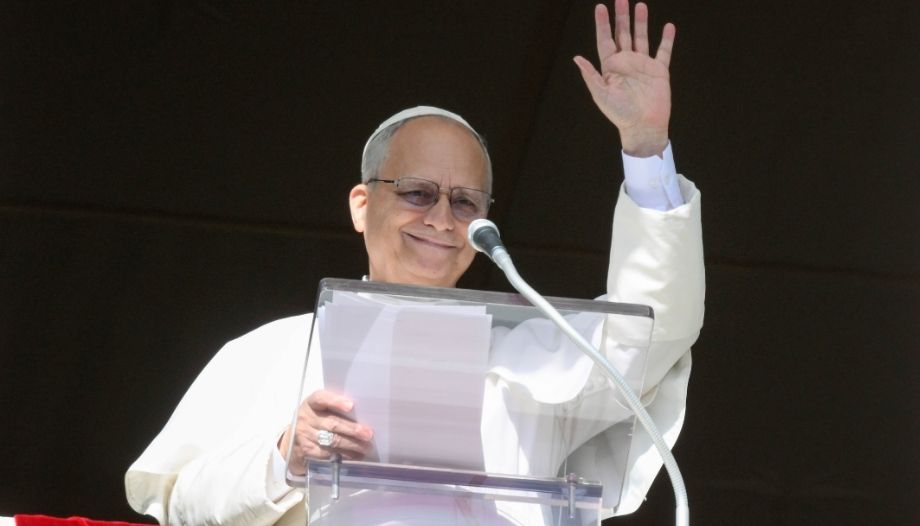
On the third Sunday in Ordinary Time, Word of God Sunday, instituted by Pope Francis seven years ago, the Pope recalled “next to the mortal remains of the Apostle of the Gentiles, that his mission is also the mission of all Christians today: to proclaim Christ and invite everyone to trust in him”.
During the celebration of Vespers for the conversion of St. Paul the Apostle, the last day of the Week of Prayer for Christian Unity, the Pontiff wanted to make an appeal to the Church's evangelizing mission. He did so with reference to the Second Vatican Council and his own words at the beginning of his Pontificate in May 2025.
Vatican II: “to proclaim the Gospel to every creature”.”
At the beginning of the Constitution on the Church, the Second Vatican Council “declared its ardent desire to proclaim the Gospel to every creature (cf. Mc 16,15). And thus “to enlighten all people with the light of Christ that shines on the face of the Church» (Dogmatic Constitution on the Church in the Modern World). Lumen Gentium, 1)”.
“It is the common task of all Christians to say to the world, with humility and joy: “Look to Christ, draw near to him, accept his word that enlightens and comforts” (Homily at the Mass of Inauguration of the Pontificate , May 18, 2025).
At the Angelus, with the example of Jesus
These words are very similar to those he used in the Angelus in the morning, which took place in St. Peter's Square, encouraging Romans and pilgrims to proclaim the Gospel, and “not to remain closed in”. And he gave the example of Jesus himself.
“The evangelist tells us that Jesus began his preaching ”when he heard that John had been arrested.” This occurs, therefore, at a time that does not seem ideal: the Baptist has just been arrested, and therefore, the leaders of the people are reluctant to welcome the news of the Messiah.
“Overcoming internal resistance or unfavorable circumstances.”
It is a moment that would suggest caution, the Pope reflected, “but precisely in this dark situation Jesus begins to bring the light of the good news: ‘The kingdom of heaven is at hand.’.
“Even in our personal and ecclesial life, sometimes due to internal resistance or circumstances that we consider unfavorable, we think that it is not the right time to proclaim the Gospel, to make a decision, a choice, to change a situation.”.
However, Leo XIV has stated that “the risk is to remain stuck in indecision or imprisoned by excessive caution. Whereas the Gospel invites us to take the risk of trust. God works at every moment, and every moment is good for the Lord, even if we feel unprepared or the situation does not seem ideal.”.
Prayer for Christian Unity: Commitment to Mission
Returning to the homily of the evening Mass, the Pope recalled that “the Week of Prayer for Christian Unity calls us each year to renew our common commitment to this great mission. Aware that the divisions among us, while not preventing the light of Christ from shining, nevertheless obscure the face that should reflect it in the world”.
Drive towards full unity
As usual, references to the unit Pope Leo's words have been constant. “In the passage from the Letter to the Ephesians, chosen as the theme of this year's Week of Prayer, we repeatedly hear the word “one”: one body, one Spirit, one hope, one Lord, one faith, one baptism, one God (cf. Ef 4,4-6)”.
“Dear brothers and sisters, how can we not be deeply moved by these inspired words? How can our hearts not burn with their impact?” the Pope asked.
And their response was: “Yes, ‘we share the same faith in the one God, the Father of all men; we confess together the one Lord and true Son of God, Jesus Christ, and the one Holy Spirit, who inspires and impels us towards full unity and common witness to the Gospel’ (Apostolic Letter In unitate fidei, We are one! We already are! Let us recognize it, let us experience it, let us manifest it!.
2033, the 2000th Anniversary of the Passion, Death and Resurrection of the Lord Jesus
In the Basilica of St. Paul Outside the Walls, the Holy Father Leo XIV recalled that “my beloved predecessor, Pope Francis, observed that the synodal journey of the Catholic Church “is and must be ecumenical, just as the ecumenical journey is synodal”.
This was reflected in the two Assemblies of the Synod of Bishops in 2023 and 2024. And “as we look forward to the 2000th anniversary of the Passion, Death and Resurrection of the Lord Jesus in 2033, let us commit ourselves to further develop ecumenical synodal practices and to communicate to one another who we are, what we do and what we teach (cf. For a synodal Church, 137-138).
Thanks to Cardinal Koch and Christian Church leaders
In concluding, the Pope “cordially greeted Cardinal Kurt Koch, the members, consultors and staff of the Dicastery for Promoting Christian Unity, as well as the participants in the theological dialogues and other initiatives promoted by the Dicastery.”.
In particular, he thanked for the presence at this Liturgy of “numerous leaders and representatives of the various Churches and Christian Communions of the world, in particular Metropolitan Polykarpos, representing the Ecumenical Patriarchate, Archbishop Khajag Barsamian, representing the Armenian Apostolic Church, and Bishop Anthony Ball, representing the Anglican Communion”.
Courageous testimony of the Armenian people
With deep gratitude, the Holy Father recalled “the courageous Christian witness of the Armenian people throughout history, a history in which martyrdom has been a constant”. Tradition bears witness to Armenia's role as the first Christian nation, with the baptism of King Tiridates in 301 by St. Gregory the Illuminator, the Pope said.
“As we conclude this Week of Prayer, we remember the Catholic saint St. Nerses Shnorhali, ‘the Merciful,” who worked for the unity of the Church in the 12th century.” He was ahead of his time in understanding that the search for unity is a task of all the faithful and requires the healing of memory.
St. Nerses can also teach us the attitude we should adopt on our ecumenical journey, as my venerable predecessor, St. John Paul II, reminded us”, the Pope said: “‘Christians must have the deep inner conviction that unity is essential not for strategic advantage or political gain, but for preaching the Gospel”" (Homily at the Ecumenical Celebration, Yerevan, 26 September 2001).




 Español
  English
  Italiano