


Leo XIV's first trip outside Italy had two mottos: One Lord, one faith, one baptism (Turkey, November 27-30) and Blessed are the peacemakers (Lebanon, November 30–December 2).
In both places, it is worth asking yourself about the what and the how of his thoughtful and unifying, yet incisive message, addressed not only to Christians, but to the entire population and to the heart of each individual, without ignoring the problems.
The Pope said in Ankara: “The occasion of this trip, the 1700th anniversary of the Council of Nicaea, speaks to us of encounter and dialogue, as does the fact that the first eight ecumenical councils were held in the lands of present-day Turkey.
In Beirut, he proposed “bear witness to the enduring truth that Christians, Muslims, Druze, and many others can live together and build a country united by respect and dialogue".
“Only together are we ourselves.”
Upon his arrival in Turkey (where Christians represent only 0.3% of the population), Leo XIV met with the authorities at the presidential palace in Ankara (cf. Speech, 27-XI-2025). He pointed out that a society is alive if it is pluralistic, if it overcomes the polarizations that today threaten and fragment human communities.
That is why it is necessary to overcome the “false logic” that emphasizes the distinctions between religions and communities of believers and choose, instead, the “culture of encounter” between the different sensibilities of Turkish identity. Otherwise, we would be adding to the “globalization of indifference,” which Pope Francis opposed from the heart of the Mediterranean.
For this reason, and because we are all children of God, compassion and solidarity must be considered criteria for development. We all form the “human family,” like a bridge (an image that is recurring these days, due to the bridges that connect Europe and Asia via Turkey) that unites our destinies and experiences.
"However –warned the Bishop of Rome–, It is not from an individualistic culture, nor from contempt for marriage and fertility, that people can obtain greater opportunities for life and happiness.".
This is a deception perpetrated by consumerist economies; because, he added with special reference to family life and the contribution of women, “Only together can we truly become ourselves. Only in love can we deepen our inner selves and strengthen our identity. Those who despise fundamental bonds and do not learn to accept even their limitations and fragilities become more easily intolerant and incapable of interacting with a complex world.".
The “smallness” and Christocentrism of faith
The following day, a prayer meeting was held with the clergy, consecrated persons, and pastoral workers (cf. Speech at the Holy Spirit Cathedral, Istanbul, November 28, 2025).
From Ur of the Chaldeans, Abraham traveled to southern Turkey (present-day Harran) and set out for the Promised Land. Christian communities lived in the lands of present-day Turkey during the time of the apostles and the Church Fathers. Today, the Catholic community is small, but God has chosen the path and logic of smallness..
“Therefore, I encourage you to cultivate a spiritual attitude of confident hope, founded on faith and union with God.”Signs of this path, already underway, are pastoral care for young people, ecumenical and interreligious dialogue, the transmission of faith to the local population, and pastoral service to migrants and refugees.
On the occasion of the 1700th anniversary of the First Council of Nicaea, Leo XIV issued three challenges. First, “embrace the essence of Christian faith and being. That is, “always seek, even within different perceptions, spiritualities, and cultures, the unity and essentiality of the Christian faith centered on Christ and the Tradition of the Church".
Second, rediscover in Christ the face of God the Father, without falling into the temptation of Arianism, which reduces Christ to his human form. Finally, the mediation of faith and the development of doctrine. Thanks to the First Council of Nicaea and the First Council of Constantinople, the faith was deepened and the Symbol (Creed) that we pray today in Sunday celebrations was established.
The latter, the Pope observed, teaches us the lesson that “It is always necessary to mediate the Christian faith in the languages and categories of the context in which we live.”, distinguishing “the core of faith from the historical formulas and forms that express it, which are always partial and provisional”As Newman explained, this is the “internal development of a living organism, which brings to light and better explains the fundamental core of faith".
Christian unity, universal brotherhood, witness of Catholics
On the same day, November 28, the Pope presided over an ecumenical prayer meeting near the archaeological excavations of the ancient basilica of St. Neophytus in Iznik. He emphasized the temptation of Arianism: “the risk of reducing Jesus Christ to a kind of charismatic leader or superman, a misrepresentation that ultimately leads to sadness and confusion". "But –argued– If God did not become man, how can mortals share in his immortal life? This was at stake in Nicaea and is at stake today: faith in the God who, in Jesus Christ, became like us so that we might ‘share in the divine nature.’ (cf. 2 Peter 1:4),” as St. Irenaeus and St. Athanasius emphasized.
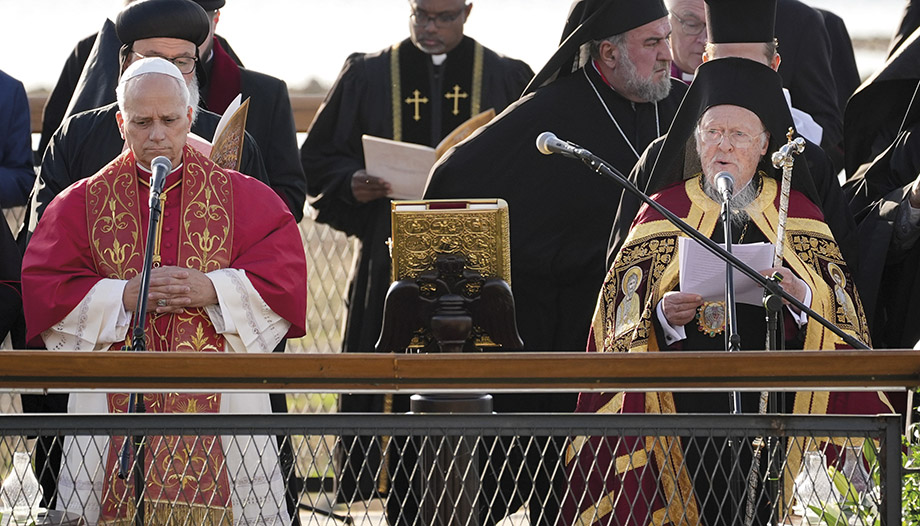
In fact, the following day he met with Bartholomew I, Ecumenical Patriarch of Constantinople, and together they signed a joint declaration recognizing in the Nicene Creed the faith that unites us, 60 years after a similar declaration signed by Paul VI and Athenagoras.
On Saturday, November 29, Mass for the first Sunday of Advent was held in Istanbul. During the celebration (cf. Homily at the Volkswagen Arena, 29-XI-2025), Peter's successor illustrated two “images” of our being Church, suggested by the liturgy of the day: the “high mountain on top of the mountains” (cf. Is 2:2) and “a world where peace reigns”(cf. Is 2:4). He proposed the witness of holiness (through vigilance over ourselves and the cultivation and living of faith through prayer, the sacraments, and charity) as a source for promoting unity in the Catholic community, in ecumenical relations, and in encounters with brothers and sisters of other religions.
Along these lines, the following day (cf. Address at the conclusion of the Divine Liturgy, On November 30, 2025, in the Patriarchal Church of St. George (Istanbul) and before the bishops of the Ecumenical Patriarchate, Leo XIV proposed renewing efforts to build peace, combat the ecological crisis, and use new communication technologies responsibly.
The anchor and the cedars, the coin and the rose
In Lebanon, Pope Prevost was welcomed by large crowds. During his meeting with the authorities (cf. Speech in Beirut, 30-XI-2025), praised the resilience of that people, and encouraged them to continue building peace. He pointed out three means: “the language of hope” – in the face of pessimism and feelings of helplessness, instability, and conflict – the “culture of reconciliation” and the contribution of everyone (especially young people and women) from local cultures.
The following day, he met with bishops, priests, consecrated men and women, and pastoral workers at the Shrine of Our Lady of Lebanon in Harissa (cf. Speech, 1-XII-2025). He encouraged them to create, without naivety, a climate of trust in the regenerative power of forgiveness and mercy.
Here, too, he used various images. That of the “anchor” (which appeared in the logo for his trip, taken from Francis“ catechesis), which assures us of our union with Heaven; the strong and deep roots of the “cedars”; the “Syrian currency”, found by a priest in the alms bag along with Lebanese coins, because “Giving to each other enriches us all and brings us closer to God.”; the “Golden Rose”(papal gift to the shrine), symbolizing the perfume of Christ that spreads Christian life amid difficulties and wounds.
Recalling his prayer before the tomb of Saint Charbel (December 1, 2025), Leo XIV exclaimed: “How much of your history can sustain the difficult path to the future!" (Farewell Ceremony, December 2, 2025).
On the same day, he used the image of the vigorous cedars –symbol of unity, fertility, and hope—in the meeting with young people (cfr. Speech in Bekerké, December 1, 2025): “You know well that the strength of the cedar lies in its roots, which are usually as extensive as its branches. The number and strength of the branches correspond to the number and strength of the roots.”. That is why he encouraged them to join the “the humble, hidden, and honest work of so many doers of good”, of the entire tree in all its beauty.
He told them that, in order to build peace, “The true beginning of new life is the hope that comes from above: it is Christ!”; that “You don't truly love someone if your love has an expiration date, if it lasts only as long as the feeling does.”, because “A love with an expiration date is a mediocre love.”The Bishop of Rome added: “Strong and fruitful relationships are built together, on mutual trust, on that ‘forever’ that beats in every vocation to family life and religious consecration.”He concluded by pointing out the means: the power of Christ, the example of the saints, recourse to prayer, and devotion to the Virgin Mary (the rosary).
Peacebuilders, grateful and committed
During the ecumenical and interfaith meeting in Beirut (cf. Speech in Martyrs' Square, 1-XII-2025), Leo XIV pointed out, in the words of Benedict XVI, that dialogue with other religions “is based primarily on theological foundations that challenge faith” (E. A. Ecclesia in the Middle East, 19). Specifically, in line with the statement Nostra Aetate of the Second Vatican Council, insisted on “the very core of interfaith dialogue: the discovery of God's presence beyond all boundaries and the invitation to seek Him together with reverence and humility".
Along with the cedars, “the olive tree” (revered by Christianity, Judaism, and Islam) is characteristic of Lebanon. It symbolizes “resilience and hope, reflecting the steadfast commitment needed to foster peaceful coexistence”Its oil is balm for wounds (reminding us of God's compassion) and nourishment for light (which we must give through faith, charity, and humility).
"In an increasingly interconnected world –concluded the Pope– You are called to be peacemakers: to confront intolerance, overcome violence, and banish exclusion; illuminating the path toward justice and harmony for all through the witness of your faith.".
As a culmination of those intense days, during Mass at the Beirut Waterfront (cf. Homily, December 2, 2005), Peter's successor invited us to cultivate attitudes of praise and gratitude. Contemplating once again the beauty of Lebanon—now overshadowed by temptations of disenchantment and desolation, uncertainty and disorientation in the face of so many difficulties—he pointed to the small lights that shine in the night, like sprouts of life and hope, inviting gratitude and commitment.
Jesus praises the Father “because it reveals its greatness precisely to the small and humble, to those who do not attract attention, who seem to count for little or nothing, who have no voice".
"At the same time –warned Leo XIV– this gratitude must not remain an intimate and illusory consolation. It must lead us to a transformation of the heart, to a conversion of life, to consider that it is precisely in the light of faith, in the promise of hope, and in the joy of charity that God has planned our life. And so, we are all called to cultivate these buds, not to lose heart, not to give in to the logic of violence or the idolatry of money, not to resign ourselves to the evil that is spreading.".




 Español
  English
  Italiano