



 Pope Leo XIV and the abuse crisis: What's next?Pope rejects idea of a "virtual pope" and explains his vision of AI
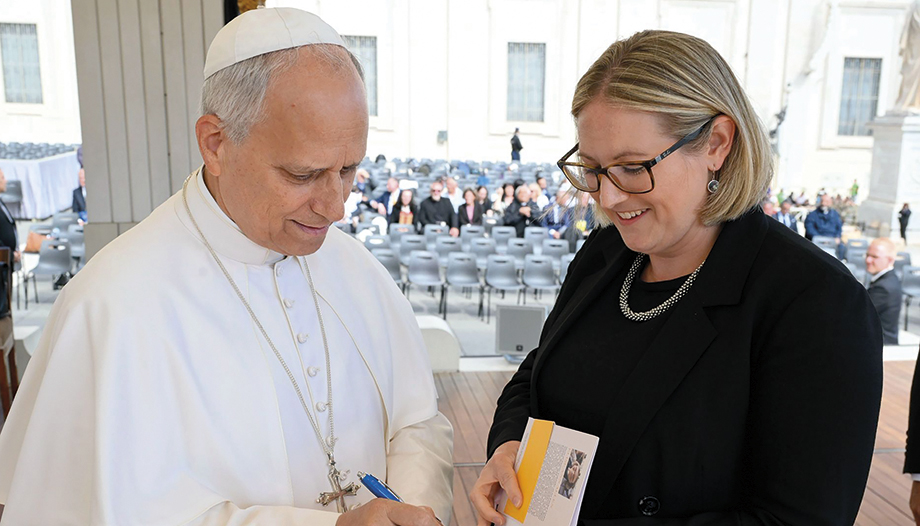
In the first months of his pontificate, Leo XIV has begun to outline his own style: continuity with Francis in social and pastoral priorities, but with a more collegial way of governing and an explicit desire for dialogue. To better understand the profile of the new pope - his roots, his global outlook and his ability to “build bridges” - Omnes talks with journalist Elise Ann Allen, one of the U.S. Vaticanists in Rome who conducted the first interview with Robert Prevost after his election.
His background also offers a particularly valuable perspective: to his knowledge of the Vatican he adds a direct familiarity with Peru, a decisive country in the biography of Pope Leo XIV. In this interview, Allen reviews gestures, priorities and challenges: from synodality and mission to peace, artificial intelligence, communication and the delicate chapter of abuse.
You were the first to interview Leo XIV after his election and to dedicate a book to him. When did you realize that you were no longer simply narrating a life, but that a pontificate was beginning to take shape?
-During the interview, when we began to talk about the period he spent and his work in Peru, it became clear to what extent that experience was decisive for his entire pastoral vision. It shaped him as a person, but above all as a priest, superior and bishop. His work with the poor, the many social projects he was involved in, the way the Augustinians structure their parishes, his way of relating to the local and national political leadership, and his perspective on Vatican II and liberation theology are all key insights that offer a unique look into his mentality and his instincts.
You are an American and have been a Vatican correspondent in Rome for years. What does your experience bring to understanding Leo XIV better than other analysts?
-It allows me to understand it. Like Pope Leo XIV, I am also an American and I know the Vatican, but I also know Peru from personal experience, prior to my work as a Vaticanist. That is why I know the three worlds of Robert Prevost, today Leo XIV, and I think that gives me a privileged perspective to interpret what he will say and do.
What elements of Prevost's roots-his family in Chicago, dual U.S.-Peruvian citizenship, his multicultural sensitivity, and recent findings about his African-American origins-help to understand the way he is Pope today?
-All of them. You can't take just one element and pretend to know and understand Leo XIV. He is a profoundly open person: open-minded, open to new ideas and perspectives, but also to new experiences and to the people around him, including new people he encounters. He has been - and continues to be - shaped by the people and cultures he has met throughout his life, including his childhood experiences of racism. Therefore, to understand him, it is essential to know his background and that fundamental openness.
In the portrait that emerges from your book, Leo XIV is often described as a “bridge-builder” and a “citizen of the world.” What gestures - even small but significant ones - seem to you to best reveal that attitude?
-I believe that his first appearance on the balcony of St. Peter's and his first words were the most eloquent signs. Even his mode of dress is, in a way, a “bridge”, because it combines the simplicity of Francis and, at the same time, recovers some elements of the Pope's traditional attire, which many associate with the Petrine ministry and which they regret to have seen disappear. He has also wanted to meet with figures perceived as very different from each other: for example, with Father James Martin, considered by some as “progressive” and close to the LGBTQ+ community, and also with Cardinal Raymond Burke, seen as “conservative” and favorable to the elimination of restrictions on the traditional Latin Mass. He wants to talk to all sides.
I also think that his meeting with King Charles III and their prayer together in the Sistine Chapel were particularly significant gestures in building ecumenical bridges, as were his trips to Turkey and Lebanon.
The Holy Year that has just ended and the death of Pope Francis mark the beginning of the new pontificate. Where do you see the main continuities and where, on the other hand, do you see some new accents?
-Most of Leo XIV's priorities are in full continuity with those of Francis: attention to the poor, pastoral care of migrants and refugees, climate and criticism of inequalities. In our conversation he even spoke of the growing wage imbalance between employers and employees, which I believe will continue to be one of his flagships. The novelty will be above all in the style: Francis governed in a very direct way; Leo XIV, on the other hand, prefers to work as a team and collaborate closely with the cardinals and the curia.
In addition, new themes will emerge, such as attention to artificial intelligence and a new approach to Vatican finances. He is also very concerned about the family and polarization: he wants to heal divisions and will make unity a hallmark of his pontificate.
«Most of Leo XIV's priorities are in full continuity with those of Francis: attention to the poor, pastoral care of migrants and refugees, climate and criticism of inequalities...»
Elise Ann Allen
A first session of Leo XIV has already taken place. What is your reading of this meeting and the issues that were put on the table?
-It was a consistory designed to go deeper into various topics: Evangelii gaudium, The Pope left it to the cardinals themselves to choose two, and they opted for two. However, the Pope left it to the cardinals themselves to choose two, and they opted for Evangelii gaudium and along the synodal path.
To me it says a lot that they wanted to prioritize the missionary identity of the Church and a more collaborative, more listening and less clerical way of being Church. It also shows the distance between the media agenda and what really concerns the Catholic people.
And this consistory also shows the style of Leo XIV: it is not common to begin a pontificate by taking the magisterium of the predecessor as a guiding thread. Leo XIV has seen in Francis a great visionary and wants to continue that work. Many present him as a “Francis II”, but this is not so: he has his own style, although his agenda is in full continuity with Francis.
In your book, you deal bluntly with the chapter on abuse and the case of the diocese of Chiclayo. What do the Pope's words - the suffering for the slowness of justice and the desire for reform - reveal about his way of exercising authority and asking for forgiveness?
-His words show a wide experience in positions of authority and in dealing with the abuse crisis. He has dealt with such cases for almost his entire career: as a judge, as a superior and as a bishop, and later in Rome as a cardinal and prefect, also in sensitive situations involving bishops for abuse or cover-ups.
Leo XIV has listened to many victims and understands well what hurts them in these processes. That is why he insists on the importance not only of listening to, but of believing the victims. At the same time, as a canonist and judge, he knows that a judicial system must be objective and protect the rights of all parties: it is a difficult and slow balance.
Moreover, from experience, he has also seen cases of false accusations. That is why he approaches the problem with a holistic view, as judge, canonist, pastor and administrator. He has already met with abuse victims and survivor advocates during the hearing with the organization. Ending Clergy Abuse in October 2025, which shows that this issue is a priority for him and that he is already trying to build bridges in this area as well.
Ukraine, Gaza, relations with Russia and Israel, dialogue with the Islamic world, ecumenism, the anniversary of Nicaea: what, in your opinion, is the “hallmark” of Leo XIV in the area of peace and dialogue, compared to his predecessors?
-We can say that the “hallmark” of Leo XIV, in this field, is precisely to build bridges and facilitate dialogue. This is not something new, but he will carry it forward with all the strength and energy at his disposal. He is not a man of polemics: he wants to reduce aggressiveness and bring a sense of calm, both in political rhetoric and in the field of arms.
Regarding Gaza and Ukraine, we have already seen that his position is perhaps somewhat clearer than Francis'. Already in our interview he said publicly - without expressing it directly - that what happened in Gaza was genocide. And he is meeting frequently with the Ukrainian authorities: he has met three times with President Zelenski since his election. So he is very involved and will always look for ways out that respect international law and avoid further escalation.
«Leo XIV is a very approachable communicator. He knows how to speak today's language with today's media... He expresses himself directly and clearly, and offers prudent but honest answers.»
Elise Ann Allen
The pope has linked his name to Leo XIII and to Rerum novarum, What vision of AI emerges from his language and priorities, and what contribution can this pontificate offer to the Church's social doctrine?
-The contribution that Leo XIV can offer is, above all, a search for balance. Already in his words - both in what he said to me and in his public speeches in recent months - he has spoken of human creativity and of all the possibilities that exist for doing good and helping humanity through artificial intelligence, but also of the many risks. Among them is the risk of forgetting our own humanity: that which distinguishes human beings from other creatures. But there is also the risk of losing sight of the truth. We live in an age of “fakes": fake news, The technology, false images, false content that is difficult to verify. And then there is the whole economic component: there are billions behind this technology, enriching a few while an increasing number of people live in poverty, with land and labor exploited by large companies dominated by the “1 %”, so to speak.
Leo XIV is a man who wants to foster human creativity, also in the field of technology, but in a just way that respects human dignity and in which people - especially the poor - are not forgotten.
You remember that Leo XIV, even before the election, was already using social networks, including WhatsApp. What kind of communicator does he seem to you and to what extent does this style influence your way of exercising the Petrine ministry?
-He is a very close communicator. He knows how to speak the language of today with today's media, even with a very competent use of the emojis in mobile applications. He expresses himself directly and clearly, and offers prudent but honest answers. He is a very capable person, very attentive to what is happening in the world, and someone who dialogues and knows how to dialogue with the world.
He knows where the people are and he knows how to be present there, with them. He wants to continue to promote that dialogue and, in fact, he is especially prepared to do so.
If I had to point out to the readers of Omnes a single scene from your book that best “tells” who Leo XIV is, which one would you choose and why?
-I would choose the moment in which Leo XIV relates his arrival in Peru for the first time, in 1985. That, for me, is the key to understanding him. He speaks of the culture shock of moving from Rome to Chulucanas in those years, of poverty and terrorism, of being sick with typhus and having to drive three hours to get to the nearest clinic. It was in those conditions - sick and suffering, in the midst of nothingness and extreme poverty - that he clearly understood God's call and decided to accept it without looking back. After his “yes” to the priesthood, that was his first “yes” to the mission: to a call from God that would take him to the whole world and, finally, to the See of Peter.




 Español
  English
  Italiano