



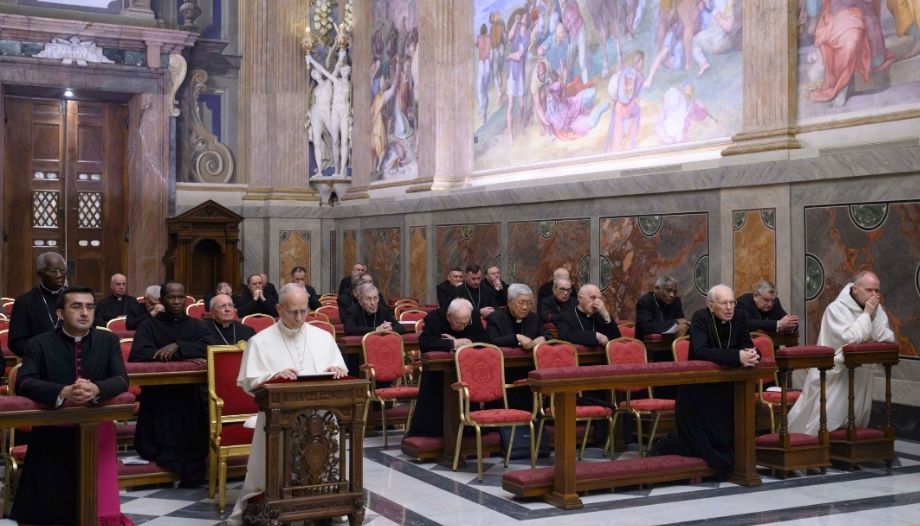
- Father Francis J. Hoffman, OSV News
The saints, notoriously happy, bore witness to this reality. Even St. Maximilian Kolbe, the Claretian martyrs of Barbastro and the Carmelite nuns of Compiègne sang hymns of joy on their way to martyrdom. Immersed in conditions that would sadden mere mortals, these friends of God faced suffering with joy. It was their friendship with God that gave them strength and joy.
But friendship takes time and needs to be strengthened by conversation. Couples with strong marriages will tell you how important it is to get away for a long weekend to talk alone. We need to do the same with God, which is why the Church strongly recommends annual retreats for the faithful.
Retreats are a time away from our usual activities to reconnect with God, examine life's priorities and make concrete, practical resolutions for improvement. Retreats can be a powerful step toward personal conversion.
Our Lord: days of retreat
Before our Lord began his public ministry, he spent forty days in the desert praying and fasting in preparation for the important work that awaited him (cf. Lk 4:1-13). These were days of retreat.
During his three years of public ministry, Jesus sometimes invited his disciples to «withdraw to a solitary place to rest a while» (Mk. 6:31). Again, days of retreat.
When Jesus burst forcefully into St. Paul's life, he instructed him to get up and go to the city, where he would be told what to do. For three days, St. Paul did not eat or drink, preparing to receive spiritual direction from Ananias (see Acts 9:1-9). These were also days of retreat.
Great saints and founders
Over the centuries, the Holy Spirit has raised up great saints and founders for the reform and service of the Church. While the methods of Franciscans, Jesuits and members of Opus Dei have varied considerably, what their founders shared was a deep spiritual experience during their retreats, whether in the woods surrounding Assisi, in the caves of Manresa or in a residence of St. Vincent de Paul.
These saints sought solitude to listen to God. Jesus called them to a secluded place to spend time with him.
The current ecclesiastical legislation urges the parish priest to organize periodic retreats or missions for the good of the faithful, while all those who are to be ordained must make a one-week retreat. Likewise, priests and religious are asked to make an annual retreat.
For the good of the Church, as well as for the good of their own souls and families, lay people are also encouraged to take a few days away each year to rekindle their relationship with Christ.
Top 5 elements to make a good retreat
There are many types of retreats, and many church organizations offer retreats of varying lengths and themes. Retreats can last two or forty days; they can be for men, women or couples.
They can follow a traditional format with a preaching priest as retreat master, offering several spiritual conferences or daily meditations. Or they can have a more charismatic tone.
They can be directed or not. You can make a retreat with a large group in a hotel or alone in a Trappist monastery. In general, however, prudent pastoral experience suggests that the following elements are the most helpful for a good retreat: silence, the Holy Eucharist, confession, spiritual reading and closeness to the Blessed Virgin.
Silence, Holy Eucharist
First, the silence. Seek a place of retreat that fosters an atmosphere of silence, not as a penance, but as a means of listening to the Holy Spirit and getting to know Jesus while knowing yourself.
When you go on a weekend retreat, you go to be with God and deepen your friendship with him. Too often in daily life, we are overwhelmed by sensory distractions and fail to hear God's voice. When you go on retreat, turn off your cell phone and disconnect from all cyber communication. God wants your attention. Others can wait.
Secondly, the Holy Eucharist. Since the Holy Eucharist is the Body, Blood, Soul and Divinity of Christ, it is extremely beneficial for the practitioner to attend Mass and receive Holy Communion daily during the retreat. It is also helpful to spend time in silent conversation in the presence of the Blessed Sacrament and even to participate in the Exposition and Benediction of the Blessed Sacrament during the retreat.
The Church so strongly recommends Eucharistic adoration that a plenary indulgence can be obtained whenever one of the faithful spends 30 minutes in adoration before Our Lord.
Confession, spiritual reading
Third, the confession. A retreat is about seeking, finding and loving Christ. By spending time in silent reflection and examination of conscience, the Holy Spirit will prompt you to confess your sins to a priest.
Often, the annual retreat provides special graces for a deeper examination of conscience, which impels the soul to a deeper contrition. Souls sometimes seek to make a general confession of their whole life - renouncing pride, envy, lust and jealousy - and thus open their souls to the redeeming graces of Christ.
For true and lasting spiritual progress, it is essential that the person make a deep and profound examination of conscience, express sincere contrition and confess his sins to a priest.
Fourth, spiritual reading. What a joy to read the Bible slowly and in silence! How good it is for the soul!
Priority should be given to the New Testament, and in the first place to the Gospels. The soul benefits greatly from reading and reflecting on the words and actions of our blessed Savior.
Early morning is usually the best time to nourish the soul and spirit with the words of the Gospel. Many also find it very helpful to read spiritual works of saints and great teachers.
Timeless classics, such as «The Three Ages of the Interior Life» by Father Reginald Garrigou-LaGrange, «The Imitation of Christ» by Thomas á Kempis or «In Conversation with God» by Father Francis Fernandez are always a good bet.
Blessed Mother, Rosary
Fifth, closeness to the Blessed Mother. After Our Lord's ascension into heaven, the apostles gathered around Our Lady and accompanied her in prayer. Ten days later, at Pentecost, the Holy Spirit infused his grace into each of those present in the Upper Room, and thus the Church was born.
Those days of prayer and petition were fruitful because of the Apostle's closeness to the Blessed Mother.
During your retreat, take time to pray the rosary daily and meditate deeply on each mystery. By reflecting on the example of the Blessed Mother, you will draw closer to Our Lord.
Some practical and generous purposes
As you near the end of your retreat, be sure to make some practical and generous resolutions (no more than three) to improve in prayer, service and sacrifice. Write those resolutions down in your notebook or save them in your phone.
Finally, beware of post-retirement syndrome, also known as post-retirement syndrome. This is the tendency to fail at one or more of your resolutions soon after returning. Forget it and start over.
With God's grace and your humble contrition, you will progress.
—————
Father Francis J. Hoffman, also known as ‘Father Rocky,’ is the executive director of Relevant Radio (relevantradio.com).




 Español
  English
  Italiano