



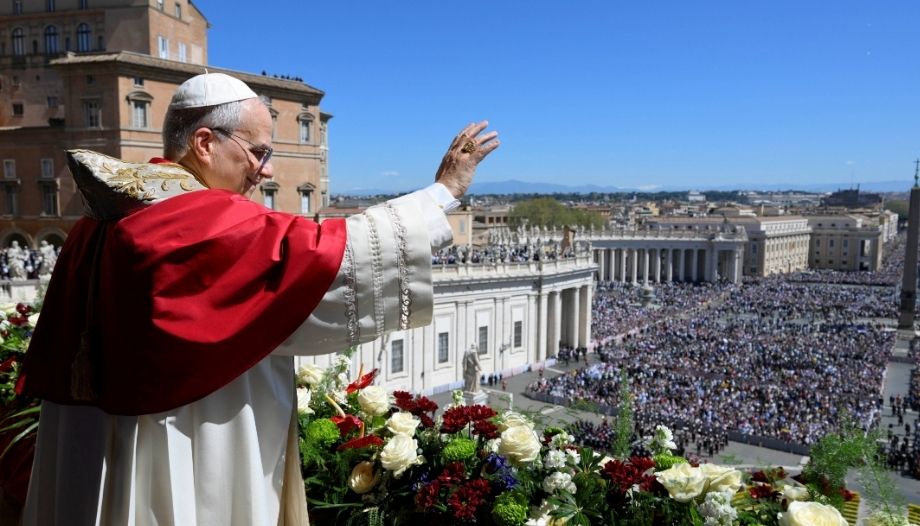
Jesus is the good news to be witnessed to in the world, Pope Leo XIV announced in the Regina Coeli of Easter Monday. This greeting, “Christ is risen! full of wonder and joy, will accompany us throughout the week,” in the Octave of Easter.
The liturgy celebrates the entrance of all creation into the time of salvation; the despair of death is removed forever, in the name of Jesus, the Pope added.
This is the meaning of Easter. When it is proclaimed in the world, the Good News dispels every shadow, in every age.
Christ, the Son of God, has given his life for us.
“The Lord's Passover is our Passover - the Passover of humanity - because this man, who died for us, is the Son of God, who gave his life for us. And who gives new voice to hope, no to the violent, The Pontiff continued in his brief Marian prayer, the Regina caeli, which replaces the Angelus at Easter.
“Just as the Risen One - always alive and present - frees the past from a destructive end, so the Easter proclamation frees our future from the grave,” he added.
With particular affection, in the light of the Risen Lord, we remember today Pope Francis, who on Easter Monday of last year gave his life to the Lord, said Leo XIV.
“As we remember her great witness of faith and love, let us pray together to the Virgin Mary, Throne of Wisdom, that we may become ever more luminous heralds of the truth.”.
Why is the Octave of Easter a solemnity?
The Octave of Easter (the eight days from Easter Sunday to the second Sunday of Easter) is considered a “solemnity” because the Church liturgically prolongs the celebration of the Resurrection as if it were a single great feast day.
Pope Leo explained this morning. “I hope that you will spend this Easter Monday and these days of the Easter Octave, which continue the celebration of Christ's Resurrection, with joy and faith. Let us persevere in prayer for the gift of peace for the whole world.”.
“It's not just another week.”
The Octave of Easter is not “just another week”, but a single great prolonged day, where the Church lives intensely the joy of the presence of the Risen Christ, and the mercy that flows from his victory.
At liturgiapapal contains a clear formulation about the Octave of Easter. The key phrase is: “The first eight days of the Easter Season constitute the Octave of Easter and are celebrated as solemnities of the Lord”.
Indeed, the Octave is part of the Easter Season, which is described as a “week of weeks” (50 days in all), culminating on Pentecost Sunday.
During those eight days no other celebrations are allowed, and the liturgy proper to Easter is always used, as if it were an extension of the same day. In practice, it is lived as an extension of Easter Sunday.
Ancient Christian tradition
According to the Roman Missal and the norms of the Catholic liturgical calendar, celebrating each day of the Octave as a solemnity is based on an ancient Christian tradition. Celebrating the great feasts for eight full days (octaves), inherited in part from the biblical symbolism of the “eighth day” as a new creation,
Easter commemorates the central event of Christianity: the Resurrection of Jesus Christ. For this reason, it is not limited to a single day, but extends as a continuous time of joy. It is as if the Church were saying: the Resurrection is so important that it does not fit into 24 hours.
St. John Paul II: Divine Mercy Sunday
St. John Paul II strongly linked the Octave with mercy and new life. In connection with the Second Sunday of Easter, he wrote that “the Octave of Easter is a privileged time for welcoming the divine mercy that flows from the paschal mystery.”.
Specifically, declared officially that the second Sunday of Easter (the last day of the Octave) be called Divine Mercy Sunday. He did so on April 30, 2000, during the canonization of St. Faustina Kowalska.
The decision is deeply linked to St. Faustina's revelations about divine mercy, and the desire to emphasize that Easter culminates in God's mercy.
Benedict XVI: the resurrection, “a bridge between the world and eternal life”.”
Benedict XVI explained in 2009 that “the Christian community rejoices because the Lord's resurrection assures us that the divine plan of salvation will surely be fulfilled, despite all the darkness of history. It is precisely for this reason that his Passover is truly our hope”.
He also added: “His resurrection has created a bridge between the world and eternal life, over which every man and woman can pass to reach the true goal of our earthly pilgrimage”.



 Español
  English
  Italiano