



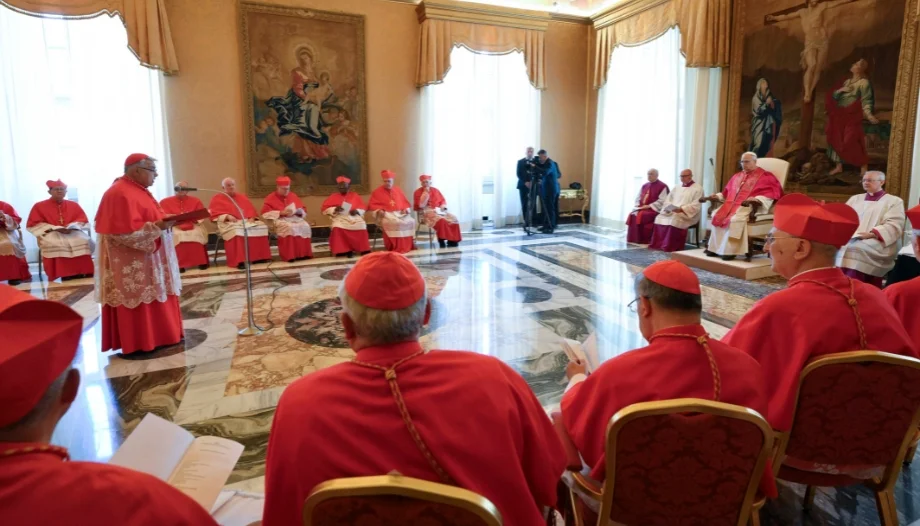
The Vatican confirmed on December 20 that Pope Leo XIV will convene an extraordinary consistory of cardinals on January 7 and 8, 2026. It will be the first meeting of its kind during his pontificate. It will also be the first time that the entire College of Cardinals has met since the conclave that elected him.
This is important because an extraordinary consistory is not primarily ceremonial. It is one of the few moments, outside of the conclave, when all the cardinals are in the same room with the Pope. In canon law, it exists for «particular needs of the Church or matters of special gravity.» In practice, it is a tool of governance. It allows the Pope to consult widely, take the pulse of the global Church, and signal priorities in advance.
What a consistory?
A consistory is a formal meeting of cardinals called by the pope to assist him in governing the universal Church.
An ordinary consistory is usually ceremonial. It is often used to create new cardinals or for certain steps in canonizations. It is usually attended mainly by cardinals who live in Rome; however, it can still be significant due to its nature. Pope Benedict XVI, for example, announced his resignation at a consistory in 2013.
An extraordinary consistory is different. It is designed to consult with the entire College of Cardinals. The word itself points to the idea of «being together.» Historically, it has been an important way for popes to seek advice on doctrine, discipline, and governance of the Church. It is explicitly consultative. The pope remains the decision-maker, but he listens in a structured way.
The last extraordinary consistory with a significant strategic impact was held in February 2014 under the pontificate of Pope Francis, focusing on marriage and the family ahead of the Synod on the Family. This was the only extraordinary consistory convened by the late Pope.
The importance of this consistory
The January 2026 meeting will be the first time most of the cardinals have gathered since the election of Pope Leo XIV. Many had little opportunity to get to know each other before the conclave. That means the College is not yet familiar with the Pope's main pontifical priorities. Therefore, this meeting is not just about the items on the agenda. It is also about relationships, trust, and consistency.
That is why the meeting has symbolic significance. Pope Leo XIV is bringing together a body that is geographically vast and often divided by experience, culture, and priorities. If he succeeds in creating true communion and a viable form of collaboration, he will strengthen his ability to govern and lead the Church.
The Holy See Press Office said the two days will include “moments of communion and fraternity” as well as time for “reflection, sharing and prayer”. The stated aim is to offer “support and advice” to the pope and to strengthen communion between the Bishop of Rome and the cardinals.
These phrases may seem generic. But in a new pontificate, they point to something specific: Pope Leo XIV is setting the tone for how he will lead. Will he govern through a small inner circle? Or will he try to establish broader consultation and shared responsibility?
The agenda signals the pope’s governing instincts
In a Christmas letter to the cardinals signed on December 12, the feast of Our Lady of Guadalupe, to which Crux News in Rome has had access, Pope Leo outlines four main points of discussion for the two-day meeting, which will likely address two topics per day.
Firstly, he asked for a renewed reading of Evangelii Gaudium (2013). That document is closely linked to Pope Francis' vision of a missionary Church. Leo XIV seems to say that the Church cannot begin with internal debates. It must begin with the proclamation of the Gospel. If you take this as a starting point, it frames the rest as tools for mission, not as ends in themselves.
Secondly, he asked cardinals to study Praedicate Evangelium (2022), the constitution that reformed the Roman Curia. This is crucial. Many disputes in recent years have not been solely about theology. They have been about authority: who decides what and at what level. If Pope Leo XIV focuses here, he may be testing how much consensus there is to continue Pope Francis' reforms and how they will be implemented.
Third, he emphasized synodality as a key form of cooperation with the Pope on matters affecting the whole Church. This is no minor sign. Synodality has become a defining issue and a point of controversy. By including it on the agenda from the outset, Pope Leo XIV indicates that he wants the College to engage directly with him, rather than treating it as someone else's project.
Finally, he called for theological, historical, and pastoral reflection on the liturgy, emphasizing the need to preserve healthy tradition while remaining open to legitimate development, in line with Vatican II. This issue is often where conflict within the Church is most visible. A pope who addresses it early on may be trying to ease tensions by clarifying principles. Or he may be preparing to make decisions that will require the support of the cardinals. In any case, the fact that he has included it suggests that he knows the issue cannot be avoided.
What this means for the Church
This council will likely be the first clear window into the mind of Pope Leo XIV. It will show what he wants to emphasize, what he considers urgent, and how he expects his closest collaborators to work with him.
It may also expose real limits. The subjects are wide. The time is short. That combination can produce either focus or frustration. A successful consistory will not solve everything. But it can establish a method: honest listening and clear priorities with a shared sense of direction.
In that sense, the extraordinary consistory is not merely procedural. It is the first important institutional act of this pontificate. It is where Pope Leo XIV will begin to define how he intends to govern with the cardinals and what kind of Church he wants them to help him lead.
Founder of "Catholicism Coffee".




 Español
  English
  Italiano