



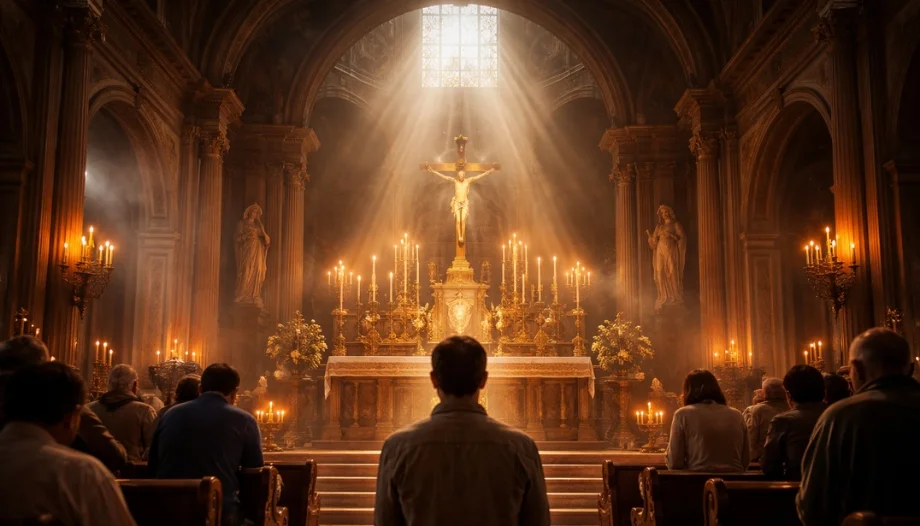
Let us think for a moment about the fact that defines the sacred, man himself has within himself a reference that makes him sacred. The question of his origin, his existence and his end is always marked by something he considers sacred.
Let us think first of all that man needs to know, to be known first, is love, there is no love without being loved, and the one who loved us, is the same one who knows us. Man opens himself to the supernatural, but he opens himself by the simple fact that he has supernaturalness, it is in other words “to show a true face”. The being open to transcendence is not exhausted, that being-with God, which gives it its existence, that relationship with the sacred, of which Leonardo Polo speaks to us: “being-with respect to God means absolute dependence”. Without the relationship, the being is simply enclosed in a loss of meaning.
Hierophany
The holy places that we can appreciate are in our world, it is not a reality that is outside our space. In this is important the term hierophany that means the manifestation of the sacred, and this manifestation cannot be excluded from the earthly realm, otherwise it would not be sacred but simply eschatological, which we would not be able to see or witness.
In this sense, in the temples we find a fundamental part that founds the sacred places, but to know the places we need an attraction towards those places, and that attraction is the power of the divine. If we stop a little in the rites, in the fact of the sacred towards which man participates as an active being, we get into the liturgy. This means that man participates in the divinity in a sphere, but not by capacity, but by gift. It could be said that it is an introduction to the time of God, but simply because He loved us first.
If we go to the passage of the burning bush, where Moses enters and what he is told is “take off your sandals from your feet, for the place you are treading on is holy” (Ex 3:5), the fact that he enters a place is to enter God's time, where the noises of the exterior have no validity. This, although sometimes forgotten, does not manage to lose its character of transcending man, by its opening to what is truly beautiful and true.
Man's need to encounter something sacred is ultimately to encounter the one who gives him his true being, gives him his beauty and gives him his goodness, not in a simple sense, but his being as one, with his true being, his beauty as he shares it with the creator and goodness as he tends to it, as his own or another's good.
The concept of “the divine man” is sometimes upset by the fault of relativism, nothing does more harm than going like a boat in the middle of the sea, from side to side and not having a fixed course, this by the simple fact that we become hypocrites before God and before ourselves. In the sacred, man plays an important role, he is the one to whom the sacred is directed, in the same way man is directed to the sacred, not as a simple desire, but as a mere necessity.
The temple
The defense of divine places are sometimes desecrated throughout history, but does man not have divinity? How does something created from the divine, attack the divine? If we look at it, the men who challenge the sacred places are those who believe themselves to be divine, created out of love and with freedom, yet unable to reciprocate that love.
“His fathers used to go every year to Jerusalem for the feast of the Passover” (Lk 2:41) This is the feast of the lamb, which is one of the three feasts of the Jewish calendar to make a pilgrimage, which obliges men to appear before the temple, which included the sacrifice of the lamb. The loss of Jesus in the temple that tells us is certainly surprising, because we realize several details: first of all the loss of Jesus who is found three days later, but three days? Jesus in another passage speaks in John: “Destroy this temple and I will rebuild it in three days” (19) is a relationship that shows how the temple of God, is now in a temple built by mankind to give worship to the same that is the temple. It is his body, the divinity is no longer between walls, it is now in the person of Jesus.
The three days, the same days he spends in the tomb, symbolize not only the death, but the resurrection, the most perfect temple has been rebuilt. The establishment of the new cult and the new, living and eternal covenant is presented by teaching how to go to the Father, and this way to the Father is done through the sacraments, carefully prepared, first of all worthy, which will never equal the full beauty before God. They orient man towards adoration. Thus, the temple, as a sacred place, becomes a mediator that makes Christ present, who is the true Temple, and teaches how to participate in the communion with the Father.
Now, the encounter with the temple of God, in Christ himself, brings about communion with him, but also with one's neighbor. The now divine law no longer dwells in stone, but in a person who also explains the law: “Why did you seek me? did you not know that I must be about the things of my Father?” (Lk 2:49) the things of the Father, which includes being in existence every day with the recognition that we are before God.
Places help us to always be in communion with God, because of the beauty that most of them contain, from a painting to a crucifix, which transports us to the mystery of the Redemption, which always reminds us that we are God's creatures and that God is God. Entering the space destined for God makes it visible that the heart always has its gaze fixed on the creator, hence the importance of taking care of them, since they are constantly bringing praise to God himself, following the example of Christ himself.
It is a way of being, where the supreme goodness takes the initiative to reveal itself, and this relationship with God leads to the rites, to the liturgy and to the worship that is ours to give. When we think of the rites, we think of the entire liturgy, with its center in the Holy Mass, but which also involves the hours of the whole Church, with a constant extension of the Eucharist by making ourselves victims and sharers in the divine filiation.
“Christ Himself performs the worship before the Father, He becomes worship for His own at the moment that they gather with Him and around Him” (Joseph Ratzinger “The Spirit of the Liturgy”) the community that gathers, that shows that Christ is the recipient and at the same time is the subject who offers in the person of the priest, hence the importance of the churches as a temple, because it is where Christ Himself offers Himself to the Father, and gathers us with Him, therefore; The liturgy itself is not born of a human invention, nor of a convenience, but of a divine revelation, so that men may come to the knowledge of the truth.
Speaking of the sacred places, we must also mention St. Mary, as the bearer of the divinity, the one who carried in her womb by which the world was made, “Mary, in whom the Lord will dwell, is in person the daughter of Zion, the Ark of the Covenant, the place where the glory of the Lord dwells: she is “the dwelling of God among men” (Rev 21:3). “Full of grace”, she has given all of herself to the one who comes to dwell in her and to the one who will deliver the world” (CEC 2676). The Ark mentioned in the Old Testament, which contains the presence of God, is now Mary who carries in her womb the creator, in her, who by her purity is carved with gold inside and out, is the one who receives the greatest treasure to achieve Salvation, to her who has an essential place and not least in our sacred places, we always go as Virgin who is not overtaken by sin, is able to reach, embrace and support the sinner.




 Español
  English
  Italiano