



 History, faith and culture in Algeria and TunisiaTunisia and Algeria: the land of St. AugustineThe Holy Land of Jesus
No, in this article I am not going to talk about lasagna, even if it is one of the many delicacies for which Italy is famous. Instead, I am going to write about a basilica that, like Rome (in many of its monuments), often defined as «archaeological lasagna», preserves the memory, in the same place, several meters deep and layers of earth, of very specific historical periods.
Let us now speak of St. Clement, located a few hundred meters from the Colosseum and not far from San Giovanni in Laterano, in the hollow between the Esquiline and Celio mountains. This basilica is dedicated to Clement I, the fourth pope, who died around 100 AD, but it is also linked to the cult of St. Cyril, buried here.
A few nights ago, when I found myself there, I took the opportunity to enter this wonderful church that I had visited several times, always during the day, to accompany friends who had never seen it.
In the evening, its charm, if possible, was even greater. The mass celebrated by the Dominican Fathers had just ended and I went inside for just a few minutes to enjoy its splendid atmosphere.
And I thought of St. Clement's as an authentic Roman lasagna. Each of its steps, each meter of its construction, corresponds to centuries of history: four superimposed levels, from the first century A.D. to the twelfth, in about twenty meters from the current street level.
The oldest part
The deepest and oldest layer dates back to the imperial period (Nero's fire, 64 AD). Its structures were not discovered until the 19th century, with the excavations initiated by P. Joseph Mullooly, which brought to light the remains of two buildings separated by a narrow alley (60 cm): on one side, a structure of tufa and travertine blocks that seems to correspond to a horreum (public warehouse) possibly related to the imperial mint located in this area. insula (hence the Italian expression «isolato»): an apartment building with several floors around an interior portico (such as the "isolato"). block in Spanish).
In the courtyard of the insula, Between the end of the second and the beginning of the third century, the followers of the Mithraic religion built a small temple, precisely a mithraeum. In an article on the historicity of Christmas we had already seen how Mithraism was a mysterious cult of Eastern origin that later spread to Rome. Its central figure was the god Mithras (also related to the Sun Invictus), miraculously born on December 25 from a rock with a dagger in his hand with which, by order of the Sun, he kills a bull (tauroctonia) to generate the universe.
The scene of tauroctonia is still visible on the altar of the mithraeum of St. Clement, where a statue of the Good Shepherd was also found, a sign of a physical proximity, and perhaps of an initial syncretism, between pagan and Christian worship. However, as early as the 4th century, construction of the first Christian basilica was begun on the insula. At that time, the mithraic cult, still lawful, was celebrated on the first floor. But then it was declared illegal, so the mithraic cult was buried and forgotten until the 19th century.
The early Christian basilica
Let's move on to the second layer from below. In the third century, the horreum fell into disuse and was buried under a layer of earth. A private residence was built on top of it, which was probably converted into a domus ecclesia, The first Christian communities gathered in the house of a wealthy man. Thus was born the titulus Clementis.
The tituli like this one, in late Rome, were the oldest form of parish: urban churches officially recognized and entrusted to a presbyter. They often had their origin in domus ecclesiae which later became formal places of worship. They were the basis of the Church of Rome and, in addition to celebrating liturgies, they provided catechesis and assistance to the poor. They took the name of the founder or the original owner of the domus and their «parish priests» (designated presbyters) formed the presbyterate that collaborated with the Bishop of Rome: the cardinals, who even today are still attributed the titulus of a Roman church in which they are «incardinated». In Late Antiquity, there were twenty-five tituli, but today there are more than 140.
St. Jerome, around 390, already testifies to the existence of the titulus Clementis and of the church that guarded his memory. But it was around the year 400 when the building was transformed into a real basilica with three naves, columns and an apse that projected over the entrance of the Mithraic temple, already fallen into oblivion.
In the following centuries, the church was enriched with works of great value. In particular, its titular priest Mercurius, who later became Pope John II (533-535 A.D.), ordered the construction of the schola cantorum and a mosaic floor. Between the 8th and 9th centuries, other marble columns and several frescoes were added.
One of them deserves special mention for its importance in the history of the Italian language. It is located in the central nave of the lower basilica and depicts the legend of the prefect Sisinnius. Furious at the conversion of his wife Theodora, he ordered his servants to take St. Clement away, but they, blinded by God, ended up dragging some columns. Sisinnius, then, even more enraged, shouted at them: «Sons of bitches, pull, Gosmari, Albertel, pull! Get a stick in the back, Carvoncelle!«. Unfortunately, these are some of the earliest words written in vulgar Italian (in this case, really vulgar). They date back to between 1084 and the early 1100s, and have a marked Roman inflection (unmistakable!). Noteworthy fact: the proper names (or nicknames) of the servants are of Germanic origin.
The medieval basilica
The third layer is medieval, built after the fire caused by the Norman troops of Robert Guiscard in 1084. Around 1100, Cardinal Anastasius ordered the early Christian basilica to be buried with stones up to the height of the columns. The present basilica, slightly smaller, was built on top of it.
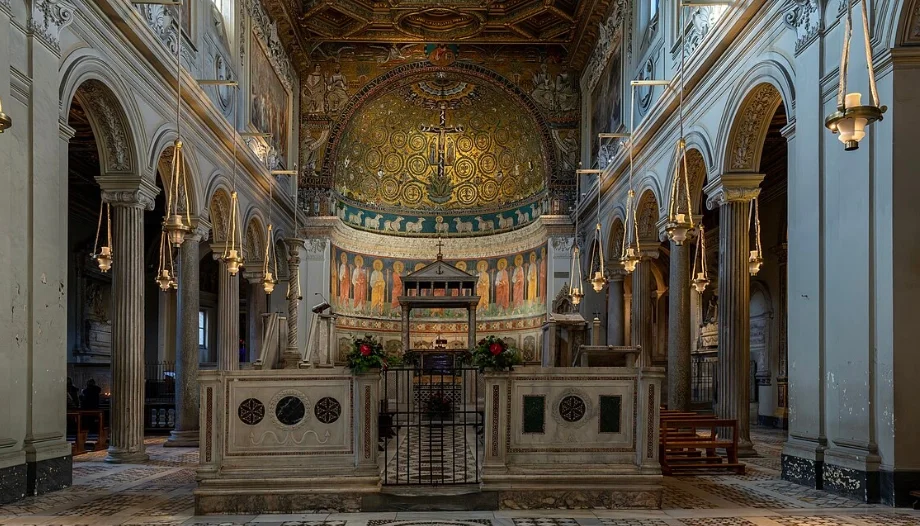
Upon entering, the wonderful mosaic of the apse (from around 1100) immediately catches the eye: in the center, Christ crucified between the Virgin and St. John, with the cross that transforms into a tree of life from which beautiful plant and animal figures sprout. The inscription reads: «The Church of Christ is like this vine, which the Law dries and the Cross makes green".
The floor is Cosmatesque (from the Cosmati family, Roman marble workers active between the 12th and 13th centuries, whose unmistakable style was characterized by geometric polychrome marble inlays, made with tesserae and fragments of ancient marbles) and its marbles come from all over the Mediterranean. The schola cantorum reuses fragments of the lower basilica, including the monogram of Pope John II. Also very beautiful is the chapel of St. Catherine, frescoed between 1428 and 1431 by Masolino da Panicale, with scenes from the life of the saint.
To Pope Clement XI we owe the current appearance of the facade, the coffered ceiling and the stucco decorations, the work of the architect Carlo Stefano Fontana between 1713 and 1719.
The basilica is still managed today (it has been since 1645, after England expelled the Irish clergy and outlawed the Catholic Church) by the Irish Dominicans of St. Sisto. One of them, Father Joseph Mullooly, led excavations in the 19th century that brought to light the early Christian basilica and the underlying Roman buildings.
The link with Cyril and Methodius and Eastern Europe
In 868, Saints Cyril and Methodius arrived in Rome carrying with them the relics of St. Clement, found in the Crimea. They presented them to Pope Adrian II, who not only approved their mission and the use of the Paleo-Slavic language in the liturgy, but also consecrated Methodius bishop. As we have seen, Cyril, seriously ill, remained in Rome and died there in 869. He was buried precisely in the Basilica of St. Clement.
Here, in the lower basilica, there is an 11th century fresco depicting the transfer of the relics of St. Clement, with Cyril and Methodius, and Pope Hadrian in the center, leading the solemn procession accompanying the body of the saint.
Cyril's original tomb was probably located near the fresco of the Anastasis, to the right of the altar, as described in the Life of Cyril. However, in the 12th century, when the lower basilica was abandoned, his relics were transferred to the upper basilica. Today they are housed in the corresponding chapel, built in 1880, and are the destination of pilgrimages of Eastern Christians from all over Europe.
At the beginning we jokingly defined St. Clement as a historical lasagna, but this metaphor fits him like a glove: in how many places in the world do so many ancient pagan, early Christian, medieval and modern historical testimonies, of different origins and rites, stories of resilience in the face of adversity and of faith that transcends the ages, overlap?




 Español
  English
  Italiano