



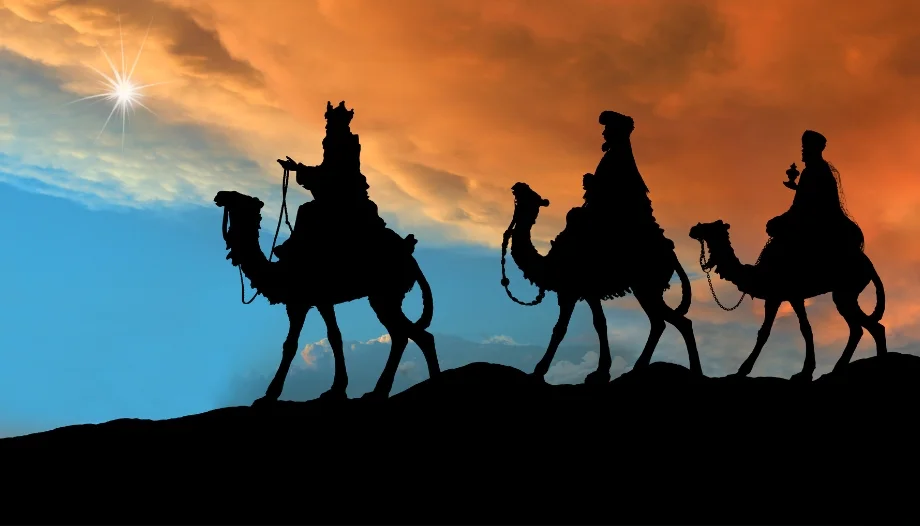
On January 6, the Church celebrates the arrival at the portal of Bethlehem of the Magi from the East, those scholars of the stars who traveled from distant lands to visit the Baby Jesus. Apart from tradition and some later representations, the main source we have about these characters is the Gospel of St. Matthew, written a few decades after the events took place:
«...some Magi arrived in Jerusalem from the East, asking: »Where is the King of the Jews who has been born? For we saw his star in the East and have come to worship him (...). After hearing the king, they set out (for Bethlehem). And then the star they had seen in the East went before them, until it came to rest over the place where the Child was.".
Matthew does not provide us with much information about them. In fact, we are not even sure how many there were. Traditionally, it has been assumed that there were three people, in keeping with the three gifts they brought: gold, frankincense, and myrrh. This number appears in the first known depiction of the Magi, in the Catacombs of Priscilla in Rome, dating from between the second and third centuries. On the other hand, the word Matthew uses to refer to them, magoi (magoi), was generally used to refer to scholars of Persian origin. Be that as it may, looking at the Gospel, we can deduce that they were wise men who came from the East and appeared in Jerusalem because they were looking for the king of the Jews. Furthermore, we can deduce that they were not looking for just any sovereign, but a king announced by the stars and who, moreover, deserved their adoration: We saw his star in the East and came to worship him..
As I said, we don't have much more to say about the Magi, but we can ask ourselves about the star that led them to the Child. Was it really an astronomical object that made these wise men set out on their journey? It could well have been a miraculous event that only they saw, or an allegorical reference, to an angel, for example. But if we can assume that we are talking about a physical phenomenon, what was it?
What does «star» mean in the biblical text?
When researching the star of Bethlehem, we encounter a small difficulty in Matthew's text itself: the Greek word used (star) is usually translated as star, but a more accurate translation would be star, and could refer not to a star, but to any bright astronomical body, such as a planet or a comet. In any case, it seems clear that Matthew's text refers to a relatively peculiar astronomical phenomenon: the magi did not observe just any star, but saw your astro (his star).
What phenomenon occurred in the heavens that caused some wise men from the East—probably Persians—to undertake a long journey precisely to Jerusalem? As is well known, we are not sure of the date of Jesus Christ's birth, but we can say that it must have occurred after 6 BC—the most likely year of Quirinius' census mentioned by Luke—and before 4 BC, the year of Herod's death. So, what phenomena could have been observed in the heavens at that time?
Signs in the sky: three decisive astronomical phenomena
Well, around that time, three interesting astronomical phenomena occurred. The first took place in the year 7 BC, more specifically between May 29 and December 5: the conjunction of Jupiter and Saturn.
It is true that a planetary conjunction is not something exceptional and does not seem likely to have sufficiently astonished our magicians. But we must bear in mind that the one in 7 BC was not just any conjunction: it had three peculiarities. First, both planets were particularly close to Earth, which made them appear much brighter than normal. Second, it was a triple conjunction. Due to the combined movement of Jupiter, Saturn, and Earth, it appeared that, on its path through the sky, Jupiter overtook Saturn; then Saturn surpassed Jupiter (let's say “escaping” from it) and, finally, Jupiter ended up winning the battle. And finally, and this is perhaps the most interesting thing, this triple conjunction occurred precisely in the constellation of Pisces... And the fact is that, for the Persians, the constellation of Pisces represents Israel.
In summary: in the year 7 BC, the magicians could see in the sky that Jupiter (which for the Persians was a representation of good) fought and won to Saturn (which represented evil) and all of this precisely over the constellation that referred to Israel...
The second curious phenomenon that could be observed a few months later was Jupiter's occultation behind the Moon. It is not very common, but from time to time the Moon covers a planet. And the important thing is that, as the Moon continues on its path, after a while the occulted planet reappears on the opposite side: it is as if the Moon «gives birth» to that planet... We know that in ancient times, the births planets by the Moon were associated with illustrious births, those of kings or important people. Well, in April of the year 6 BC, the Moon gave birth Jupiter, the same man who a few months earlier had announced his battle against evil in Judea...
It is logical to think that these two events, so significant and so closely linked to Judah, would have alerted wise men who devoted their lives to observing the stars. That is why we can say that the third event we refer to could have been a real starting gun: this refers to the sudden appearance of an unknown star in the sky.
The Ch'ien-han-shu, or Book of the Han Dynasty, is a Chinese classic that chronicles the history of the Western Han Dynasty. In addition to providing us with a wealth of interesting information about that period, this work records the astronomical events that took place during the reign of Emperor Ai. We are interested in a rather brief note: “In the second year, second month: a hui-hsing emerged in Ch'ien Niu for 70 days.
The second month of the second year spans from March 9 to April 6 of the year 5 BC, which fits quite well with the possible date of Christ's birth. On the other hand, we know that Ch'ien Niu is one of the constellations in the Chinese sky, which includes several of the stars in the constellation Capricorn. Finally, we know that hui-hsing (literally “broom star”) is how Chinese astronomers referred to comets.
Was it a comet?
What exactly did Chinese observers see at that time? If we trust what they say, it is clear that it was something that appeared suddenly (that “emerged”) and then disappeared after a little over two months. There are only three possible explanations for a phenomenon of this kind: the explosion of a supernova, the appearance of a nova, or the arrival of a comet in the inner Solar System. The first two possibilities can be ruled out, as both leave physical debris and nothing has been observed at that point in space. Furthermore, as we have said, the expression used by the Chinese (broom star) seems to leave no room for doubt.
However, it could be argued that comets do not appear suddenly. But that is not entirely true. They are relatively small objects and can only be seen when the sun's rays heat the comet's body, causing the nucleus to evaporate, which creates its classic “tail.” This striking trail, which is the only visible part of comets, appears more or less when they cross the orbit of Mars. All comets are invisible to the naked eye for most of their journey and appear (or emerge) suddenly as they approach Earth.
Finally, we find another difficulty in accepting that the star in Han's book was a comet. As the sentence is written, it gives the impression that the hui-hsing it remained fixed in the sky for 70 days (“it emerged in Ch'ien Niu for 70 days”) and that does not seem consistent with the behavior of a comet, which should move, as we know. But this is not correct: as is evident, a comet can appear fixed in the sky if its trajectory is directed directly—or almost directly—toward Earth. That very thing—the appearance of a fixed point in the sky—is what those who explore possible objects that could collide with our beloved planet fear they will find...
In any case, everything seems to indicate that the hui-hsing from Han's book could be a very good candidate for the star of Bethlehem, especially if we combine its appearance with the other two signs: the conjunction and the illumination of Jupiter.
But could the star seen by the Magi have been a comet? Some have objected that, in that case, the Gospel would have referred to it as κομήτης (komḗtēs). But we must bear in mind that, undoubtedly, the source from which Matthew took this information, whether oral or written, must have been Hebrew. And in ancient Hebrew, as far as we know, there is no word for comet. Furthermore, we know that Origen already considered the idea that the star of Bethlehem was a comet in the mid-third century.
It has also been said that comets are often linked to misfortune or disaster, but this is not entirely correct. A recent example is the so-called Caesar's Comet, a bright star that visited us in 44 BC, a few days after the death of Julius Caesar. The event was interpreted in Rome as a sign of the emperor's deification.
The Magi did not follow the star at night.
It seems appropriate to make an important clarification here. It is common in iconography to depict the Magi traveling at night and following a star, usually with a tail. But this does not seem to correspond to reality. First, because it would be very strange for our wise men to travel at night: it would be natural and logical to travel during the day... And second, because nothing in Matthew's account leads us to think such a thing: quite the contrary.
In fact, Matthew's text uses the aorist tense twice when referring to the vision of the star: we sawwe saw)his star in the East. And, further on: the star they sawI saw) in the East. The use of the aorist tense indicates a past event that has been completed, which tells us that the magi saw the star some time ago, when they were in the East, and not that they saw it during their journey to Jerusalem. Or, at least, not during the entire journey. This fits quite well with the Chinese record, which indicates that the star was seen for 70 days. Although authors disagree, it is estimated that a caravan journey from Persia to Jerusalem (about 1,600 km) could not have taken less than three months. That is, without taking into account the necessary preparations, of course.
In short, we can assume that the magi saw the signs we have detailed (the conjunction and birth of Jupiter, as well as the appearance of the comet) in the east and decided to embark on a journey to Jerusalem in search of the king of the Jews. Furthermore, this fits in quite well with another piece of information we have. When Herod—mocked by the Magi—decides to kill all the children in Bethlehem, he indicates that those who must die are two years or younger, according to the time he had carefully ascertained from the Magi. In fact, the first notice, The conjunction of Jupiter occurred two years prior to that date.
From Jerusalem to Bethlehem: a star that stops?
I believe that what we have seen so far reasonably explains the events of the first part of the magi's journey, that is, the journey to Jerusalem. But what can we say about the second part, that is, the journey from Jerusalem to Bethlehem? According to Matthew, when they set out again, The star they had seen in the East moved in front of them until it stopped over the place where the Child was. According to the text, it is undeniable that the star they saw in this second stage was the same they saw in the East. That is to say: if our theory is correct, the comet that shone for seventy days near the constellation of Capricorn, at a certain moment appeared before them, that is, south of Jerusalem. Is it possible for a comet to do that? Well, it turns out that it is...
We have already pointed out that, if we trust Han's book, our comet remained near the constellation Capricorn for seventy days. We have already mentioned that for this to be possible, the comet must have had a trajectory that would have brought it very close to Earth. Specifically, we can deduce that it must have been a comet with a parabolic trajectory rather than an elliptical one, which means that it was a comet that will not return. This is actually the most common occurrence in our solar system: in fact, of the more than four thousand comets we know of, only five hundred have elliptical orbits.
Mark Matney, a planetary scientist at NASA, became interested in calculating the trajectory that the hui-hsing from Han's book and came to a rather interesting conclusion. Specifically, he concluded that the comet in question must have passed very close to our planet, even grazing the Moon's orbit. Such proximity would make it possible, at least for a few hours, to see the comet even in sunlight. Let us remember that it was normal for magi to travel during the day... And not only that: a comet so close could move in an almost geostationary manner, like many artificial satellites, stable in the south and showing the way to Bethlehem, and even stopping for a while directly above that city. If Matney's calculations are correct, such an event—the comet stopping over Bethlehem—would have occurred specifically on June 8, 5 BC, between 10:00 and 11:30 in the morning. Of course, Matney's studies cannot categorically affirm that such a phenomenon occurred, but they make it clear that it is a perfectly plausible event. The article in question has the interesting title “The Star That Stood Still.” It can be consulted at here.
In summary: although, logically, we cannot be certain what the Star of Bethlehem was, we do find in the comet described by the authors of the Book of Han an interesting candidate for having been the astronomical trigger for the Magi's journey.
Physicist and priest.




 Español
  English
  Italiano