



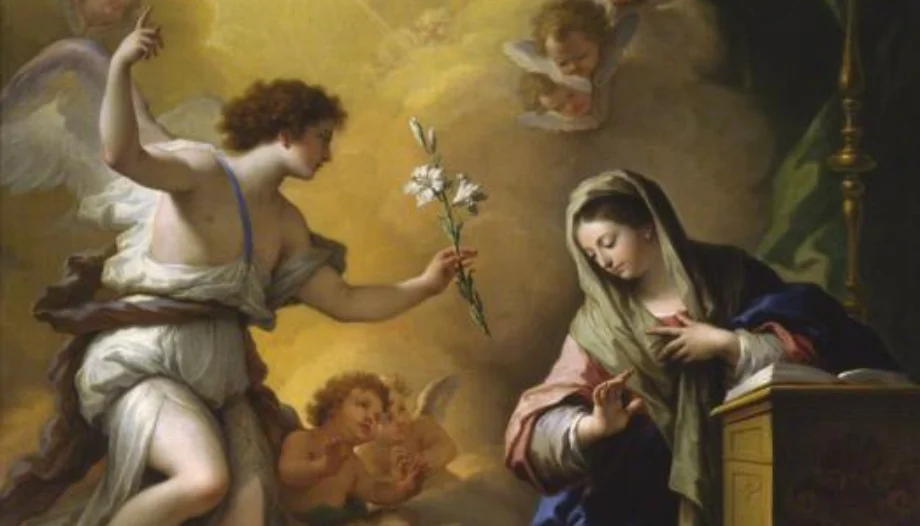
Each Advent, the liturgy leads us to a specific place: Nazareth. A simple house. An unknown young woman. And a word that, spoken in that silence, resonates today with an uncomfortable force: «Behold the handmaid of the Lord» (Luke 1:38).
It is striking that, at a time when freedom and personal dignity are being championed, such a brief expression arouses a visceral discomfort in many women, especially young women. The word «slave» evokes images of oppression and loss of dignity, and it seems difficult to reconcile it with the figure of Mary, a model of freedom, strength, and human fulfillment.
However, Advent does not shy away from difficult questions: it illuminates them.
1. What does it really mean? doulē?
The Gospel of Luke was written in Greek, and the word Mary uses is doulē, feminine form of doulos. In the civilized world of the first century, it could legally refer to a slave, but in the Bible this word takes on a luminous and surprising twist.
The Septuagint calls «servants of the Lord» to Moses, David, and the prophets, not to degrade them, but to indicate that they belong uniquely to God. Saint Paul bears this title with apostolic pride and repeats it 17 times in his letters as a confession of identity. Mary herself, in her Magnificat, says again «has looked upon the humility of his servant», revealing that this word does not diminish her, but rather defines her spiritually.
In Scripture, doulē It does not express oppressive servitude, but rather loving belonging, radical availability, and a liberating surrender. It is the great Christian paradox: those who surrender themselves to God do not lose their freedom, but rather see it elevated to its highest expression. Advent begins here: in the certainty that God's will does not crush, but rather enriches.
2. Handmaid of the Lordin the tradition
Throughout the centuries, Handmaid of the Lord It became one of the most cherished expressions in Christian spirituality, especially for women who found in it not an echo of oppression, but a name of their own. For them, this phrase described a specific way of being before God: open, available, capable of welcoming grace with a fullness that does not nullify, but transforms.
Saint Catherine of Siena signed her letters as «servant and slave of the servants of God,» and there was no trace of resignation in her words, but rather the joy of knowing that she belonged entirely to Christ. Saint Teresa of Calcutta spoke of herself as «a pencil in the hands of God,» a simple and powerful image of a life that allows itself to be written by Love. For centuries, thousands of nuns embroidered Handmaid of the Lord in their habits, making it clear that their identity consisted of being a space available where grace could act.
Why did this expression, so disconcerting to some today, fascinate so many Christian women? Because in it they discovered something deeply feminine: the ability to give oneself without losing oneself, to give oneself without diluting oneself, to make room for another to live without renouncing one's own dignity. When a woman loves, she does not shrink: she expands. She does not cancel herself out: she becomes fruitful. She does not disappear: she blossoms. In that capacity to welcome and give life—both physically and spiritually— Handmaid of the Lord acquired a luminous meaning: to reveal a freedom that arises precisely from surrender.
Mary perfectly embodies this mystery. Her «let it be done» concentrates the spiritual maturity of one who understands that surrendering oneself is not giving oneself up, but allowing God to be God. In her, Handmaid of the Lord It is not a gesture of inferiority, but a declaration of identity: Mary belongs entirely to God, and that is why God can come out to meet the world through her.
3. A contemporary malaise... and an opportunity
It is not surprising that, in a culture deeply wounded by violence against women, trafficking, and abuses of authority—including within the Church—the word «slave» provokes rejection. This sensitivity is not the enemy of faith; it is a cry that asks to be heard with respect and welcomed with patience, because it arises from real wounds.
Faith does not seek to avoid that pain, but to face it at its root. Understanding the doulē Mary demands, first, that we lament and firmly reject structures that oppress and strip away dignity. If the Gospel is not capable of being outraged by injustice, it loses its liberating power. Only by embracing the legitimacy of this historical rejection can we approach the purity of the ‘yes’ of Nazareth, which has nothing to do with coercion or submission.
Precisely for this reason, Advent urges us to enter into the text without fear, to discover its heart. When Mary says «Here is the handmaid of the Lord.», it is not absorbed or nullified. No one forces it. No one conditions it. No one pushes it. His word is born of a freedom so pure that it can only spring from love. And it is this freedom that allows the Incarnation: his availability opens up a space in history where God can become man.
Mary's «slavery» is not submission, but motherhood: a yes so profound that it becomes a dwelling place for Life. God does not hide her; he reveals her. He does not diminish her; he magnifies her. He does not use her; he exalts her with the greatest dignity ever granted to a human creature. His «let it be done» does not destroy her; it fulfills her.
This contemporary discomfort, far from forcing us to water down the Gospel, can become a precious opportunity. Instead of changing the text, we can help people discover what it really means, showing that biblical language does not speak from the oppressive categories we reject today, but from a logic of love that liberates and transforms.
The free slave
On her hurried journey to the hill country of Judah, Mary reveals the secret to us: her «servitude» is the purest form of freedom. It is the tone of a heart that has discovered that true greatness does not consist in asserting oneself, but in opening oneself; not in possessing, but in giving oneself; not in controlling, but in letting God do his work.
To say today Handmaid of the Lord is to embrace a freedom deeper than that promised by the world: the freedom of one who no longer needs to protect himself from God because he has learned that in Him there is no threat, but home.
Those who truly utter these words do not diminish themselves: they expand. They do not disappear: they reveal themselves. They lose nothing: they receive everything. And in the secret of that «let it be done,» the same creative spark is always ignited: the possibility of new life, the divine irruption that transforms the everyday, the silent beginning of the Incarnation.
God saw the humility of his servant... and the world dawned differently. Happy Advent to all! handmaid of the Lordtoday. May your «let it be done» —perhaps uttered in the discretion of a prayer or in the harshness of a difficult decision— continue to open doors through which light can enter the world.
Doctor of Canon Law




 Español
  English
  Italiano