




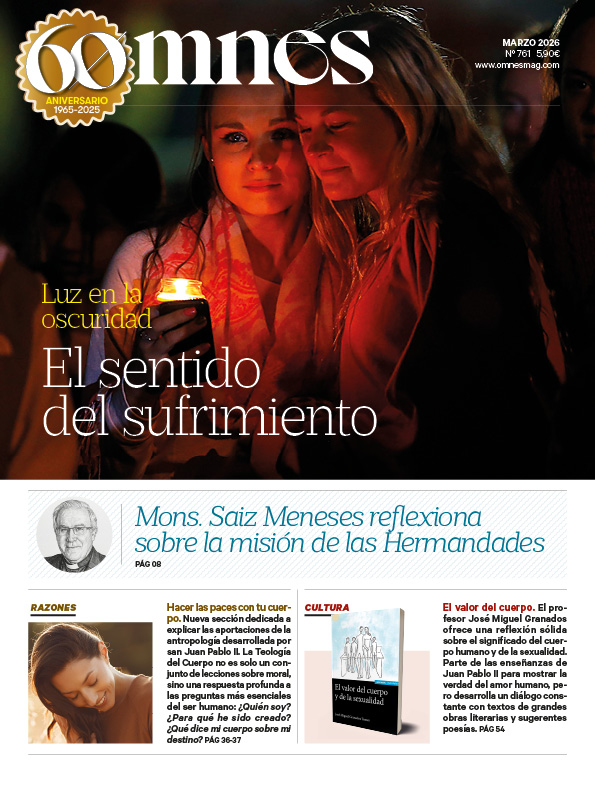
 "In the face of hypersexualization, educate the body to love".Body. Love. Where does the separation between nature and person lead?J. M. Granados presents "The value of the body and sexuality"."
One afternoon, while talking to a young man, he told me something that left me very thoughtful: “My body is my enemy.”.
He didn't say it with anger, but with weariness. He told me about this constant fight of comparing himself all the time, of being frustrated, anxious, of falling into habits he didn't want....
I gave him some advice, tried to encourage him... but when he left I kept thinking that it was not the first time I had heard something like that. And, although perhaps they didn't use such direct words, I had heard it before from students, from friends, in theological reflections during my studies in Rome. In short. It seemed to be something that many of us can feel, but few of us dare to tell. It is impressive to discover how many people live at war with their own bodies.
That night I wondered if this problem was something to be taken lightly, or if there was something deeper behind it. Could it be that we have forgotten what the body means to Christianity?
The response from St. John Paul II on the Theology of the Body: 129 catecheses preached on Wednesdays during the general audience in St. Peter's Square from 1979 to 1984 and dedicated to reflection on the human body in the light of Revelation.
I decided to study all the texts seriously, and I did my thesis for my degree in Dogmatic Theology on this topic as well. And I understood better something that surely motivated the Pope to dedicate so much time to this theological reflection: If the body is seen as an enemy, the person becomes divided inside. But if the body is discovered as a gift, the person begins to heal.
That is why I am beginning this series of articles. To go through together, step by step, the Theology of the Body under the interpretative key of the body as a gift of God and thus rediscover that Christianity does not despise the body... it illuminates it.
And that if you, dear reader, are going to give a class or talk on the subject, or if you are going to advise a friend about it, you can remind him or her of a truth that we need to hear again: Our body is not an enemy. Our body is a gift from God. And learning to receive it as a gift can change our lives. Our human relationships. Our way of approaching God. Our way of striving to be good Christians.
Let's get started....
The current view of the body vs. the Christian view of the body
We live in a culture that sends two opposing messages about the body. On the one hand, the body is everything: we are worth for our appearance, for our performance, for the pleasure we achieve. Hours comparing ourselves on social networks, impossible diets, fear of aging, obsession to be liked.
On the other hand, the body is worthless: it becomes something to be used, it doesn't matter if it is modified, it is discarded when it is uncomfortable. Two different paths that end in the same sadness.
The Christian faith begins in another place. In Genesis, when God creates man and woman, he says: “God saw all that he had made, and it was very good.” (Genesis 1:31). This is not a decorative phrase. It is a fundamental revelation: everything in the human being is good, not only his soul, but also his body, because it has come from the hands of God.
As Karol Wojtyła explains in. Person and action, The person is not a soul that has a body: it is his body. Thanks to the body we can pray, sing, work, embrace, ask for forgiveness. Without the body, love is not seen.
This is why Christianity does not despise matter; in fact, the center of our faith is that the Word became flesh. From the body of the Child in Bethlehem to the resurrected body of Christ, Christian history confirms the ever-present goodness of our humanity.
The great secret of the body
Only with the body can we love as true humans. Love needs visible gestures: a word, an embrace, a caress, a silent sacrifice. But these gestures must be full of truth. Because there are acts that look like love... and are not: a kiss can betray, like Judas“. An ”I love you" can hide selfishness. But as we can see in these examples, the body does not lie: it reveals what is in the heart.
Therefore, it is important to consider that when love is transformed into material -corporal- acts of service, forgiveness, care, surrender, the body speaks its true language. When it becomes use, domination or manipulation, the problem is not the body, but the wounded heart.
The great secret of the body is this: it is made to truly love.
When the body speaks your language
We have all experienced the joy after helping someone. The peace of a sincere hug. The happy tiredness after working for others. In those moments we discover something: our body does not separate us from God, it brings us closer to Him. Because we experience that the body is the place that allows the person to enter into communion, to give himself.
How to convince me of all this? By going deeper into the Theology of the Body. Not as a beautiful but impossible theory, but as a meditation on our Christian hope: the Word made flesh.
In Christ's humanity we also see the fullness of our humanity: to return to the Father with a healed heart and a glorified body.
Even if you have fallen many times, even if you carry wounds or shame, remember: that is why Jesus came. In the Easter liturgy the Church sings: “O happy guilt that deserved such a Redeemer!” It is no coincidence, nor mere poetry, Christ came to heal the heart... and to redeem our body as well.
A decision for today
Look at your hands. Feel your breath. Look in the mirror. They are not an enemy. They are not a mistake. They are a gift. Part of a whole body that is called to resurrection.
Start today with something small to let the body speak its language: an act of generosity, a sincere confession, an apology asked in time, a silent service. Then you will discover something surprising: your body ceases to be your enemy and becomes your best ally in learning to love, because it is identifying itself with the actions of Jesus, God and true man.
Licentiate in Dogmatic Theology from the Pontifical University of the Holy Cross.




 Español
  English
  Italiano