



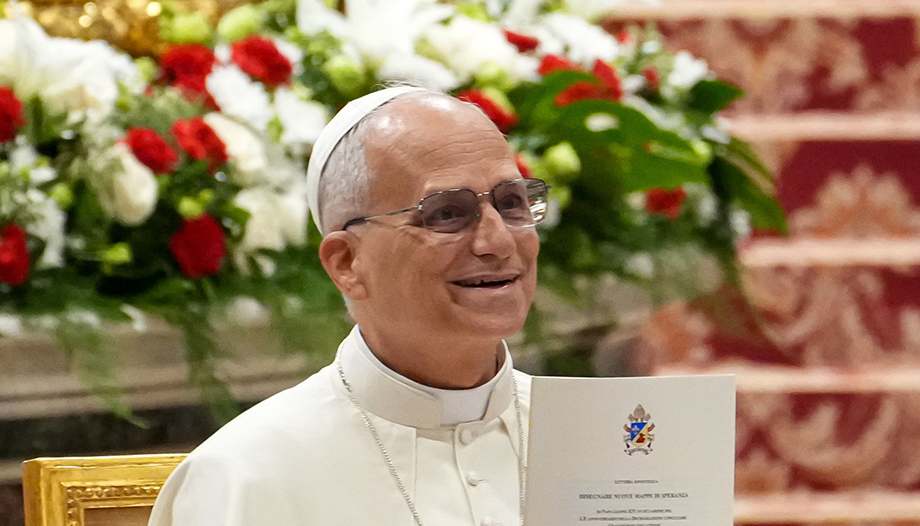
We all know that education is an important and difficult issue. What would be the emphases and priorities in a Christian-inspired education? How does Pope Leo XIV see it?
The transition from October to November had a marked educational character in terms of the Pope's teachings. First, the publication of the Apostolic Letter on education Designing new maps of hope, on the occasion of the 60th anniversary of the conciliar declaration Gravissimum educationis. A few days later, the anniversary of the educational world was celebrated.
“Designing new maps of hope”
On the occasion of the 60th anniversary of the conciliar Declaration Gravissimum educationis, The Pope has published the apostolic letter. Designing new maps of hope (October 27, 2025).
In it, he explains that education is the “fabric itself” of evangelization (cf. 1. 1). It is a “choral work” of the entire educational community. “Christian education is a collaborative effort: no one educates alone. The educational community is a ‘we’ in which teachers, students, families, administrative and service staff, pastors, and civil society come together to bring life.”. And Leo XIV observes: “This ‘we’ prevents water from stagnating in the swamp of ‘it's always been done this way’ and forces it to flow, to nourish, to irrigate.” (3. 1).
In our complex world, Christian-inspired education, with its own identity, is as necessary now as it was during the Second Vatican Council, if not more so. It is like a compass (in the furrow opened by the declaration Gravissimum educationis) to navigate the new urgency educational (caused by wars, migrations, inequalities, and various forms of poverty). At the same time, it is one of the highest expressions of Christian charity (cf. 1. 3).
Education, and especially Christian-inspired education, is a task of love (3.2). And it has the responsibility to rebuild trust (4. 3).
A comprehensive anthropological perspective
The educational tradition of Christians has a long, dynamic, and living history (cf. 1.2, 1.3). Today, too, it must be renewed on the basis of a comprehensive vision of the person., and with the premise of the relationship between faith and reason, without forgetting the emotional and social aspects, since truth is sought in community. Listening to questions and dialogue are essential. And there is no room for functional reductionism.
“We must not separate desire and the heart from knowledge: it would mean breaking the person.” (3. 1); “A person is not a ‘skills profile,’ not reducible to a predictable algorithm, but rather a face, a story, a vocation.” (4. 1).
Catholic pedagogy presupposes a comprehensive anthropological perspective with Christian perspective (Christian anthropology: an integral humanism that includes social responsibility, spiritual contemplation, and also the contemplation of created beauty, promoting sustainable lifestyles).
Christian formation therefore goes beyond functionalist and utilitarian visions that are overly dependent on the labor market and finance; it calls for discernment of people's situations and circumstances and promotes fraternity among peoples (cf. 4. 2.).
It is necessary to educate in the relationship between faith, culture, and life, in collaboration with families (parents are the first educators, and the State must respect the principle of subsidiarity). Equally necessary is the Christian witness of teachers, as well as their ongoing formation in various scientific, pedagogical, cultural, and spiritual aspects (cf. 5.2, 5.3).
From the point of view of educational institutions (today greater generosity and vision are required, in the service of society and the Christian mission), there is a call to grow in collaboration between different educational charisms, with creativity and a spirit of service, including discernment of technology, and giving primacy to the maturation of the person (cf. 8.1 and 8. 3).
“This constellation demands quality and courage: quality in educational planning, teacher training, and governance; courage to guarantee access for the poorest, to support vulnerable families, to promote scholarships and inclusive policies.” (10. 4).
Proposes to resume (and expand) the priorities of the Global Education Pact launched by Pope Francis, expanding on his seven goals (special attention to the person, children and young people, women, the family, welcome and inclusion, the renewal of the economy and politics at the service of human beings, and care for our common home) with three others, referring to the interior life or interiority, human digitality, and education for peace (cf. 10. 1 and 10. 3).
Forming “educational constellations”
During this Jubilee of Hope, Leo XIV addressed two speeches to students and educators, had another meeting with members of Catholic universities, and celebrated Mass in which he proclaimed St. John Henry Newman a Doctor of the Church and co-patron, with St. Thomas Aquinas, of Catholic educators.
At the meeting with students (October 30, 2025), with the words of Pier Giorgio Frassati, he encouraged them to life to the fullest: “Living without faith is not living, but merely getting by.”. You also have to live. “Upwards”.
Against the backdrop of Newman's figure, he invited them to shape their lives in analogy with the stars: “True peace is born when many lives, like stars, come together and form a pattern. Together we can form educational constellations that guide the way forward.”.
And he noted: “Travelers have always found their way by the stars.”.Students also have stars or compasses that guide them (parents, teachers, priests, good friends, etc.). At the same time, they are called to form constellations of meaning with others, to become “shining examples for those around them”.
Galileo discovered many things by looking up. Education, says Leo XIV, is like “A telescope that allows them (students) to look beyond, to discover what they would not see on their own. So don't stop to look at your phone and its quick fragments of images: look at the sky, look up.”.
The Pope paused on the three new objectives he has added for the Global Education Pact, partly at the request of the young people themselves: inner life, digital education, and education for peace. Inner life: “It is not enough to have great scientific knowledge if we do not know who we are and what the meaning of life is. Without silence, without listening, without prayer, even the stars go out. We can know a lot about the world and ignore our hearts.”. As St. Augustine teaches, educating for the interior life means “Listen to our concerns, don't run away from them or fill them with things that don't satisfy.”. “Our desire for infinity is the compass that tells us: ‘Don’t settle, you are made for something greater,’ ‘don’t settle for just getting by, live!’”.
With respect to the technology, he urged them to use it wisely without letting it use them; to cultivate emotional, spiritual, social, and ecological intelligence; and to build spaces for fraternity and creativity. And the peace education This is achieved by rejecting violence and vulgarity and promoting the dignity of all.
Interiority, unity, love, and joy
The following day (October 31, 2025), the Pope held a meeting with educators from around the world. “Thanks to the luminous constellation of charisms, methodologies, pedagogies, and experiences that you represent, and thanks to your “polyphonic” commitment in the Church, in dioceses, in congregations, religious institutes, associations, and movements, you guarantee millions of young people an adequate education, always keeping the good of the person at the center of the transmission of humanistic and scientific knowledge.”.
Referring to Saint Augustine, he pointed out four fundamental aspects of Christian education to educators: inner selfthe unitthe love and the joy, as the “cardinal points” of his task.
Interiority: “Truth does not circulate through sounds, walls, and corridors, but rather in the profound encounter between people, without which any educational proposal is doomed to failure.”, and this is important for both teachers and students. Unit in Christ and in educational centers, where sharing knowledge is a great act of love. He warned of the risk that artificial intelligence could contribute to students' isolation from themselves. Above all, he encouraged a love concrete: “In the field of education, then, each person could ask themselves what their commitment is to understanding the most urgent needs, what efforts they are making to build bridges of dialogue and peace, even within teaching communities; what their capacity is to overcome prejudices or limited views; how open they are to co-learning processes; and how committed they are to responding to the needs of the most vulnerable, poor, and excluded. Joy: because “the very joy of the educational process is fully human.”.
On the same day, October 31, the Pope met with members of Catholic universities in Latin America and the Caribbean. He asked them to create spaces for encounter between faith and culture: “The aim of Catholic higher education is none other than to seek the integral development of the human person, forming minds with critical thinking skills, hearts of faith, and citizens committed to the common good. And all this with excellence, competence, and professionalism.”.
As “beams of light in the world”
Finally, on November 1, the Pope celebrated Mass on the Solemnity of All Saints, closing the Jubilee of Education and proclaiming St. John Henry Newman a Doctor of the Church. This saint will serve as an inspiration to many generations. “with hearts thirsting for infinity, ready to embark, through research and knowledge, on that journey which, as the ancients said, takes us ‘per aspera ad astra’, that is, through hardship (to the stars).”.
On this solemn occasion, the successor of Peter expressed his desire to reiterate to educators and educational institutions: “They shine today like rays of light in the world (Philippians 2:15), thanks to the authenticity of his commitment to the communal search for truth, his consistent and generous sharing, through his service to young people, particularly the poor, and in the daily experience that ‘Christian love is prophetic, it works miracles.’” (Dilexi te, 120).
In his homily, Leo XIV presented the path of the Beatitudes and proposed working together., "for -in the words of Pope Francis- freeing human beings from the shadow of nihilism, which is perhaps the most dangerous plague of today's culture, because it seeks to erase hope.” (Speech November 21, 2024).
Evoking Newman's prayer “Kind Light,” Pope Prevost proposed: “Let us contemplate and point out those constellations (the great reasons for hope), which transmit light and guidance in our present, darkened by so many injustices and uncertainties.”.
Also following Newman, he presented education as the task of helping each person discover their vocation and mission: “We are called to form people, so that they may shine like stars in their full dignity.”. In other words, helping everyone to become saints.. “And holiness is proposed to everyone, without exception, as a personal and communal path traced by the Beatitudes.”. That is, he said, what the Pope prays for: “May Catholic education help each person discover their vocation to holiness.”.




 Español
  English
  Italiano