



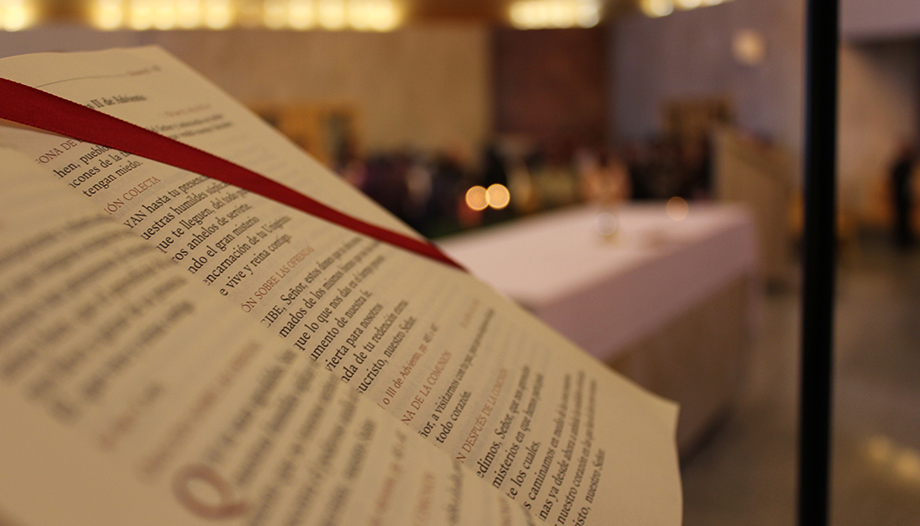
«Having loved his own who were in the world, he loved them to the end.» (Jn 13:1). At this sacred moment of Holy Week - the mother of all weeks, the most important week of the liturgical year - we enter the Easter Triduum with today's celebration. The Sacred Triduum begins with that which most profoundly characterizes God and Christianity: love. Tonight we celebrate the Mass of the Lord's Supper, the institution of the Holy Eucharist.
Today's liturgy is marked by love in action. St. John, in his account of the Last Supper, introduces the scene with a profound affirmation: Jesus «he loved them to the end». It is not a half-hearted love. It is a love taken to the extreme, a love taken to its fullness and fulfillment. John tells us that Jesus knew that his «hour» had come - the hour of his passion. The Cross was to be the most radical manifestation of his love, because «Greater love hath no man than this, that a man lay down his life for his friends». However, even before this supreme act, the Lord offers his disciples a concrete sign of this love: he washes their feet. It is, so to speak, an anticipation of the mystery of the Cross.
God loves us so much that he comes down to meet us at our feet. He comes down from divine glory, takes on the condition of a servant and meets us in our fragility and misery. In Christ Jesus, God kneels before humanity. He performs the work of a slave, washing our dirty feet, purifying us so that we can sit at his table and participate in the Eucharistic banquet.
The first reading recounts the eating of the Passover lamb-the prefiguration of the Lord's Supper in the Old Testament. The second reading, taken from St. Paul's first letter to the Corinthians, presents the fulfillment of this prefiguration in the New Testament and shows how this mystery has been transmitted to us. In the Gospel, however, we see the inner attitude that moves everything: love. Love is the force that impels Christ to give himself completely.
In the face of such extreme and complete love, we can respond in two ways: like Peter or like Judas. Jesus' love is so overwhelming that it leaves Simon Peter bewildered. When Jesus approaches him, Peter protests: «Lord, will you wash my feet?» Jesus responds: «What I do, you don't understand now, but you will understand later.». Pedro initially resists: «Thou shalt never wash my feet.», Jesus answered him: «If I don't wash you, you have no part with me.». Peter struggles to understand, but in the end he allows himself to be loved. Faced with such humility and such radical love, he hesitates, but does not close his heart.
Judas, on the other hand, responds differently. Jesus says: «You are clean, though not all of you.«. John explains that Jesus knew who was going to betray him. Judas does not openly question or protest. Rather, he silently rejects such extreme and complete love. It is the rejection of love - not wanting to be loved, not loving - that makes man impure.
Are we capable of accepting such a complete love, or do we easily reject it because we do not understand it? Jesus has remained in the Eucharist out of love. He loves us also in radical ways. Lack of understanding should not lead us to rejection, but to deeper communication with God. Are we open to love or closed to it?




 Español
  English
  Italiano