



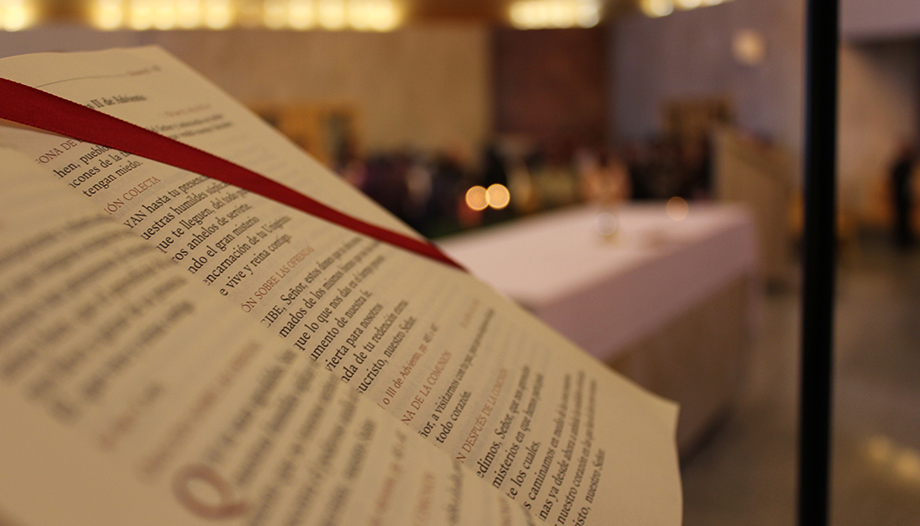
In this Sunday's liturgy we find Jesus seated on the chair on the mountain. We continue the reading of the same chapter of Matthew proclaimed in previous Sundays, the great “Sermon on the Mount”. After announcing the Beatitudes and revealing the identity and mission of Christians as the salt of the earth and light of the world, today we find our Lord speaking with the authority of the Lawgiver himself: “You have heard that it was said to those of old ... But I say to you.".
This decisive expression -“But I say to you” - reveals the authority with which Jesus teaches. He does not limit himself to interpreting the law; he is the law. He knows it from within and leads it to its true and definitive height. Jesus is the fulfillment of the law. In his own person, the law reaches its fullness.
The law given by God to the chosen people through Moses and the prophets was a sign of God's loving revelation, and fidelity to the law expressed Israel's fidelity to him. Obedience to the law was, at its deepest core, an act of love. Now Jesus declares that he himself is that to which the law and the prophets pointed. The relationship of love between God and his people is now definitively linked to the person of Christ.
From the beginning of the Sermon on the Mount, Jesus is clear: he did not come to abolish the law or the prophets, but to give fullness. What does this fullness mean, then? It is not a subtraction, but a plus; not a weakening of the law, but its deepening. Jesus leads us beyond mere external observance to an interior adherence of the heart. This is why he can say: “For I say unto you, Except your righteousness shall exceed the righteousness of the scribes and Pharisees, ye shall in no wise enter into the kingdom of heaven.”. This “more”is not a competition, but a call to a more radical conformity to Christ himself and to what is good. The Christian vocation goes beyond avoiding sin or doing only the minimum. We are called to a continuous growth in our relationship with Christ, to a deeper friendship with him, to an interior communion that transcends external observances. It is a joyful and positive affirmation of following Christ more closely.
In today's Gospel, the expression “but I say to you”.” is repeated several times, and on each occasion Jesus raises the level, exhorting us to reject sin at its root. This harmonizes with the conclusion of the first reading from the book of Sirach, which affirms that God does not incite anyone to sin: “God does not incite anyone to sin.“He compelled no one to be wicked, and gave no one permission to sin”. God desires our holiness and therefore clearly reveals to us what separates us from him. Avoiding sin is an act of fidelity, a grateful response to the love God has shown us. The Christian is called to reject every form of sin, even venial sins, and to strive to live the virtues in a heroic way. Every sin, no matter how small it may seem, is a form of infidelity to the love we have received.
Finally, Jesus reminds us that the Kingdom of God is at stake in our obedience to the law. Our relationship with the Lord, and indeed our eternal destiny, are implicated in what may seem like small things. Our actions in this life resonate into eternity. Not to identify ourselves with the Law-that is, with Christ Himself-is to choose separation from Him. Hence the gravity of Jesus“ words: "For I say unto you, Except your righteousness shall exceed the righteousness of the scribes and Pharisees, ye shall in no wise enter into the kingdom of heaven.”, and also: “it is better to lose a limb than to go to the gehenna”.
Fidelity to the commandments is fidelity to Christ himself. We are called to live this fidelity fully -inwardly and outwardly-, letting the law, fulfilled in Christ, shape our life and lead us to the Kingdom of heaven.




 Español
  English
  Italiano