



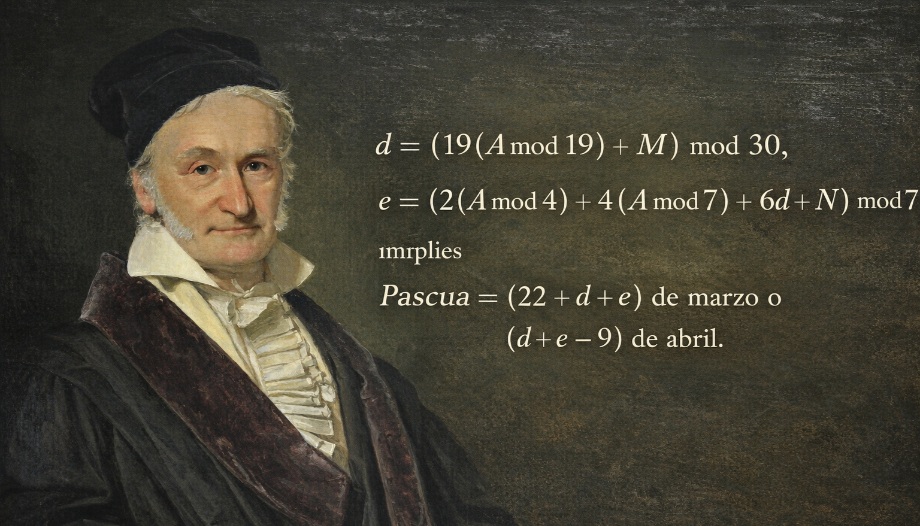
The calculation of the date of Easter has always given rise to some headaches. As is well known, we celebrate the Resurrection of Our Lord on the Sunday following the first full moon of spring. Every year, therefore, we have to go to the calendar to find out when this feast is celebrated, since the beginning of Lent and, in a way, the whole liturgical calendar is also fixed according to that date.
It is easy to realize that the calculation of that day is not a simple task: three different calendars have to be squared: the solar calendar -it has to be in spring-, the lunar calendar -full moon- and the weekly calendar -it has to be Sunday. And that means taking into account the translation movement of the Earth, the translation movement of the Moon and the daily rotation of our planet. This is complicated enough in itself, but it is compounded by the fact that these are not exact movements: the Moon goes around the Earth in 29 days, 12 hours and 44 minutes, while the Earth takes 365 days, 5 hours and 49 minutes to go around the Sun.
There are not only leap years
The problem of the year not lasting an exact number of days is solved by adding or subtracting a day from time to time. As is well known, every four years we add a new day, February 29, giving rise to leap years. But it may not be so well known that this arrangement is not entirely accurate. Therefore, once every century it is necessary to “remove” that extra day, to square the calendar again. And not only that: every four hundred years, it is necessary to add a new day.
In short: a day is added to those years that are multiples of 4, except if they are multiples of 100, unless they are multiples of 400... Thus, the year 1900 -multiple of 100- was not a leap year, but the year 2000 was, since it was a multiple of 400. The year 2100 will not be a leap year either, as well as the years 2200 and 2300.
In short, as can be seen, the calculation of the date of Easter presents a difficulty that also makes it an interesting mathematical problem. In fact, since the Gregorian calendar was established in 1582, there were several scholars who tried to find an exact mathematical formula that would give without errors the right day for each year. But it was not until the 19th century that Carl Friedrich Gauss found the right formula.
A mathematical problem
The figure of this German scholar is quite interesting, and not only because he was one of the greatest mathematicians in history: already during his lifetime he was nicknamed Princeps Mathematicorum. It also stands out because, despite the criticism of what we could call the «reigning intelligentsia» of his time - when being a believer was not «politically correct” - Gauss always manifested himself as a believer and practitioner: we know from his biographers that he read the Gospel every night. In the original Greek, by the way...
As a good scientist, Gauss was perfectly aware that science is enormously powerful, but that it would be naive to pretend that it could explain everything. I copy a phrase of his that his biographer G. W. Dunnington quotes: «There are questions whose answer I would place in an infinitely higher value than that of mathematics, for example those that refer to ethics, or to our relationship with God, our destiny and our future; but their solution remains unattainable above us, outside the area of competence of science».
The formula
As we were saying, Gauss looked for and found the mathematical formula that allows to calculate the date of Easter. For this it is necessary to establish two constants, M and N, which change every century. In the present case, the 21st century -although, coincidentally, they are also valid for the 20th century-, they are the following: M = 24 and N = 5.
Then, five values are set:
a is the remainder of the division of the year by 19
b is the remainder of the division of the year by 4
c is the remainder of the division of the year by 7
d is the remainder of the division of (19a + M) between 30
e is the remainder of the division of (2b + 4c + 6d + N) among 7.
f is d + e
Having made these calculations, if f is less than 10, then Easter will fall on the day (f + 22) of March. Otherwise, it will fall on the day (f - April 9).
Thus, in this year 2026, we have a = 12, b = 2, c = 3, d = 12, e = 2 and f = 14. f is greater than 10, subtract 9 and the result is that Easter 2026 is April 5.
Physicist and priest.






 Español
  English
  Italiano