




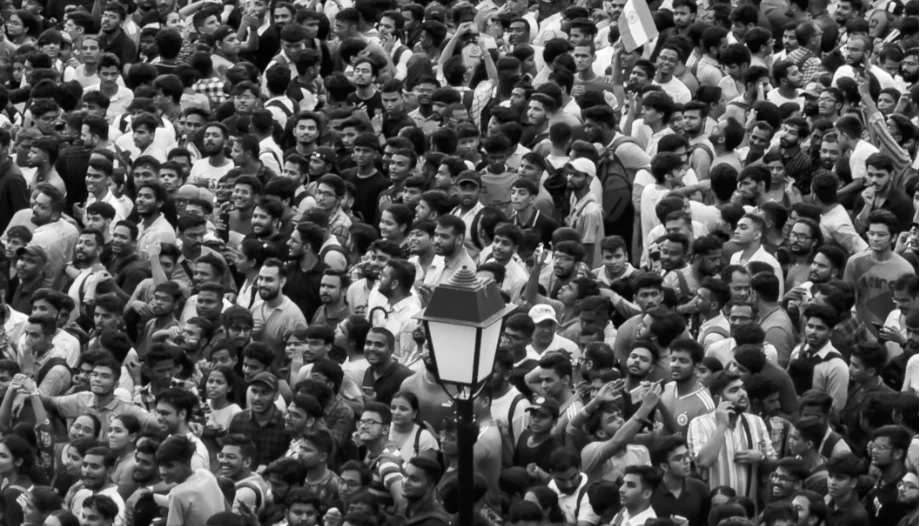
Fulton J. Sheen wrote in 1948 in Communism and Western Consciousness that the conscience of the Western world is at stake, “since it has lost the concept of man as a being made in the image and likeness of God and has reduced him to an integral part of the universe, an economic animal or a physiological bag full of psychological libido.
He added: “When man became materialized and atomized in Western thought, it was only natural that a form of totalitarianism should emerge that would bring the fragments together into a new whole and replace the individual man, isolated from all social responsibilities, with the collective.”.
It does not seem that the situation has changed 77 years later. But we are not resigned—whether there are many or few of us, I do not know—to the loss or abandonment of the concept of man as the image of God. Indeed, the ontological degradation of the human being leads to collectivism, because en masse things and people seem to have greater consistency. That is why statistics is the queen of sciences, and quantitative evaluation reigns supreme over qualitative evaluation.
We refuse to be subsumed by this collectivism or to be considered machines, cockroaches, poorly finished chimpanzees, or specks of dust. With Renaissance humanism, a successful synthesis of Judeo-Christianity and Greco-Latin culture, we maintain that we are of divine lineage, the image of God, and even the image of Christ. And we do not say this because we are Eurocentric or vain, but because we seek the truth about man.
So-called artificial intelligence renews this debate, reminding us that the man who created it is more intelligent, and that man himself is not just computational: he is intelligent, rational, free, sensitive, passionate... and capable of God, a being in search of meaning, a homo sapiens before a homo habilis.
From a humanistic perspective, we review a culture focused on doing, subservient to technology and dominated by an omnipresent, bureaucratic state, a manufacturer of collective emotions (to paraphrase Simone Weil) and pontiff of substitute religions such as environmentalism and feminism. The question is to leave the media cave—reductionist, fragmentary, and mediated—and settle into the culture of the book rather than that of the tweet.
Ecology and feminism must be integrated into a unified, non-fragmentary anthropology that does not absolutize or messianize fragments. Nature and man; male and female. A comprehensive, humanistic vision that does not bow down to the calculator and the test tube: one that trusts in speculative and poetic reason, not geometric reason. A spirit of Pascalian finesse.
Humanism. The state for the people (not the other way around). Technology for the people (and not the other way around).
Antonio Barnés has just published Image of God, a dialogue on human dignity.
Image of God. Dialogue on the dignity of man.







 Español
  English
  Italiano