



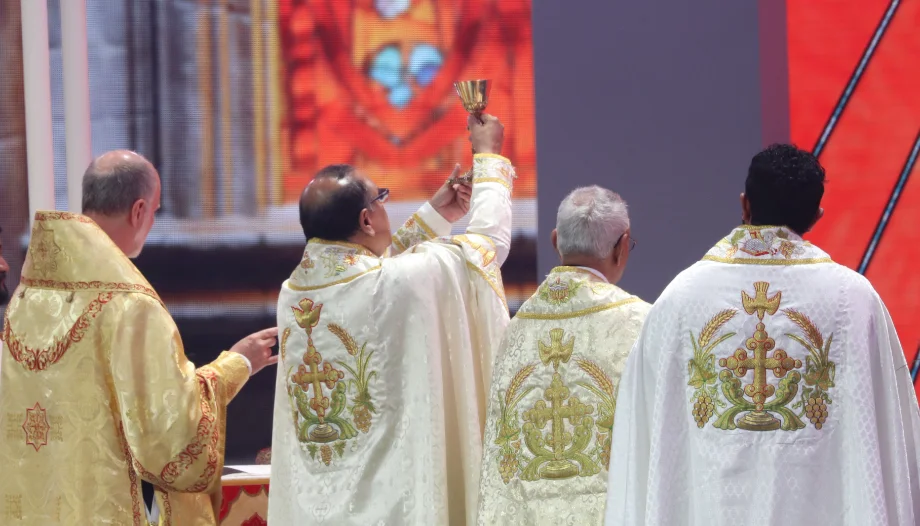
Almost a year and a half. This is the time that, at least one morning a week, I have been listening to a priest alter the words of Jesus in the formula of the Eucharistic consecration: instead of saying, with regard to the precious Blood of the Lamb, “which will be poured out for you and for many...”, the minister introduces a particular innovation: “For you and for all mankind”. Just like that, so quietly. Again and again.
And again and again this writer - and believer - wonders why he continues to do so. Yes, yes: I have already spoken to the gentleman, but he is unapproachable to discouragement. “It's just that I couldn't stick to a schematic formula,” he tells me, in a sort of vindication of human freedom to transform the rite, to make it more palatable, closer, less rigid... It's not that Jesus said: “For you and for all the immeasurable relation of human beings whose nature was damaged by the first sin and who, if they believe in the Gospel, will be redeemed by me in a few hours”. No, no. It is nothing fancy, nor extensive, nor noisy: it is a simple and faint “and for many”, but it seems to the good priest that the formula stifles him and puts him in an uncomfortable mold that prevents him from making visible the expansive grace of Christ. So no one should feel left out: “This is for all mankind, guys, okay?.
In the decades that I have been practicing the faith, I have certainly seen everything. I will not give a list of anecdotes, because who more, who less, has witnessed some liturgical irregularity, some outburst of tone, some nonsense said from the ambo... But a change at whim of the consecratory formula was not something I imagined I would ever hear. It is the inviolable summit, the sancta sanctórum The verbal and active announcement of the most sublime thing that happens in the universe at that precise moment: that Christ offers himself to the Father, in the Holy Spirit, under two meals that, minutes later, will be distributed to common people, fallible, capable of great injustices..., but capable of faith, of conversion, of amendment.
“Miracle of love so infinite...”, says a song. It is Christ who gives himself to us. It is to tremble, but not with terror: it is that our good God has gone mad with love for a speck of dust. Contemplation, awe and reverence. There is no more.
It is not understood, therefore, that it is necessary to make amends to the blessed Establisher of the Eucharist, as if He had forgotten to tell us something and a priest needed to fix the “forgetfulness” of the Redeemer with a footnote. The Church, of course, in her journey through history, would continue to need help, clarifications, lights..., but nothing has escaped Him. “I still have much to say to you, but you cannot do it now. When he, the Spirit of truth, comes, he will guide you into the whole truth” (Jn. 16:12-13).
And indeed, the Spirit has come. He is still around, and he inspires the successors of the apostles, in communion with Rome, to judge what can be opportune and what not for the People of God, and to do so, moreover, in the light of pastoral experience in a concrete time. Thus it was that Benedict XVI, in his 2012 letter to the German bishops on the adoption of the “and for many” (pro multis) in the new translation of the Roman Missal, noted as the basis for the decision the “reverential respect of the Church” for the word of Jesus and the fidelity of Our Lord to the word of Scripture. “This twofold fidelity,‘ he added, ’is the concrete reason for the formula ”for many'.
In harmony with the Holy Father, four years later the Spanish Episcopal Conference published its Instruction “Celebrating the Eucharist with the Roman Missal”, in which it pointed out that, if the Church demanded “a reverential respect for every liturgical text, so that it is not licit to change or substitute it in whole or in part, this norm must be applied with greater reason to the Eucharistic prayers and especially to the words of consecration”.
So no: we are grateful for the concern about whether “what Christ meant to say was this and not that”, but for that purpose there are already “doctors in the Church” who, assisted by the Holy Spirit, are in charge of the configuration of the Eucharistic liturgy and the preservation of the treasure of faith, of which they know they are administrators, not owners; not owners of this House of ours built on rock, as if they could widen a door or pull down a pillar at will. Let there be no mistake: the Church does not belong to her pastors, but only to a Pastor.
One of the first to forget ended up nailing down his own ideas -sui generis, The first, curious, somewhat bizarre - on a piece of paper on the door of a German church five centuries ago. It was “successful”, it must be said, because it ended up attracting a good group of fans.
But his name is not in the saints' calendar. Nor, foreseeably, will it be.




 Español
  English
  Italiano