




 Our Lady of Guadalupe, Patroness of Extremadura and Queen of the Hispanic WorldCatholics and Public Life: The answer to the decadence of the West is to preach and live the Gospel of the CrossOmnes Forum: "Marriage in the West, from deconstruction to reconstruction".
As philosopher Julián Marías masterfully explains in his work España inteligible (Intelligible Spain), since the mid-18th century, humanity began to believe in an idea that became dogma: that of inevitable progress. Turgot, Condorcet, and other Enlightenment thinkers imagined that history was automatically advancing toward an ever-better future. But the 20th and 21st centuries have shown us that there are no automatisms in history. Progress may exist, yes, but so does regression.
Perhaps the most serious aspect of this progressive mindset has been that it has robbed us of the identity of each era, as if the present had no value in itself, but only as preparation for an ideal future. Against this undefined horizon, cultures ceased to be understood as projects with their own meaning.
In light of this, I propose that we view our history as a vocation. Spain was never an accident or a simple accumulation of events. It was, and continues to be, a conscious project, a historical will that forges its path through uncertainty.
From its origins, Spain understood its existence as a mission. For centuries it was Islamic and Eastern, but a minority decided to keep it Christian and European. That decision was the beginning of a journey that would shape what we now call Hispanic culture.
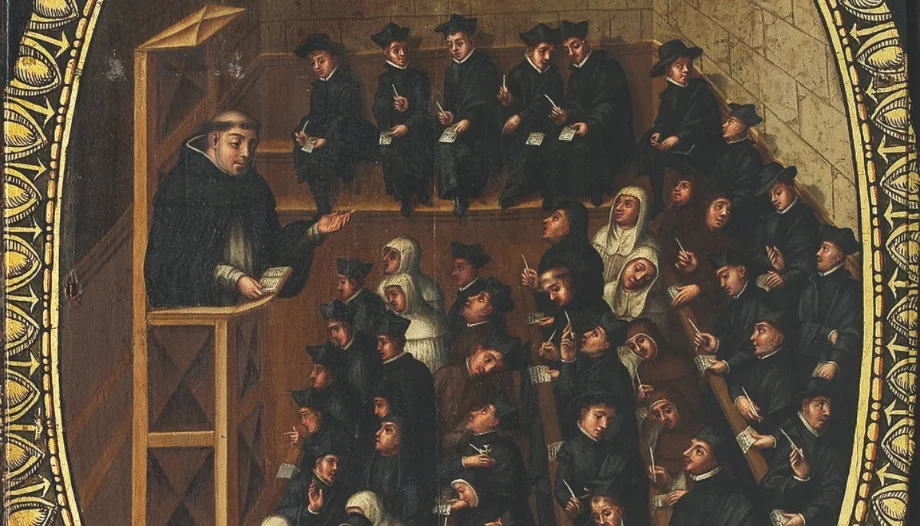
When Charles I arrived in Spain in 1517, two visions of empire were being debated. Gattinara dreamed of a universal monarchy based on conquest. But Pedro Ruiz de la Mota proposed something else: a Christian empire, a universitas christiana based on harmony between peoples and the defense of justice. A few years later, one of the greatest contributions to our history would emerge from these roots: the School of Salamanca, whose 500th anniversary we are celebrating this year. This school would certainly continue its legacy through illustrious figures from the sister university of Coimbra, such as Luis de Molina, Francisco Suárez, and the unjustly forgotten Juan de Santo Tomás.
Francisco de Vitoria, Domingo de Soto, Francisco Suárez, Luis de Molina... all of them were pioneers in affirming that man has an inalienable dignity simply because he is a person. Their reflections on natural rights, just law, and the equality of all before God gave rise to what we now call human rights and international law. Long before the Enlightenment, our universities were already debating whether it was lawful to dominate other peoples or strip them of their possessions. And from those debates emerged specific laws: those of Burgos, those of Valladolid, and the New Laws of 1542, which abolished the encomienda system.
It is fair to remember that the seed of human rights was sown there: in Salamanca, in the heart of Hispanic culture.
From the Black Legend to the identity crisis
However, that effort was distorted. Spain's enemies spread a false image: the so-called Black Legend. In it, Spain was presented as intolerant, fanatical, and backward, hiding its defense of human rights and dignity. This manipulation not only succeeded abroad, but also ended up taking root at home. From the 17th century onwards, many Spaniards began to see themselves through the eyes of foreigners, doubting their own identity.
The subsequent history was, in large part, a consequence of that fracture. The loss of Portugal in 1640 marked the beginning of the decline. The European Enlightenment, with figures such as Montesquieu and Voltaire, revived prejudices against Spain, presenting it as a symbol of irrationality. At the same time, our enlightened thinkers—Jovellanos, Moratín, Isla—who were reformists, moderates, and deeply Catholic, were unfairly identified with the excesses of the French Revolution. This confusion slowed down reforms and fueled a climate of mistrust and division.
Then came the Napoleonic invasion of 1808, and with it, a civil war between two Spains: the traditional and the liberal. When Ferdinand VII restored absolutism, the break was final. The American colonies, influenced by this conflict, gained their independence by renouncing their Spanish heritage. The Creoles, descendants of Spaniards, attempted to found new nations by denying three centuries of shared history. Thus began the crisis of Hispanic identity, the consequences of which we continue to experience on both sides of the Atlantic.
During the 19th century, religion went from being a shared faith to becoming an ideological trench: clericalism versus anticlericalism. Later, the disasters of 1898 and 1936—the loss of the last territories and the civil war—accentuated the disorientation. Spain isolated itself and took decades to rebuild. The democratic transition of 1978 restored freedom, but failed to completely liberate the mentality inherited from the Black Legend. We continue to view our history with complexes, without fully recognizing what we have contributed to the world.
The current mission of Hispanic culture: to renew the West
And yet, the West—that West that today seems to doubt itself—is unthinkable without the contribution of Hispanic culture. The West is based on three pillars: Greek reason, which taught us to interpret reality; Roman law, which gave us the concept of justice and legitimate authority; and the Judeo-Christian vision, which revealed to us that every human being is a child of God and a brother to all men. Spain, and with it Hispanic culture, was the point where these three roots came together. From that union arose a civilization capable of spreading a revolutionary idea throughout the world: that of man as a person.
At a time when Europe was beginning to slide toward materialism and the denial of the spirit, Spain insisted that human beings are not things, nor biological mechanisms, but free, responsible beings called to transcendence. That is why many contemporary thinkers—such as Charles Taylor, John Finnis, Alasdair MacIntyre, and Byung-Chul Han—directly or indirectly acknowledge the influence of the Hispanic legacy in their reflections on dignity and human rights.
Hispanic culture, more than a political concept, is a cultural, linguistic, and spiritual community. It is the awareness of sharing a history, a language, a way of looking at the world. It is the feeling of being at home in any Spanish-speaking country. And that community still has much to say to today's world, which is experiencing a profound crisis of morality and meaning.
Recovering the values of Hispanic culture—reason, justice, and the Christian view of the individual—is, in my opinion, an urgent task. Because if we want our civilization to survive, we must once again believe in man as a dignified, free, and responsible being, created out of love.
It has been precisely the Christian faith that, for two thousand years, has given millions of people a worldview in which truth, beauty, and justice have a place. And it was Spain, through its work in the Americas and Asia, that spread that vision across the globe. With mistakes, yes, but also with a greatness that changed the history of mankind.
Spain has always understood life as a mission. It has not been utilitarian, nor has it subordinated man to the state. It has viewed existence as an adventure and has felt sympathy for the defeated. Its literature, since Cervantes, bears witness to this deeply human and compassionate outlook.
If we prolong that spirit and adapt it to our times—free from prejudice, ideology, and inherited complexes—we will be able to offer the world an authentic renewal of the Hispanic project, a Hispanic culture that once again becomes the living heir to the West and defender of human rights. And hopefully Portugal will do something similar in the Lusitanian world.
Menéndez Pelayo said that “the Catholic faith is the foundation, the essence, and the greatest part of our philosophy, our literature, and our art.” I would add: also of our view of humanity. That is why the Hispanic culture that was and the one that can be again coincide in essence: both are born from the recognition of the dignity of the person.
Our task, in these times of confusion, is simply to continue the historic mission of Hispanic culture without hesitation. To preserve the best of our civilization and, with humility, offer it to the world. Because only by remaining faithful to who we are can we look to the future with hope.





 Español
  English
  Italiano