



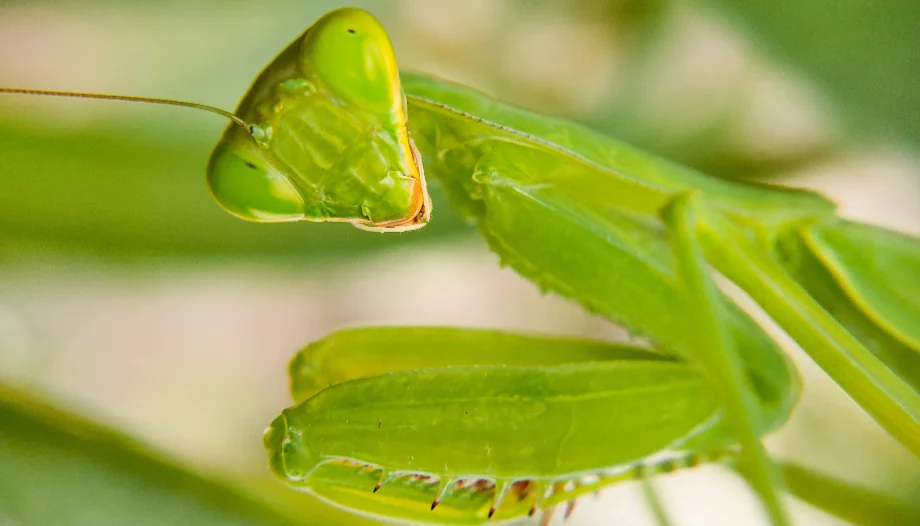
Ever since I was a child, the particular biomechanical shape of insects has fascinated and, in equal parts, disturbed me. The funiculus of the antennae, the insertion of the coxae, the transition between pronotum and elytra or their particular texture and stippling... so familiar and alien at the same time. Perhaps that is why it is so effective to discipline my impatient -and not infrequently scattered- temperament through the illustration of insects. I wouldn't call it a hobby, nor a spontaneous inclination. It is, rather, a form of correction.
Hours of physiognomic exploration, archetyping and graphite. With time, one learns to look -not so much to draw- and as anyone who has ever been interested in portraiture knows, good looking is the basis of good seeing. Holding one's attention is enough for the form to stop being resolved with simplicity and the appearance becomes denser. One begins to discover details, secrets, to ask oneself questions: what makes something like that to be there, not in the trivial sense of its function (that is deeply studied by entomology), but in a more demanding one: what really makes something, like that, to be there?
Is the meticulous architecture of the circulation system of the wings of odonates (a dragonfly, for example) an ontological whim as well as an evolutionary whim? Do its bifurcations hide the secret of God's tongue, in the manner of the tiger's spots that terrified the prisoner of El Aleph?
I am not referring to a suggestive image, nor to a pious metaphor, but to an exact structure: «a phrase whose reading -if it were possible- would be enough to liberate or destroy». Borges had the good sense not to specify further.
Yes.
Yes, and ten times yes.
The Western classical tradition never thought of the world as a set of simply given things. It understood it, rather, as a structure of referral. Not because every creature hides a secret meaning, but because no creature is exhausted in what it shows. Insofar as it is, by its very being, it refers... To what? To its Creator, if I may say so?
Bonaventure considered that creation does not appear as a self-sufficient set of entities, but as a weave of vestigiatraces that go beyond what they show. Not a naked presence of their Creator, of course, but a trace of him. Not everything refers with the same clarity, nor does every creature allow itself to be read in the same way; but nothing remains completely outside this grammar.
The diversity of created things, Thomism tells us, is neither an accident nor a tolerated excess: it is a condition of the perfection of the whole. Fullness is not concentrated at the top and diluted downward; it is distributed. «The perfection of the universe requires that there be inequality in things, so that all possible perfections are represented.» (Summa Theologica q. 47).
Why is there form where there could be none? Why is there determination where indeterminacy would suffice? Hence the question is not whether things “mean” something, as if they carry a coded message, but whether their very ontological consistency is already a way of saying. They do not add meaning; they are in act. Creation does not speak about God: it speaks from Him. «Question the world, question the beauty of the earth, question all things: they will answer you: we are not God, but He has made us.» (Sermon 241). Things do not say what they are; they say from whom they come, as St. Augustine would say.
The created, insofar as it is created, is already a place of access. Mutatis mutandis, As many valid secrets are to be found in the contemplation of the order of the celestial spheres as in the close attention paid to the architecture of a common insect. No accumulation of grandeur comes closer to the origin than the humblest of forms, because what is at stake is not the quantity of being, but its received character; both are, strictly speaking, equally disproportionate to their origin, and both speak to us of their Creator. And here there are words of power, for one thing, the power to turn drawing into prayer?





 Español
  English
  Italiano