




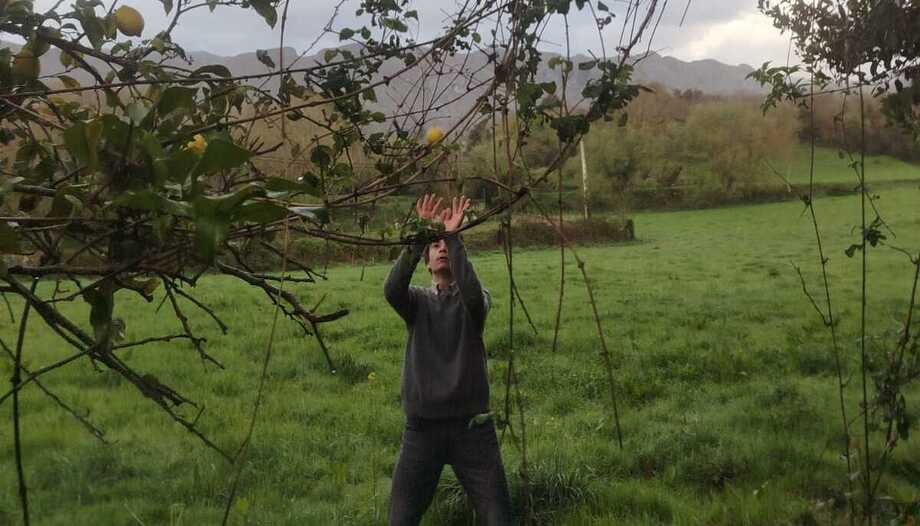
Every time we travel to Asturias, on the other side of the wall, a lemon tree has fun showing us his new stickers. Invariably Santiago and I usually go on the last day in a lightning operation, and while I pluck them and throw them to him he catches them on the fly and keeps them in a bag.
The lemons, polished and yellow, contrast with the gray color of the clouds and shake with joy on Sunday morning. We will return to Madrid, but taking smuggled goods from Asturias.
Fruit trees are poems but with photosynthesis in between. We pluck a few citrus verses to hold out in Madrid, because here it's too foggy and too far away. We take our poetry elsewhere.
Write like this: a yellow lemon growing in a cloudy meadow. Read like this: throwing lemons in the air.
I suppose that beauty, in order to be transported, cannot be too big: I would say it is barely the size of a lemon, and it smiles like a lemon. The yellow of a lemon is simple, not pretentious. The lemon is not so yellow because of the yellow, in fact it is so yellow because of the gray. If the sky were not gray today, the lemon would be less blond.
It's like Madrid a little bit: if Madrid wasn't so official and asphalt and meetings and noise, probably the beauty wouldn't stand out so much. Maybe if Madrid wasn't so regimented, no one would expect anything from poetry. The gray fog is Madrid. Poetry, a red car arriving with kilos of yellow lemons in the trunk.
When poetry hides, you have to pull it out. It is easy to find: the more gray there is around, the more yellow it dares. And on top of that, you can grab it: all you have to do is climb up and throw it into the air.
But nobody even jumps over the wall, because times are very sensitive, very Madrilenian, very regimented. That's why beauty has to be tiny, and be obtained in a lightning operation: lemons taste better smuggled.
Maybe Miguel d'Ors is right. Maybe writing verses is just another way of stealing lemons.






 Español
  English
  Italiano