




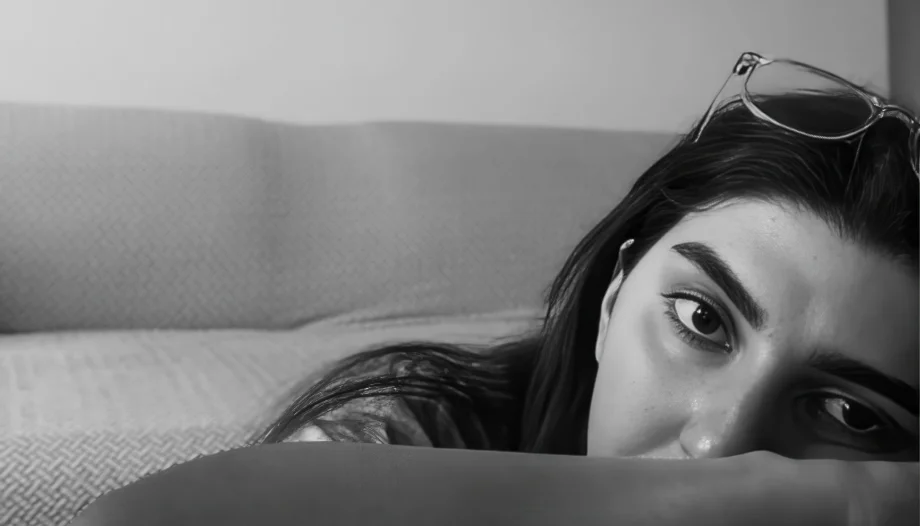
I often feel like I'm just surviving my marriage; that I lack the strategies or resources to enjoy it more. Something always gets in the way: either the kids demanding nonstop attention, the demands of our jobs outside the home, or material needs of some kind: we're out of diaper wipes, cooking oil, or the laundry won't dry no matter what... And, above all, the most difficult thing to overcome is the discomfort that settles between my husband and me when our conversations are reduced to talking about all of this, asking each other for things, and managing the children.
When we spend a long time like this, when life at home is pure management, it is inevitable that we get caught up in mental loops, searching for meaning in this daily repetition that seems to be overshadowing our entire lives. You may even find yourself thinking: when did I get myself into this mess? How do I get out of it? Or even, what if I've chosen the wrong life? I think these are natural questions that we may ask ourselves internally.
In an article published in the New York Times, Alain de Botton states: “The good news is that it doesn't matter if we realize we married the wrong person. We shouldn't abandon that person, but we should abandon the romantic idea on which the Western understanding of marriage has been based for the last 250 years: that there is a perfect being who can satisfy all our needs and every one of our desires.”.
Far from agreeing with everything this thinker argues, there is one idea in his argument that I would like to highlight at all costs. Of course, marriage is a legal contract that seeks to protect all its members; of course, marriage is a sacrament of the Catholic Church where God manifests himself with all his grace so that we can move forward with this intense relationship.
But marriage is also a pact, an agreement that we establish in a certain way at the beginning of the relationship and that we must reestablish again and again in different ways because, with the passage of time and the constant changes that occur throughout our lives, many details of that first pact cease to clearly define our daily lives. Furthermore, many of the expectations we had at the beginning have not been fulfilled, and we must review them so as not to discard the entire relationship along with them.
That question about the meaning of all this chaos is crying out for husband and wife to find more creative ways to live their marriage, and that creativity becomes inevitable, since we are dealing with one of the most dynamic relationships that can exist between two human beings.
This creativity does not seek to break the relationship, but rather to redefine it in such a way that everything we decided when we said “I do” makes sense again. And only a husband and wife can do this for each other; only they can answer questions about the meaning of their marriage and commit to seeing their love through to the end, until death do us part.
This way of looking at our marriage as a constant renewal of that first covenant of love is diametrically opposed to more rigid cultural and ideological proposals, such as the one presented to us in the film “Marriage Story.” There, we see much of the dynamics that a marriage experiences, but we see very little of the creativity that spouses can develop to improve the situation.
This film sensitively portrays the story of a couple united by a child and a shared passion: theater. He directs a company and she is the lead actress in his plays. There is a sense of stability between them: they seem to know each other deeply, admire each other, and care for their child with great dedication.
Everything seems to be going well between them, until one day she announces that she wants to change jobs and move to another city. His reaction is superficial; he doesn't probe into what this plan means to her. He doesn't stop to consider his wife's deepest desires. Faced with this reaction, she decides to go ahead without fighting for an agreement with her husband. From that moment on, the story takes a turn for the worse. She starts a new professional life far from home, and the two begin a battle for custody of their child. A whirlwind of assumptions, repressed feelings, and questions arises, casting doubt on the meaning of what they have experienced up to that point. Both are trapped in a loop from which they do not know how to escape.
Deep down, the film narrates the collapse of a relationship incapable of having a story of its own, told by themselves and not by third parties. They share a love of theater and adore their son, but neither of these things helps them to rethink their relationship in a creative way without breaking it. Neither dares to open up completely to the other; that would mean arguing, experiencing tension, and having difficult and unpleasant conversations. They decide not to go there, not to clarify their feelings. She keeps quiet about what she has been feeling for a long time; he avoids confronting his wife's feelings, especially those he could have resolved.
The rigidity of the narrative lies precisely in this: in presenting a succession of events as if, by themselves, they made up the story of a marriage. And although the film is magnificent and accurately portrays the complexity of a couple's life together, it leaves many feelings unresolved, as if it were possible to live like this without clarifying them.
Divorce suddenly appears to be the only possible way for her to find the satisfaction she did not get with her husband. When they turn to lawyers, both reveal the essence of their relationship: it was a case of letting themselves go from the beginning, there was never any agreement between them. She herself admits it; she entered his life without any negotiation.
Once again, in that same article by Alain de Botton, I come across an idea that I want to highlight before finishing: “The best person for us is not the person who shares all our tastes (that person does not exist), but the person who can negotiate differences in tastes intelligently, the one who is good at disagreeing. Instead of that imagined idea of the perfect match, it is precisely the ability to tolerate differences generously that truly indicates who is the “least categorically wrong” person. Compatibility is an achievement of love; it should not be its precondition.”.
I think it is this, “the art of good discussion,” that would define the history of a good marriage.





 Español
  English
  Italiano