




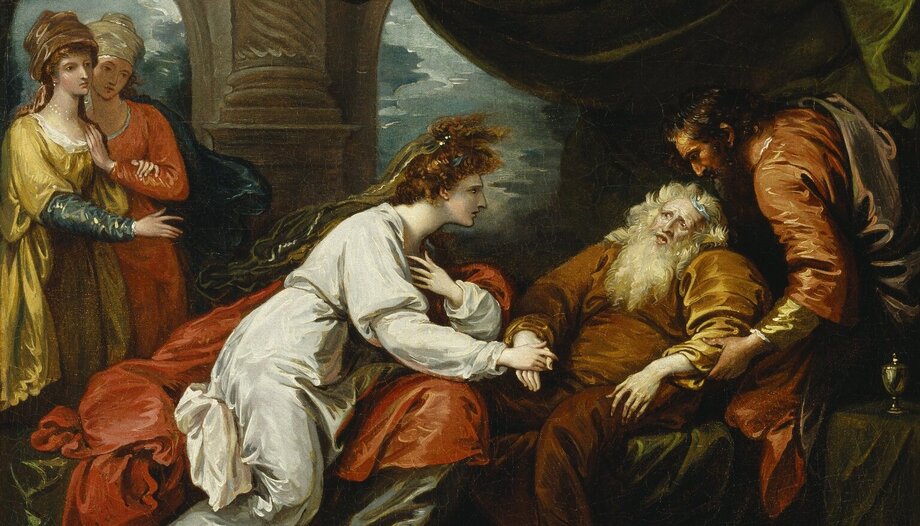
At the beginning of “King Lear” by William Shakespeare there is a scene that has always struck me as disturbingly close. A father asks his daughters to declare how much they love him. The measure of love is subjected to a prior mold born of his own hubris. Lear does not listen, he compares. He does not seek the truth of the bond, he seeks confirmation of himself. When the word does not fit the form he has imposed, he interprets it as an offense. The only daughter who refuses to play this game is Cordelia. She keeps silent, a silence in the form of truth. This silence pays dearly. Lear banishes and disowns her. Eventually Cordelia returns when she learns that her father has fallen into disgrace.
A contemporary reading of this tragedy appears in “Casting Lear” by Andrea Jiménez. The play revisits Shakespeare's text and makes it resonate in our current sensibility. The stage becomes a place of inquiry about forgiveness and the fragility of human relationships.
The resonance of forgiveness
To ask for forgiveness is to acknowledge the harm one has caused. Saying “I forgive you” means acknowledging the harm received. There is also another, less visible phrase. “I forgive myself.” Forgiveness cannot undo what has happened because the past remains a historical fact. Its scope is different. It acts on the consequences of the harm. It opens the possibility of a different future where there seemed to remain only the repetition of the wound.
When Cordelia meets her father again, a silent question arises. His return can be understood as a gesture of reconciliation that allows to close the wound and rebuild one's own life. Forgiveness then appears as a way of recomposing what history has fractured.
Lear's tragedy can also be read as the collapse of an inner architecture. The king, who at the beginning thought he ruled everything, gradually loses the order that sustained his world. It is only in this openness that a new form of lucidity and the possibility of reunion appear.
There are moments in which each person finds himself before the pieces that compose him. Loose pieces that are difficult to recognize within one's own biography. Fragments of experiences, wounds, gestures of love. Then comes the time to try to fit them together.
The role of memory
Thinking about this I often return to the contemplation of Hammershøi's “Die vier Zimmer”. The painting shows a succession of rooms open towards each other. Silent spaces that are chained together in depth. One enters the first room and discovers another at the back, then another. The architecture of the painting suggests the way we go through our own memory. The space organizes the gaze. Time seems suspended in the stillness of the rooms, as if it were no longer the coordinate that marks the rhythm of life.
When we organize the agenda, we place activities in a place and time. Memory works in a similar way. It records events, encodes them, stores them and retrieves them. When they return, they do so mixed with affections. The memory is not a simple piece of data. It is the representation of an event charged with feeling. Most of these memories remain outside of consciousness even though they continue to shape our identity.
In “La Reina de las Nieves” by Carmen Martín Gaite, the house called Quinta Blanca functions as an architecture of memory. Its spaces help to order the time lived. Leonardo, the protagonist, walks through the house while trying to understand his own history.
Entering the house means crossing a threshold. This step demands attention. It is the instant in which one notices that one is moving from one place to another. Something similar happens when we pay attention to our thoughts. A passage opens up to a deeper part of ourselves.
Following the metaphor, memories that have long remained without light appear in basements. They emerge suddenly and it is difficult to find a place for them. Remaining there generates uneasiness. When going up to the main floor, these fragments are somewhat more illuminated and begin to be recognized as their own, although they are not yet ordered.
Above are the rooms where the bonds live. The family, the affection received, the affection offered. There, childhood scenes reappear. The security of sleeping in the parents' bed when a nightmare interrupts the night. In these rooms we also learn to look at ourselves in the mirror of others. Recognizing the other allows us to discover that identity is never built in solitude.
Three dimensions of experience appear at this level of the house. “Pathos” is the attention that something awakens in us. “Logos” is the consciousness that interprets the memory. “Ethos” is the possibility of recognizing ourselves in the other.
In the highest part of the house appears the tower. There the light is brighter. It is Leonardo's room, the place where he lived as a child. From there history can be contemplated with a certain distance. There lie the handwritten notebooks, the first books read, the words that have been left as a trace of the passage of time. Not everything is resolved in that place. The pieces begin to show their shape.
Traversing the interiority
In the end, the three works seem to weave the same reflection.
In William Shakespeare's “King Lear” the fracture appears first. The order that Lear believed to be firm crumbles and leaves him exposed to his own truth. Only in that openness can he recognize Cordelia and understand what had been hidden under pride.
Cordelia's gaze then introduces another movement. She returns without reproach, with a silent fidelity that opens the possibility of forgiveness. Her presence allows Lear to look again. In this encounter the father recognizes the daughter and the daughter recovers the father. Between them, the lost fragments of the relationship begin to reunite. Forgiveness does not erase history. It allows it to be re-inhabited.
The silent rooms of Vilhelm Hammershøi's “Die vier Zimmer” introduce another movement. The interior space where memory moves from one room to another. Each open door suggests a transit. Something of life is left behind and something begins to light up ahead.
In “La Reina de las Nieves” by Carmen Martín Gaite, this interiority finally finds an architecture. The house of Quinta Blanca allows to find a safe place, to go through the time lived and to order the pieces of one's own history.
Fracture, interiority, home. Three gestures that respond to each other. Life is broken, memory turns inward, history seeks a form to inhabit.
The key to forgiveness
– Supernatural Lent proposes a similar journey. A time to accept the fractures, to cross in silence the rooms of memory and to allow one's own history to find its place. There, forgiveness begins to open space. It does not erase what has been lived. It makes it possible to inhabit it without rancor and to continue the path with a new look.
One question remains: Can someone forgive without having found who he or she is?
Forgiveness seems to lead to this answer. It allows to recompose one's own history and to look at the other without rancor. It allows us to stop living bent over the wound. It allows us to discover that identity is not built by denying what we have lived, but by learning to inhabit it.
Peca Macher is an architect and art curator, founder of Präsenz, a project that integrates art, education and conscious leadership through pausing, looking and listening. With more than 25 years of experience in cultural management and reflection, she writes and researches about memory, aesthetic experience and art as a tool for personal and social transformation. She is the author of the book Präsenz. Art as a tool for human and educational transformation.





 Español
  English
  Italiano