




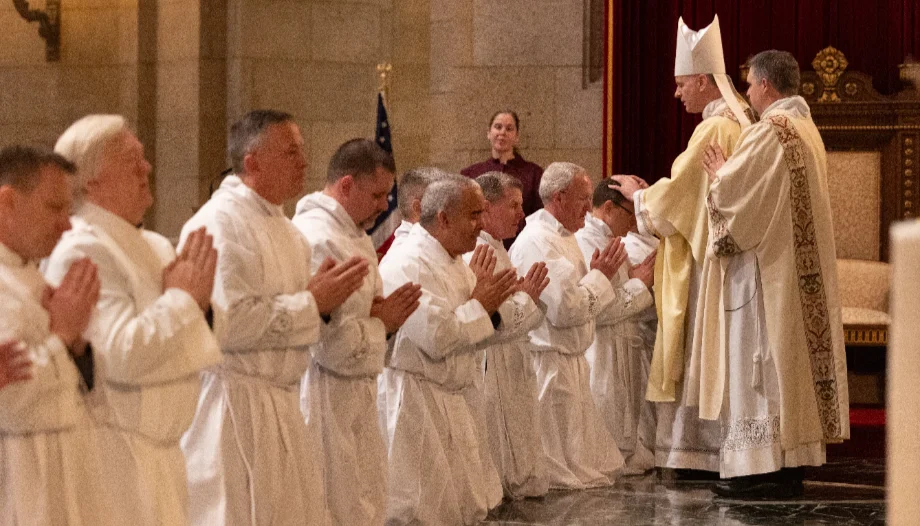
In times in which many issues are addressed with excessive vehemence and no little polarization, also within the Church, it is appropriate to make a conscious effort to deal with ecclesial issues with serenity. The announcement of the Diocese of Huesca regarding the implementation of the permanent diaconate deserves precisely that: reflection, respect and a sincere desire to seek the good of the Church and the faithful.
The decision has been communicated by means of a pastoral letter of his bishop, Pedro Aguado, in which he bases the measure with solid theological and pastoral arguments. As he emphasized in justifying the decision, the permanent diaconate - conferred on both celibate and married men - was restored by the Second Vatican Council, in continuity with the apostolic Tradition already witnessed in the New Testament, in the Fathers of the Church and in the first councils.
A ministry with its own identity
In his letter, the bishop stresses an essential point: “The diaconate is not an option of substitution for the presbyter, because of the scarce number of priests. The diaconate is a ministry in itself, not an option of substitution. Our diocese is committed to the permanent diaconate in the same way that it opts for a pastoral ministry of vocations to the priestly ministry or for a serious, clear and consistent promotion of the ministries entrusted to lay persons”.
This clarification is especially relevant in a context such as the Spanish one, where the decrease of the clergy -especially in rural areas- is painful and evident. In the diocese of Huesca, for example, the number of seminarians studying in Saragossa is very small. In this context, the implementation of the permanent diaconate can offer real help in pastoral tasks, both in villages with difficulties in having a resident priest and in cities where the clergy is overburdened.
In Spain there are currently around 600 permanent deacons, a figure that is still modest when compared to that of other countries such as the United States, where there are around 20,000, accounting for about 40 % of the permanent deacons in the world. Everything indicates that this ministry is still in the process of natural integration into the ecclesial life of our country.
From a pastoral point of view, the measure is reasonable: it facilitates access to sacraments over which the deacon can preside -such as Baptism or Marriage-, reinforces the preaching of the Word and enhances the charitable dimension of the Church.
The importance of good training
However, along with the opportunities, it is also important to clearly identify the challenges. It is essential that the lay faithful receive an adequate formation that will enable them to understand precisely the nature of the various ministries: what is the difference between a deacon and a priest, what is the meaning of the discipline of celibacy in the Latin Church and what is the specific mission of lay ministries. Only a solid catechesis will avoid confusion and will help each vocation to be valued in its proper measure.
If these distinctions are not well established, an ambiguous perception of ordained ministries can result. This is not a matter of scaremongering, but of learning from previous experiences. In other European contexts, such as Germany, the debate on ecclesial ministries has shown the extent to which certain dynamics can generate tensions and divergent interpretations.
A recent example illustrates the ease with which misunderstandings can arise even in our country. Last February 23rd, an initial headline in a media outlet close to the Church on the establishment of the permanent diaconate in Huesca literally said: “The lay priesthood arrives in Huesca to say Mass and baptize without being a priest: “‘It can create a vocation’”. Hours later it was corrected by another one more adjusted to reality. Beyond the rectification, the episode shows how an imprecise expression can generate confusion among the faithful.
The context of Sunday celebrations without a priest
The reflection is expanded in the context of Sunday celebrations in the absence of a presbyter. In some dioceses, given the impossibility of celebrating Sunday Mass in all places, celebrations of the Word with distribution of communion have been promoted, a practice that is fully orthodox and provided for by ecclesial norms.
However, during the last visit ad limina In the letter of the Spanish bishops to the Pope -to be held in December 2021-, the Holy See conveyed to them prudence regarding the expansion of these celebrations as a structural solution. The experience of the Church in France, a pioneer half a century ago in this type of practice, subsequently led the French bishops to restrict them greatly, when they realized that, over the years, it diluted in the faithful the awareness of the uniqueness of the Eucharist.
At a conference, José Ignacio Munilla explained that from Rome it was advised to avoid celebrations that externally imitate the structure of the Mass. The risk pointed out was that, with time, a certain practical devaluation of the Eucharistic sacrament would occur. For this reason, the Vatican suggested promoting other liturgical resources -such as the Liturgy of the Hours or adoration- when the celebration of the Eucharist was not possible.
It is not difficult to understand the underlying pastoral challenge: if the faithful perceive a celebration of the Word with communion and Sunday Mass as almost equivalent, they may be less willing to travel to another location to participate in the Eucharist.
A balance that requires study and serenity
None of this invalidates the opportunity of the permanent diaconate in Huesca, nor does it question its opportunity. Rather, it invites us to accompany its implementation with a clear formation and continuous reflection, which is evidently not the exclusive task of this diocese but of all the dioceses of Spain, especially those that already have dozens of permanent deacons.
Strengthening the permanent diaconate can be very positive and necessary and there are no particularly worrisome risks. The problem is not understanding what a deacon is, what the Mass is and to what extent one must make an effort to go to a Eucharistic celebration in another town.
The Church has the experience to discern and adjust its practices in the light of tradition and the pastoral fruits that are observed. The decision of the diocese of Huesca opens a new stage that can be very fruitful if it is lived in a spirit of communion, doctrinal clarity and pastoral prudence. In a time prone to extremes, perhaps the best service is precisely that: to think calmly, listen to the different sensitivities and work together for the good of the Church.
Editor of Omnes. Previously, he has been a contributor to various media and a high school philosophy teacher for 18 years.




 Español
  English
  Italiano