



On July 30, 2025, I boarded a plane to Havana, Cuba, to continue on to the diocese of Pinar del Río, where I would collaborate as pastor and administrator of two parishes. Although I had been in Cuba before, I did not really know what to expect, because the changes in the country are constant and take place day by day.
Small parishes, lively faith and few children
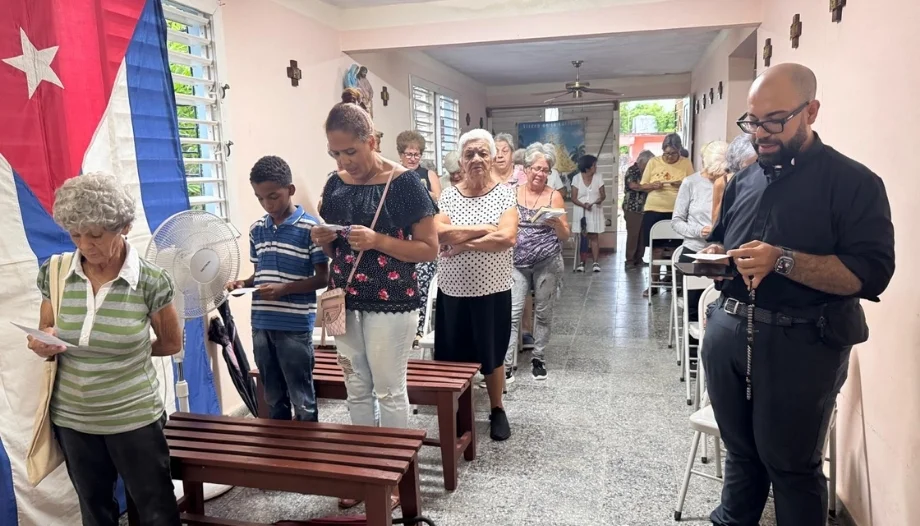
I arrived at my first destination: the Holy Family parish, located in the Mayka neighborhood. It is a small parish, located in a marginal neighborhood, with a mostly adult population and very few children.
In fact, to my surprise, it was necessary to go out into the street, pick up the children and ask them to take us to their homes to ask their parents if we could receive them in catechism. A very particular way of looking for catechumens. There I was welcomed by a married couple who had married in the Church the previous year: he was the administrator of the parish and she was the catechetical assistant, although on many occasions she was the one who taught the catechism classes directly.
The second parish I was assigned to accompany during this three-month experience was that of St. Francis of Assisi. It was very unique, since it was a house that had been bought to be converted into a church while waiting for the government's permission to build a church. As in the other community, most of the faithful were elderly and there were few children.
I was struck by the charitable work of both parishes, since they had a dining room that served people in even more precarious situations than usual three times a week.
Charity in the midst of precariousness
It was impressive for me to see how people who had to worry about whether water would come, whether there was electricity or whether they would find something to eat, were able to take time and resources to help others in greater need than themselves. This challenged me and demanded a greater commitment from me, because I had comforts and securities that they did not have.
I understood that my work there consisted, above all, in being present, listening, accompanying and bringing joy and hope. It was not always easy, since in many cases there was no way to escape from the precariousness in which they lived. However, when the time came to celebrate or to show solidarity, they gave their all, under the motto: “today for you, tomorrow for me”.
Manuel, the concrete face of hope
This thought, so detached, was embodied in a concrete person: Manuel, a simple and humble man, a participant in the Mayka dining room. He had been a teacher and was later sent as a soldier to Angola, an experience that marked him deeply and left him with a certain difficulty in speaking, as he was left somewhat stuttering. In spite of this, he retained a big and generous heart.
One Sunday, Manuel came to the parish and, in the middle of the consecration, he approached the altar and began to speak to me. As he could not be understood, the people asked him to sit down. At the end of the mass, he approached me to apologize and simply said: “Father, I am hungry”.
My immediate reaction was to look for something to feed him, which is quite normal when one feels compassion. However, the real teaching was given to me by him. The next day, Manuel returned to the parish with two fruits that had been given to him and wanted to give them to me, so that I would also have something to eat. Although I told him there was no need, he insisted. Then he turned around, shouted “Blessing, Father!” and left.
Manuel was always grateful and did not like to abuse the kindness of others, something that should be ordinary in our daily lives. So let us pray for our Cuban brothers and sisters who are going through difficult times, that their hearts may always remain open to compassion.
Priest.




 Español
  English
  Italiano