



 "She": The Virgin Mary in contemporary art."De Arte Sacra," or what a cathedral and Starbucks have in commonElena Egea: "sculpting sacred art is a way of evangelizing in silence"."
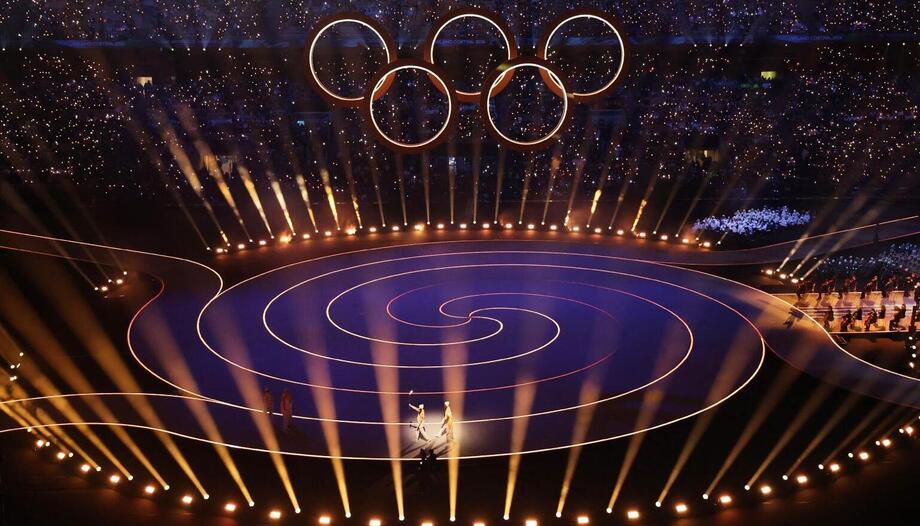
Andrea Bocelli's recent performance at the opening of the Winter Olympics led me to think about three themes: the construction of memory, the metaphor of the states of water, and the function of art as a mirror and refuge in times of emotional emergency.
I cannot read it in isolation, I perceive it as a chord initiated in 2020, when Bocelli sang in an empty Duomo di Milano. That Music for Hope was a gesture of hope in the face of a confined humanity. Six years later, the framework has mutated from a biological crisis to one of values and global geopolitical uncertainty.
The choice of Nessun Dorma, by G. Puccini, functions as a declaration of principles. In 2020 Bocelli's repertoire was religious and meditative, while in 2026 the epic of human will emerges. The Vincerò sounds like perseverance in the face of adversity and an affirmation of love that overcomes darkness.
In 2020, we saw a Bocelli alone in an immense space, a mirror of collective domestic loneliness. Humanity withdrew to survive. Art acted as a balm without applause. The tuning of millions of screens shared a vulnerability that would remain in memory.
Six years later, the tenor sings in front of thousands of people in a stadium, passing from the temple of stone to the temple of spectacle. However, the essence is the same, the art returns to build memories and confirms that we can meet again.
That memory is not only spatial, it is also temporal. Remembering, inhabiting the present and imagining the future takes almost physical forms and the metaphor of water helps me to think about it.
The past is solid. The Winter Games, snow and ice, evoke stability. The figures inspired by Antonio Canova, especially the Love and Psyche, reinforce the idea of marble as a fixed memory. They are the memories we keep to strengthen our identity. As Thales of Miletus said, water is the beginning of everything, but in solid form it becomes architecture. It is our inner sculptures that remain despite crises.
The present is liquid, it slips through our fingers. It is the perpetual flow described by Heraclitus, we never bathe twice in the same water. Its uncertainty lies in its lack of fixed form, but at the same time, the liquid allows us to flow to go through the emotional emergency without breaking.
The future is vapor. Diffuse, pure possibility and at the same time unsettling. We walk in the fog and barely see a few steps. We need references, points of density to avoid dispersion.
Here the art intervenes as an orientation. Under the motto of Harmony, The inauguration sought to unite city and mountain, the modern and the primitive. At a time when misinformation fractures access to truth and erodes trust, art acquires an ethical function, operating as a tool for critical thinking, helping to distinguish between the modern and the primitive. person y character.
In this quest for truth, the integration of science and art is the way to reprogramming our brain positively and regain emotional control. The key is to treat art not as consumption, but as a way to find the depth of life. Art acts as a mirror where the viewer looks at himself and recognizes his own capacity for survival. To reach that depth it is necessary to dwell on the psychological mechanism by which art transforms uncertainty into useful memory, as a narrative construction. This orienting role of art is not abstract, it operates directly on our memory. When Bocelli sings in 2026, we are not just listening to a song; we are activating a neural network that contains the memory of 2020. That superimposition of images, the loneliness of the Duomo over the crowd of San Siro, is what generates the meaning of resilience.
In times of war and persecution, this function is critical. Art allows one to experience the other with empathy and strengthens one's own emotional fiber. The eemotional mergence that we live is fought not with hedonistic evasion, but with confrontation through the uncomfortable beauty of art that removes our masks.
If the future is vapor, art proposes that we are the ones who can give it direction, condense it into meaning. We are capable of projecting onto that mist our own stories. In the end, it is the soul or spirit that works, processing the darkness to find in it a new form of light.
Peca Macher is an architect and art curator, founder of Präsenz, a project that integrates art, education and conscious leadership through pausing, looking and listening. With more than 25 years of experience in cultural management and reflection, she writes and researches about memory, aesthetic experience and art as a tool for personal and social transformation. She is the author of the book Präsenz. Art as a tool for human and educational transformation.




 Español
  English
  Italiano